
Posted on July 13 2026
Top 10 Countries for Physiotherapists to Work Abroad: Salary, Demand & PR Opportunities Compared

By , Editor
Updated July 13 2026
The best countries for Physiotherapists to work abroad include Canada, New Zealand, the United States, Australia, Singapore, the United Kingdom, Ireland, Germany, Switzerland, and the United Arab Emirates. Career prospects vary across these destinations, with opportunities ranging from high-paying roles and healthcare workforce shortages to skilled migration and long-term settlement pathways.
The global physiotherapy services market is projected to reach USD 90.79 billion by 2033. Growing rehabilitation needs linked to ageing populations, chronic conditions, sports injuries, and post-operative care are supporting demand for Physiotherapists across hospitals, private clinics, aged care, community health, and sports rehabilitation.
*Want to work abroad? Sign up with Y-Axis Resume Marketing Services to find right job faster.
Why is the demand for Physiotherapists growing worldwide?
The global demand for Physiotherapists is growing due to ageing populations, rising chronic conditions, more injuries and surgeries, expanding healthcare services, and workforce shortages. These factors are creating more Physiotherapist job opportunities worldwide.
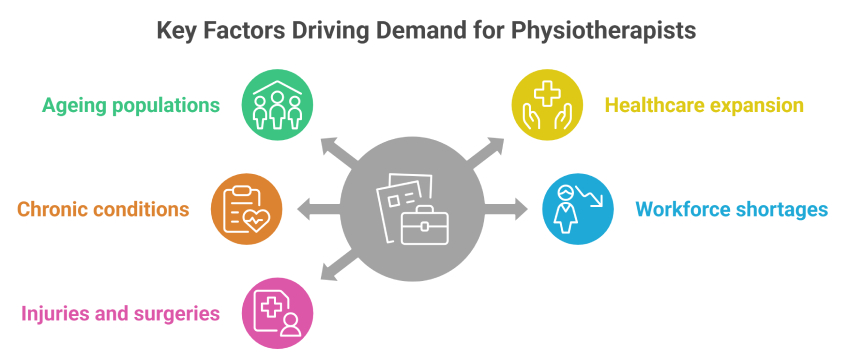
- Ageing populations: More older adults need mobility support and rehabilitation.
- Chronic conditions: Arthritis, back pain, and long-term illnesses require ongoing physiotherapy.
- Injuries and surgeries: More patients need rehabilitation during recovery.
- Healthcare expansion: Growth in hospitals, aged care, and rehabilitation services is creating more jobs.
- Workforce shortages: Shortages of Physiotherapists are increasing international recruitment.
How to choose the right country for Physiotherapist jobs abroad?
The right country for Physiotherapist jobs abroad depends on salary, job demand, registration requirements, visa options, and long-term settlement opportunities. Comparing these factors can help Physiotherapists choose a destination that matches their career and migration goals.
- Compare salaries and living costs: Check potential earnings against housing, taxes, and daily expenses.
- Check job demand: Prioritise countries with strong demand and long-term job growth for Physiotherapists.
- Review registration requirements: Compare qualification recognition, licensing, exams, and language requirements.
- Explore visa and PR options: Check work visa eligibility and pathways to permanent residency or long-term settlement.
- Consider career opportunities: Look at jobs in hospitals, private clinics, aged care, rehabilitation, and sports healthcare.
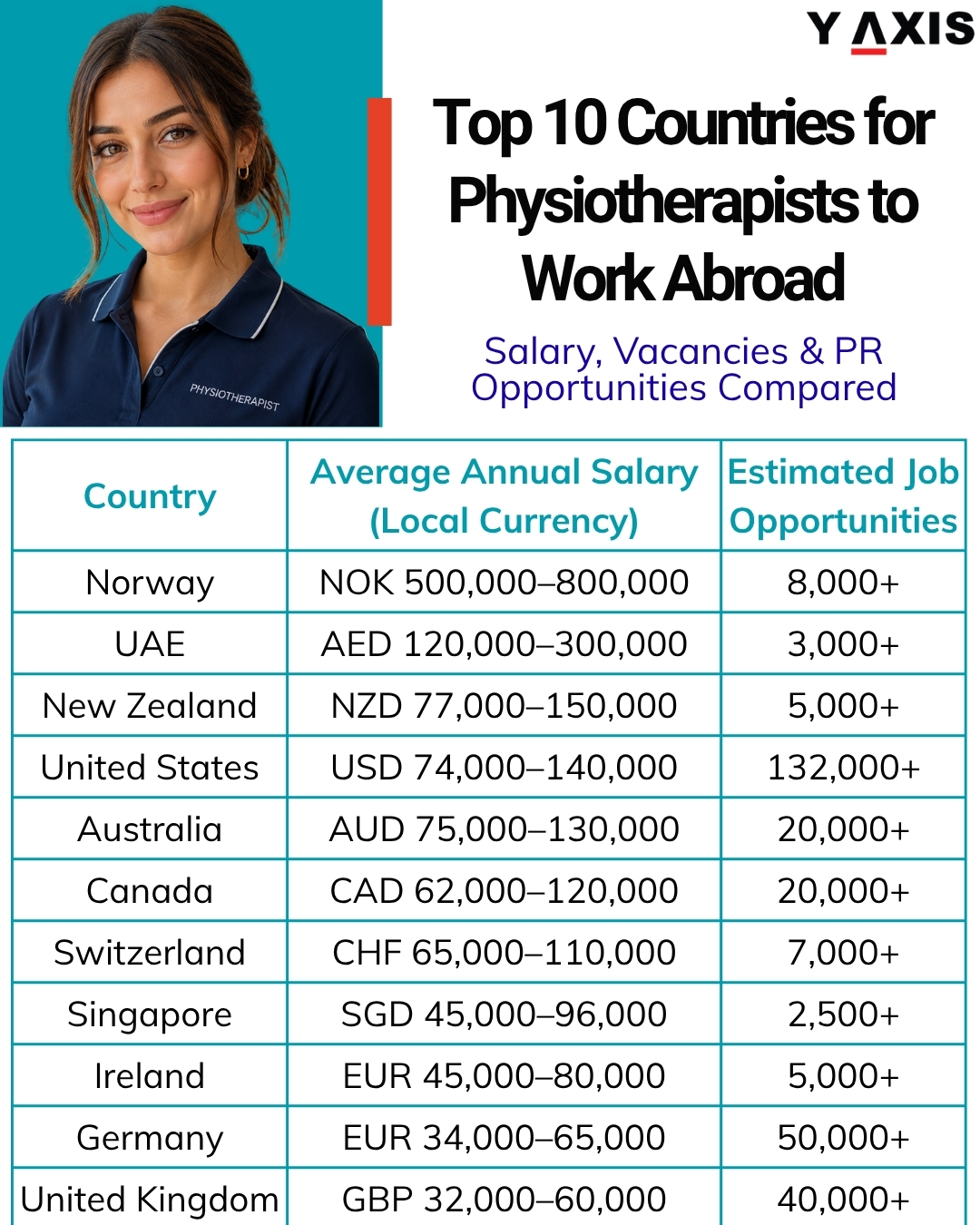
Top 10 Countries for Physiotherapists to Work Abroad
Physiotherapists have strong career opportunities across major healthcare markets, earning around AUD 70,000 to over AUD 180,000 per year in hospitals, rehabilitation centres, aged care, private clinics, and sports healthcare. Canada and New Zealand combine strong job demand with migration opportunities, while the United States and Switzerland offer higher earning potential, international healthcare experience, career progression, and long-term settlement opportunities.
|
Country |
Average Annual Salary (Local Currency) |
Estimated Physiotherapist |
|
Canada |
CAD 62,000–120,000 |
20,000+ |
|
New Zealand |
NZD 77,000–150,000 |
5,000+ |
|
United States |
USD 74,000–140,000 |
132,000+ |
|
Australia |
AUD 75,000–130,000 |
20,000+ |
|
Singapore |
SGD 45,000–96,000 |
2,500+ |
|
United Kingdom |
GBP 32,000–60,000 |
40,000+ |
|
Ireland |
EUR 45,000–80,000 |
5,000+ |
|
Germany |
EUR 34,000–65,000 |
50,000+ |
|
Switzerland |
CHF 65,000–110,000 |
7,000+ |
|
UAE |
AED 120,000–300,000 |
3,000+ |
*Want to work abroad? Sign up with Y-Axis Resume Marketing Services to find right job faster.
Best Countries for Physiotherapist Jobs Abroad and Permanent Residency
Canada, New Zealand, Australia, Germany, and Ireland are among the best countries for Physiotherapist jobs and permanent residency. Physiotherapists can work in hospitals, rehabilitation centres, aged care, community health, and private clinics while accessing skilled migration, employment-based residence, or long-term settlement pathways.
Physiotherapist Jobs in Canada
Canada offers good job prospects for Physiotherapists, particularly in Alberta, Saskatchewan, and several Atlantic provinces. An ageing population, healthcare workforce shortages, and growing rehabilitation needs are increasing employment across hospitals, private clinics, long-term care, community health, and rural healthcare services. Physiotherapists can access regulated careers through provincial registration and work in Canada through employer-supported work permits. Express Entry and Provincial Nominee Programs also provide permanent residency pathways, making Canada a strong option for Physiotherapists seeking both overseas employment and long-term settlement.
|
Factor |
Details |
|
Physiotherapist Job Market & Estimated Opportunities for the Next Decade |
Canada is projected to have more than 20,000 Physiotherapist job opportunities over the next decade. An ageing population, rising rehabilitation needs, long-term care expansion, home healthcare, and provincial workforce shortages are supporting demand. |
|
Investment in the Healthcare Sector |
Canada has committed nearly CAD 200 billion over 10 years through healthcare agreements with provinces and territories to expand services, improve access to care, and strengthen the healthcare workforce. |
|
In-Demand Physiotherapy Roles & Skills |
Demand spans musculoskeletal care, neurological rehabilitation, sports injuries, geriatric and paediatric care, and post-surgical recovery. Mobility assessment, exercise therapy, treatment planning, and patient rehabilitation are key skills. |
|
Work Visa Options for Physiotherapists |
Employer-specific work permits provide a route to Canadian employment, while provincial recruitment initiatives can connect Physiotherapists with healthcare employers facing workforce shortages. |
|
Priority Hiring & Recruitment Pathways |
Provincial healthcare recruitment programmes and targeted immigration pathways support Physiotherapist hiring, particularly in provinces and regional communities with healthcare workforce gaps. |
|
PR / Long-Term Residence Opportunities |
Express Entry and Provincial Nominee Programs provide permanent residency pathways, with healthcare occupations benefiting from category-based selection and targeted provincial streams. |
|
Registration & Practice Requirements |
Physiotherapists need registration with the regulatory authority of the province or territory where they intend to practise. |
|
Language Requirements |
English or French proficiency may need to be demonstrated through approved tests for professional registration and immigration. |
|
Eligibility for Dependants |
Spouses and dependent children can accompany the main applicant through applicable work and permanent residency pathways. |
|
Benefits for Family Members |
Depending on immigration status and provincial rules, family members can access education, healthcare coverage, and work rights in Canada. |
*Want to Work in Canada? Let Y-Axis guide you through the application process.
Physiotherapist Jobs in New Zealand
Physiotherapists are in demand across New Zealand’s public hospitals, rehabilitation centres, aged care facilities, private clinics, and community health services. Regional areas have particularly strong workforce needs, driven by an ageing population, injury recovery, and growing demand for rehabilitation and mobility care. Careers span musculoskeletal treatment, sports rehabilitation, post-surgical recovery, elderly care, and community-based services. After professional registration, Physiotherapists can work through the Accredited Employer Work Visa, while the Green List provides a pathway to residence, connecting employment opportunities with long-term settlement in New Zealand.
|
Factor |
Details |
|
Physiotherapist Job Market & Estimated Opportunities for the Next Decade |
New Zealand is projected to have more than 5,000 Physiotherapist job opportunities over the next decade. Injury rehabilitation, aged care, community health, sports injuries, and workforce shortages in regional areas are supporting demand. |
|
Investment in the Healthcare Sector |
Healthcare funding supports hospitals, rehabilitation services, digital health, disability care, and workforce development, with continued investment aimed at improving access to services across New Zealand. |
|
In-Demand Physiotherapy Roles & Skills |
Opportunities span musculoskeletal therapy, sports rehabilitation, neurological care, injury recovery, paediatric care, and aged-care rehabilitation. Exercise therapy, mobility assessment, treatment planning, and patient management are key skills. |
|
Work Visa Options for Physiotherapists |
The Accredited Employer Work Visa provides a direct route to employment with an accredited New Zealand employer, alongside other skilled work pathways available to healthcare workers. |
|
Priority Hiring & Recruitment Pathways |
Public hospitals, rehabilitation providers, community health services, and private practices recruit overseas Physiotherapists, with regional healthcare employers offering additional opportunities. |
|
PR / Long-Term Residence Opportunities |
Physiotherapists can access residence through New Zealand’s Green List and Skilled Migrant Category after meeting the pathway requirements. |
|
Registration & Practice Requirements |
Registration with the Physiotherapy Board of New Zealand is required to practise as a Physiotherapist. |
|
Language Requirements |
English proficiency can be demonstrated through approved language tests or recognised qualifications accepted for registration. |
|
Eligibility for Dependants |
Spouses and dependent children can accompany the main applicant through applicable visa pathways. |
|
Benefits for Family Members |
Depending on visa conditions, family members can access education, healthcare services, and work rights in New Zealand. |
Physiotherapist Jobs in the United States
The United States has a large Physiotherapist job market across hospitals, outpatient clinics, rehabilitation centres, nursing care facilities, home healthcare, and sports medicine. Employment is supported by an ageing population, rising rehabilitation needs, and greater demand for mobility and pain management services. Physiotherapists can build careers in orthopaedics, neurological rehabilitation, sports therapy, paediatrics, and post-surgical care. International Physiotherapists can access employment through employer-sponsored work visa routes after meeting state licensing requirements, while employment-based Green Card pathways can support permanent residency and long-term career growth in the United States.
|
Factor |
Details |
|
Physiotherapist Job Market & Estimated Opportunities for the Next Decade |
The United States is projected to have more than 132,000 Physiotherapist job opportunities over the next decade. Growth in outpatient care, home healthcare, rehabilitation, and mobility services for an ageing population is supporting employment nationwide. |
|
Investment in the Healthcare Sector |
Annual US healthcare spending exceeds USD 5 trillion, supporting hospitals, rehabilitation services, home-based care, digital health, and healthcare workforce expansion. |
|
In-Demand Physiotherapy Roles & Skills |
Opportunities span orthopaedic rehabilitation, sports therapy, neurological care, geriatric rehabilitation, paediatrics, and home healthcare. Clinical assessment, exercise therapy, mobility training, and rehabilitation planning are key skills. |
|
Work Visa Options for Physiotherapists |
International Physiotherapists can access employment through employer-sponsored work visa routes and employment-based immigration pathways supported by healthcare organisations. |
|
Priority Hiring & Recruitment Pathways |
Hospitals, outpatient rehabilitation centres, nursing facilities, home healthcare providers, and sports medicine clinics recruit Physiotherapists, particularly in areas with healthcare workforce shortages. |
|
PR / Long-Term Residence Opportunities |
Employer sponsorship can provide access to employment-based Green Card categories, creating a route from US healthcare employment to permanent residence. |
|
Registration & Practice Requirements |
Physiotherapists must meet US education equivalency requirements, pass the National Physical Therapy Examination, and obtain a licence in the state where they intend to practise. |
|
Language Requirements |
English proficiency may be required for credential evaluation, licensing, immigration, and clinical practice. |
|
Eligibility for Dependants |
Spouses and dependent children can accompany the main visa holder through applicable dependant visa categories. |
|
Benefits for Family Members |
Education access, healthcare coverage, and work rights depend on the family member’s visa or immigration status. |
Physiotherapist Jobs in Australia
Australia has strong demand for Physiotherapists across hospitals, private practices, aged care, disability services, rehabilitation, and community health. Regional and remote areas provide additional career opportunities as healthcare services expand outside major cities. Physiotherapists work across musculoskeletal care, injury rehabilitation, neurological recovery, sports medicine, and disability support. Overseas Physiotherapists can access employment through employer-sponsored visas, while skilled migration pathways include the Subclass 189, 190, and 491 visas. These routes allow Physiotherapists to combine healthcare employment with permanent residency opportunities, particularly through state nomination and regional migration pathways.
|
Factor |
Details |
|
Physiotherapist Job Market & Estimated Opportunities for the Next Decade |
Australia is projected to have more than 20,000 Physiotherapist job opportunities over the next decade. An ageing population, disability support, rehabilitation needs, and healthcare workforce shortages in regional areas are supporting employment growth. |
|
Investment in Healthcare, Aged Care & Disability Services |
Australia spends more than AUD 270 billion annually on healthcare, while continued funding for public hospitals, aged care, rehabilitation, and the NDIS supports demand for physiotherapy and mobility services. |
|
In-Demand Physiotherapy Roles & Skills |
Opportunities span musculoskeletal physiotherapy, sports rehabilitation, neurological care, paediatrics, aged care, and disability support. Rehabilitation planning, exercise therapy, mobility assessment, and pain management are key skills. |
|
Work Visa Options for Physiotherapists |
Visa options include the Skills in Demand Visa (Subclass 482), Skilled Independent Visa (Subclass 189), Skilled Nominated Visa (Subclass 190), and Skilled Work Regional Visa (Subclass 491). |
|
Priority Hiring & Recruitment Pathways |
Hospitals, aged-care providers, rehabilitation centres, disability services, and private clinics recruit Physiotherapists, with additional opportunities available across regional and remote Australia. |
|
PR / Long-Term Residence Opportunities |
Subclass 189 and 190 visas provide direct permanent residency pathways, while the Subclass 186 visa supports employer-sponsored PR and the Subclass 491 visa can lead to permanent residence through the regional pathway. |
|
Registration & Practice Requirements |
Registration with the Australian Health Practitioner Regulation Agency is required before practising as a Physiotherapist in Australia. |
|
Language Requirements |
English proficiency must meet the standard required for professional registration and clinical practice. |
|
Eligibility for Dependants |
Skilled visa applications can include a spouse or partner and dependent children. |
|
Benefits for Family Members |
Depending on the visa held, family members can access work rights, education, and healthcare benefits in Australia. |
Physiotherapist Jobs in Singapore
Singapore’s expanding healthcare system is creating opportunities for Physiotherapists across public and private hospitals, rehabilitation centres, community care, aged care, and sports medicine. An ageing population and greater focus on post-surgical recovery, mobility, and preventive care are increasing the need for physiotherapy services. Careers are available in musculoskeletal rehabilitation, neurological care, elderly rehabilitation, and sports injury recovery. Physiotherapists securing employment can work through the Employment Pass or other applicable work passes, while continued employment and residence can support an application for permanent residency in Singapore.
|
Factor |
Details |
|
Physiotherapist Job Market & Estimated Opportunities for the Next Decade |
Singapore is projected to have more than 2,500 Physiotherapist job opportunities over the next decade. An ageing population, rehabilitation needs, community care expansion, sports injuries, and post-surgical recovery are supporting demand. |
|
Investment in the Healthcare Sector |
Singapore’s healthcare expenditure is projected to reach SGD 43 billion by 2030, supporting hospital capacity, community care, digital health, rehabilitation services, and healthcare workforce expansion. |
|
In-Demand Physiotherapy Roles & Skills |
Opportunities span musculoskeletal rehabilitation, neurological care, geriatric physiotherapy, sports injuries, post-surgical recovery, and community rehabilitation. Exercise therapy, mobility assessment, rehabilitation planning, and patient management are key skills. |
|
Work Visa Options for Physiotherapists |
Employer-sponsored work passes, including the Employment Pass and S Pass where applicable, provide routes to work with hospitals, clinics, rehabilitation providers, and community care organisations. |
|
Priority Hiring & Recruitment Pathways |
Public healthcare clusters, private hospitals, rehabilitation centres, community care providers, and sports medicine clinics recruit Physiotherapists, particularly for rehabilitation and elderly care services. |
|
PR / Long-Term Residence Opportunities |
Physiotherapists working in Singapore can apply for permanent residence through the Professionals, Technical Personnel and Skilled Workers scheme, subject to the applicable assessment criteria. |
|
Registration & Practice Requirements |
Registration with the Allied Health Professions Council is required before practising as a Physiotherapist in Singapore. |
|
Language Requirements |
English is the main working language in healthcare, while Mandarin, Malay, or Tamil can support communication with a wider range of patients. |
|
Eligibility for Dependants |
Employment Pass and qualifying S Pass holders can bring spouses and children through applicable dependant pass routes. |
|
Benefits for Family Members |
Depending on pass type, family members can access education and residence in Singapore, while employment requires the appropriate work authorisation. |
Physiotherapist Jobs in the United Kingdom
The United Kingdom has a well-established Physiotherapist job market, with employment across the NHS, private hospitals, rehabilitation centres, community services, care homes, and sports clinics. Growing rehabilitation needs and pressure on healthcare services support recruitment in musculoskeletal care, neurological rehabilitation, elderly care, and post-surgical recovery. Physiotherapists with an eligible job offer can work in the UK through the Health and Care Worker visa after completing HCPC registration. The visa also provides a route to Indefinite Leave to Remain after five years, connecting NHS and private healthcare careers with long-term settlement in the UK.
|
Factor |
Details |
|
Physiotherapist Job Market & Estimated Opportunities for the Next Decade |
The UK is projected to have more than 40,000 Physiotherapist job opportunities over the next decade. NHS recruitment, community rehabilitation, private healthcare, and growing mobility and recovery needs among older adults are supporting employment. |
|
Investment in the Healthcare Sector |
Annual NHS spending exceeds £200 billion, supporting hospitals, community care, rehabilitation services, workforce development, and healthcare modernisation across the UK. |
|
In-Demand Physiotherapy Roles & Skills |
Opportunities span musculoskeletal physiotherapy, neurological rehabilitation, respiratory care, paediatrics, sports rehabilitation, and elderly care. Rehabilitation planning, exercise therapy, mobility assessment, and patient management are key skills. |
|
Work Visa Options for Physiotherapists |
The Health and Care Worker visa is the main route for sponsored healthcare employment, with the Skilled Worker route available for qualifying roles and employers. |
|
Priority Hiring & Recruitment Pathways |
NHS trusts, private hospitals, rehabilitation providers, and community healthcare organisations recruit overseas Physiotherapists through international hiring and approved sponsorship routes. |
|
PR / Long-Term Residence Opportunities |
Physiotherapists on qualifying work routes can apply for Indefinite Leave to Remain after five years of continuous eligible residence. |
|
Registration & Practice Requirements |
Registration with the Health and Care Professions Council is required before working as a Physiotherapist in the UK. |
|
Language Requirements |
English proficiency must meet HCPC standards through an accepted test or other recognised evidence. |
|
Eligibility for Dependants |
Spouses or partners and dependent children can accompany the main applicant under applicable visa rules. |
|
Benefits for Family Members |
Depending on visa conditions, family members can access education, NHS healthcare, and work rights in the UK. |
*Want to Work in the UK? Let Y-Axis guide you through the steps.
Physiotherapist Jobs in Ireland
Ireland recruits Physiotherapists across public hospitals, community healthcare, disability services, rehabilitation centres, and private clinics. Growing demand for rehabilitation, older-person care, and community-based treatment is supporting employment in musculoskeletal therapy, neurological rehabilitation, paediatrics, and post-surgical recovery. Physiotherapists can work in the public health system or private healthcare after completing CORU registration. International recruitment is supported through employment permit routes, while continued legal employment can lead to Stamp 4 permission and long-term residence, giving Physiotherapists a route from healthcare employment to greater work flexibility and settlement in Ireland.
|
Factor |
Details |
|
Physiotherapist Job Market & Estimated Opportunities for the Next Decade |
Ireland is projected to have more than 5,000 Physiotherapist job opportunities over the next decade. Recruitment across public hospitals, community healthcare, disability services, rehabilitation, and private clinics is supporting demand. |
|
Investment in the Healthcare Sector |
Ireland allocates more than €27 billion annually to healthcare, supporting hospital capacity, community care, rehabilitation services, digital health, and healthcare workforce expansion. |
|
In-Demand Physiotherapy Roles & Skills |
Opportunities span musculoskeletal care, neurological rehabilitation, respiratory therapy, paediatrics, sports injuries, and elderly care. Rehabilitation planning, mobility assessment, exercise therapy, and patient management are key skills. |
|
Work Visa Options for Physiotherapists |
The Critical Skills Employment Permit and General Employment Permit provide routes to healthcare employment, depending on the role, salary, and permit requirements. |
|
Priority Hiring & Recruitment Pathways |
The Health Service Executive, hospitals, rehabilitation providers, disability services, and private healthcare organisations recruit Physiotherapists across Ireland. |
|
PR / Long-Term Residence Opportunities |
Employment permit holders can progress to Stamp 4 permission and long-term residence after meeting the applicable employment and residence conditions. |
|
Registration & Practice Requirements |
Registration with CORU is required before working as a Physiotherapist in Ireland. |
|
Language Requirements |
English proficiency must meet the standard required for CORU registration and clinical practice. |
|
Eligibility for Dependants |
Spouses or partners and dependent children can join the main applicant under applicable employment and family reunification rules. |
|
Benefits for Family Members |
Depending on residence permission, family members can access education, healthcare services, and work rights in Ireland. |
Physiotherapist Jobs in Germany
Germany’s large rehabilitation and elderly care sector supports Physiotherapist jobs across hospitals, rehabilitation clinics, outpatient practices, care facilities, and sports medicine centres. An ageing population and growing need for musculoskeletal treatment, post-surgical recovery, and long-term mobility care continue to expand physiotherapy services. International Physiotherapists can enter regulated practice through qualification recognition and German language proficiency, with employment supporting access to a skilled worker visa. Continued skilled employment can also lead to a settlement permit, allowing Physiotherapists to build a long-term career within Germany’s healthcare and rehabilitation system.
|
Factor |
Details |
|
Physiotherapist Job Market & Estimated Opportunities for the Next Decade |
Germany is projected to have more than 50,000 Physiotherapist job opportunities over the next decade. An ageing population and growing rehabilitation needs are supporting recruitment across rehabilitation clinics, outpatient therapy practices, hospitals, and elderly care facilities. |
|
Investment in the Healthcare Sector |
Germany spends more than €500 billion annually on healthcare, supporting hospitals, rehabilitation services, digital health, modern medical infrastructure, and healthcare workforce expansion. |
|
In-Demand Physiotherapy Roles & Skills |
Opportunities span orthopaedic rehabilitation, neurological therapy, sports rehabilitation, geriatric care, post-surgical recovery, and mobility treatment. Manual therapy, exercise programmes, rehabilitation planning, and patient care are key skills. |
|
Work Visa Options for Physiotherapists |
Skilled worker residence permits and employment-based residence routes provide pathways to work in Germany after professional qualification recognition. |
|
Priority Hiring & Recruitment Pathways |
Rehabilitation clinics, hospitals, outpatient therapy centres, and elderly care providers recruit internationally trained Physiotherapists, particularly for rehabilitation and mobility care. |
|
PR / Long-Term Residence Opportunities |
Physiotherapists can apply for a settlement permit after meeting the applicable employment, residence, language, and integration requirements. |
|
Registration & Practice Requirements |
Recognition of the professional qualification by the relevant German authority is required to practise as a Physiotherapist. |
|
Language Requirements |
German proficiency is required for professional recognition and patient care, with the required level determined by the state and recognition process. |
|
Eligibility for Dependants |
Spouses and dependent children can join the main applicant through applicable family reunification routes. |
|
Benefits for Family Members |
Depending on residence status, family members can access education, statutory healthcare coverage, and work rights in Germany. |
Physiotherapist Jobs in Switzerland
Switzerland has a well-developed Physiotherapist job market across hospitals, rehabilitation clinics, private practices, elderly care, and sports medicine. Demand is supported by an ageing population, high use of rehabilitation services, and continued need for musculoskeletal, neurological, and post-surgical care. Physiotherapists can work in specialised areas such as orthopaedic rehabilitation, sports recovery, neurological therapy, and long-term mobility care. International Physiotherapists can access employment after qualification recognition and meeting the language requirements of the relevant canton. Employer-supported work permits provide a route to employment, while long-term legal residence can lead to permanent residence in Switzerland.
|
Factor |
Details |
|
Physiotherapist Job Market & Estimated Opportunities for the Next Decade |
Switzerland is projected to have more than 7,000 Physiotherapist job opportunities over the next decade. Rehabilitation services, outpatient therapy, hospitals, sports medicine, elderly care, and post-surgical recovery continue to support recruitment. |
|
Investment in the Healthcare Sector |
Switzerland spends around CHF 90 billion annually on healthcare, supporting hospitals, rehabilitation centres, digital health, medical innovation, and advanced patient care. |
|
In-Demand Physiotherapy Roles & Skills |
Opportunities span musculoskeletal rehabilitation, sports injuries, neurological therapy, geriatric care, post-surgical recovery, and mobility treatment. Manual therapy, exercise programmes, rehabilitation planning, and patient assessment are key skills. |
|
Work Visa Options for Physiotherapists |
Employer-sponsored employment can support access to L or B permits, subject to nationality, job offer, and Swiss work permit rules. |
|
Priority Hiring & Recruitment Pathways |
Hospitals, rehabilitation clinics, private practices, sports medicine centres, and elderly care facilities recruit Physiotherapists, with demand and language requirements differing by canton. |
|
PR / Long-Term Residence Opportunities |
Long-term residents can progress to a C Permit after meeting the applicable residence and integration requirements. |
|
Registration & Practice Requirements |
Foreign physiotherapy qualifications must be recognised before practising in Switzerland. |
|
Language Requirements |
German, French, or Italian proficiency is required according to the canton and workplace. |
|
Eligibility for Dependants |
Spouses and dependent children can join the main applicant through applicable family reunification routes. |
|
Benefits for Family Members |
Depending on residence status, family members can access education, mandatory health insurance, and work rights in Switzerland. |
Physiotherapist Jobs in the UAE
The UAE’s expanding private healthcare, medical tourism, and sports and wellness sectors are creating Physiotherapist jobs across hospitals, rehabilitation centres, sports clinics, home healthcare, and specialised medical facilities. Dubai and Abu Dhabi have particularly active markets for musculoskeletal care, sports injury recovery, post-surgical rehabilitation, and elderly mobility services. Physiotherapists can work through employer-sponsored residence visas after obtaining the relevant DHA, DoH, or MOHAP professional licence. The UAE also provides long-term residence options, including the Golden Visa for those meeting the required criteria, alongside tax-free salaries and international experience in a rapidly developing healthcare market.
|
Factor |
Details |
|
Physiotherapist Job Market & Estimated Opportunities for the Next Decade |
The UAE is projected to have more than 3,000 Physiotherapist job opportunities over the next decade. Private healthcare expansion, medical tourism, sports rehabilitation, home healthcare, and growing mobility and recovery needs are supporting recruitment. |
|
Investment in the Healthcare Sector |
The UAE healthcare market is projected to reach nearly AED 184 billion by 2029, driven by investment in hospitals, specialised care, rehabilitation services, digital health, and healthcare infrastructure. |
|
In-Demand Physiotherapy Roles & Skills |
Opportunities span musculoskeletal rehabilitation, sports injuries, neurological therapy, post-surgical recovery, elderly care, and home healthcare. Manual therapy, exercise programmes, mobility assessment, and rehabilitation planning are key skills. |
|
Work Visa Options for Physiotherapists |
Employer-sponsored residence visas provide the main route to work with licensed hospitals, clinics, rehabilitation centres, and other healthcare providers. |
|
Priority Hiring & Recruitment Pathways |
Private hospitals, rehabilitation centres, sports medicine clinics, home healthcare providers, and specialised medical facilities recruit Physiotherapists, particularly in Dubai and Abu Dhabi. |
|
PR / Long-Term Residence Opportunities |
The UAE does not offer traditional permanent residency, but long-term residence is available through the Golden Visa and other residence categories for those meeting the applicable requirements. |
|
Registration & Practice Requirements |
Physiotherapists need a professional licence from DHA in Dubai, DoH in Abu Dhabi, or MOHAP in the applicable Northern Emirates. |
|
Language Requirements |
English is widely used across private healthcare, while Arabic can support patient communication in some healthcare settings. |
|
Eligibility for Dependants |
Residence visa holders can sponsor spouses and children after meeting the applicable sponsorship requirements. |
|
Benefits for Family Members |
Sponsored family members can access education, healthcare, and residence, while employment requires the appropriate work authorisation. |
How to Apply for Physiotherapist Jobs Abroad?
To apply for Physiotherapist jobs abroad, choose a country, check qualification recognition and registration requirements, apply for suitable jobs, secure a job offer, and complete the work visa process. The exact steps vary by country and professional regulator.
Step 1: Choose a country based on job demand, salary, registration, work visa, and PR options.
Step 2: Check whether your physiotherapy qualification meets the country’s recognition requirements.
Step 3: Complete professional registration with the relevant physiotherapy or healthcare regulator.
Step 4: Prepare your CV, clinical experience records, qualifications, and supporting documents.
Step 5: Apply for jobs with hospitals, rehabilitation centres, aged care providers, and private clinics.
Step 6: Secure a job offer and employer sponsorship where required.
Step 7: Apply for the relevant work visa or residence permit.
Step 8: Move abroad, start employment, and follow the available permanent residency pathway.
*Want to work abroad? Sign up with Y-Axis Resume Marketing Services to find right job faster.
Job Outlook for Physiotherapists over the Next Decade
The job outlook for Physiotherapists is expected to remain strong over the next decade, with growing employment across hospitals, rehabilitation centres, private clinics, aged care, disability services, home healthcare, and sports medicine. Ageing populations will increase the need for mobility support, fall prevention, and long-term rehabilitation, while more surgeries will create demand for post-surgical recovery.
Rising rates of chronic conditions, neurological disorders, and musculoskeletal problems will further expand physiotherapy services. Growth in disability support and community-based care will create more roles outside hospitals. Sports injuries, active lifestyles, and greater focus on injury prevention are also expected to support continued demand for Physiotherapists across major healthcare markets worldwide.
FAQs
Which country is best for Physiotherapists to work abroad?
Canada, New Zealand, Australia, the United States, and the United Kingdom are among the best countries for Physiotherapists to work abroad. Canada and New Zealand provide strong permanent residency pathways, the United States has a large job market, Australia has demand across regional healthcare and disability services, and the UK recruits Physiotherapists across the NHS, private healthcare, and rehabilitation services.
Which country pays the highest salary for Physiotherapists?
The United States and Switzerland are among the highest-paying countries for Physiotherapists. Annual salaries can exceed USD 100,000 in the United States and CHF 100,000 in Switzerland for experienced Physiotherapists and specialised roles. Australia, Canada, New Zealand, Singapore, and the UAE also provide competitive salaries, depending on experience, specialisation, employer, location, and type of healthcare setting.
Are Physiotherapists in demand abroad?
Yes. Physiotherapists are in demand across hospitals, rehabilitation centres, private clinics, aged care, disability services, community healthcare, and sports medicine. Ageing populations, more surgeries, chronic conditions, sports injuries, and greater use of rehabilitation services are increasing employment needs. Demand is particularly strong in countries facing healthcare workforce shortages and expanding community, regional, and home-based care services.
Which country is easiest for Physiotherapists to get permanent residency?
Canada, New Zealand, and Australia provide some of the clearest permanent residency pathways for Physiotherapists. Canada has Express Entry and Provincial Nominee Programs, New Zealand includes Physiotherapists on the Green List, and Australia provides skilled migration and employer-sponsored pathways. The easiest option depends on age, qualifications, work experience, language ability, registration status, job offer, and points score.
Can Physiotherapists get permanent residency abroad?
Yes. Physiotherapists can access permanent residency or long-term residence pathways in several countries. Canada has Express Entry and Provincial Nominee Programs, Australia has skilled and employer-sponsored visas, New Zealand has Green List residence pathways, and the UK provides a route to Indefinite Leave to Remain. Germany, Ireland, Switzerland, Singapore, and the UAE also provide different long-term residence options.
Which countries have the highest demand for Physiotherapists?
The United States, Germany, the United Kingdom, Canada, and Australia have large Physiotherapist job markets. New Zealand also has strong regional healthcare demand, while Ireland recruits across public and community health services. Singapore and the UAE have smaller markets but growing opportunities in rehabilitation, aged care, sports medicine, private healthcare, home healthcare, and post-surgical recovery services.
What is the average salary for Physiotherapists abroad?
Physiotherapist salaries abroad vary widely by country. Annual earnings can range from around AUD 70,000 to more than AUD 180,000 when overseas salaries are compared in Australian-dollar terms. The United States and Switzerland generally provide higher earning potential, while Australia, Canada, New Zealand, the UK, Singapore, Ireland, Germany, and the UAE offer salaries based on experience, specialisation, and work setting.
Can Australian Physiotherapists work overseas?
Yes. Australian Physiotherapists can work overseas after meeting the professional registration, licensing, visa, and language requirements of the destination country. Popular options include Canada, New Zealand, the United Kingdom, the United States, Ireland, Singapore, and the UAE. Registration requirements vary, so Australian qualifications may need assessment or recognition before a Physiotherapist can begin regulated clinical practice abroad.
Do Physiotherapists need a licence to work abroad?
Yes. Most countries require Physiotherapists to obtain professional registration or a licence before practising. Australia uses AHPRA, the UK uses HCPC, Ireland uses CORU, New Zealand uses the Physiotherapy Board, and Singapore uses the Allied Health Professions Council. Canada, the United States, Germany, Switzerland, and the UAE also have country-specific, provincial, state, canton, or emirate-based licensing requirements.
What qualifications are required to work as a Physiotherapist abroad?
A recognised physiotherapy degree is the main qualification required to work abroad. Most countries also require credential assessment, professional registration, proof of clinical experience, English or local-language proficiency, and a licence to practise. Additional requirements can include examinations, supervised practice, document verification, or qualification recognition. The exact process depends on the destination country and the relevant healthcare regulatory authority.
Can Physiotherapists work abroad without experience?
It is possible in some countries, but work experience can improve job prospects, visa eligibility, and employer sponsorship opportunities. Newly qualified Physiotherapists may find entry-level roles after completing professional registration, while many overseas employers prefer candidates with clinical experience. Experience in musculoskeletal care, neurological rehabilitation, aged care, disability services, sports injuries, or post-surgical recovery can strengthen international job applications.
What are the best Physiotherapy specialisations for working abroad?
Musculoskeletal physiotherapy, neurological rehabilitation, sports physiotherapy, geriatric care, paediatric physiotherapy, respiratory care, and post-surgical rehabilitation are among the most useful specialisations for overseas careers. Demand also exists in disability services, home healthcare, community rehabilitation, and elderly mobility care. The strongest specialisation depends on the country’s healthcare system, ageing population, workforce shortages, and rehabilitation service needs.
How can I apply for Physiotherapist jobs abroad?
Start by choosing a country and checking its qualification recognition and professional registration requirements. Complete registration with the relevant healthcare regulator, prepare a CV and supporting documents, and apply to hospitals, rehabilitation centres, aged care providers, and private clinics. After securing employment, complete the required work visa or residence permit process and follow the available permanent residency pathway.
Do I need IELTS to work as a Physiotherapist abroad?
IELTS is required for some countries and registration pathways, but it is not the only accepted English test. Depending on the destination and regulator, Physiotherapists may use IELTS, OET, PTE Academic, TOEFL, or recognised evidence of English-medium education. Countries such as Germany and Switzerland may require proficiency in the local language instead of, or in addition to, English.
Can Physiotherapists get employer sponsorship abroad?
Yes. Healthcare employers in several countries sponsor overseas Physiotherapists when they cannot fill roles locally. Employer-sponsored opportunities are available in Australia, Canada, the UK, New Zealand, the United States, Ireland, Germany, Switzerland, Singapore, and the UAE. Sponsorship requirements differ by country and can depend on professional registration, qualifications, clinical experience, salary, employer eligibility, and local immigration rules.
Is Physiotherapy a good career for working abroad?
Yes. Physiotherapy provides international career opportunities across hospitals, rehabilitation centres, aged care, disability services, private clinics, sports medicine, and community healthcare. Demand is supported by ageing populations, chronic conditions, surgery recovery, and growing rehabilitation needs. Physiotherapists can also access work visas and, in several countries, permanent residency or long-term residence pathways linked to healthcare employment and skilled migration.
What documents are required to apply for Physiotherapist jobs abroad?
Common documents include a valid passport, physiotherapy degree, academic transcripts, professional registration, employment references, clinical experience records, updated CV, language test results, and police clearance certificates. Some countries also require credential assessment, qualification recognition, medical examinations, licensing examination results, or employer sponsorship documents. Requirements vary by destination, regulator, employer, and the work visa or residence pathway being used.
How long does it take to become registered as a Physiotherapist abroad?
Registration timelines vary by country and depend on document completeness, qualification assessment, language requirements, examinations, and regulator processing times. Straightforward applications may take several months, while cases requiring additional assessment, supervised practice, or examinations can take longer. Physiotherapists should begin the registration process before applying for jobs that require an active professional licence or confirmed eligibility to practise.
Can Physiotherapists take their family when working abroad?
Yes. Many countries allow Physiotherapists to bring a spouse or partner and dependent children through work visa or family reunification routes. Australia, Canada, New Zealand, the UK, Ireland, Germany, Switzerland, Singapore, and the UAE provide different dependant options. Family members may receive residence, education, healthcare, or work rights depending on the country, visa category, and immigration status.
Is it better to work as a Physiotherapist in Australia or abroad?
Australia provides strong salaries, skilled migration pathways, regional opportunities, and demand across hospitals, aged care, disability services, and private practice. Working abroad can provide access to larger job markets, higher salaries, specialised rehabilitation systems, or different permanent residency pathways. The better option depends on career goals, preferred salary, specialisation, registration process, cost of living, visa pathway, and long-term settlement plans.
Tags:
Physiotherapist Jobs Abroad
Physiotherapy Careers
Overseas Physiotherapy Jobs
Physiotherapist Salaries
Physiotherapist Job Demand
Healthcare Jobs Abroad
Skilled Migration
Permanent Residency
Work Abroad
Physiotherapist Migration
Share
Latest Article
Popular Post
Trending Article
Posted On October 09 2026
Top 10 Countries for Machine Learning (ML) Engineers to Work Abroad: Salary, Demand & PR Opportunities Compared