


Migrate to USA
Sign up for a free expert consultation

Don't know what to do?
Get Free Counseling
Last Update: 29 October 2026
Migrate to the USA from Australia: Visa Requirements, Types and Process
The United States is a popular destination for Australians seeking career advancement, higher education, business opportunities and long-term settlement. With opportunities across industries such as information technology, engineering, healthcare, finance and research, the USA offers several immigration pathways for eligible applicants. If you are planning to migrate from Australia to the United States, you can explore options such as the E-3 specialty occupation visa, H-1B work visa, employment-based immigrant visas, family-sponsored Green Cards and student visas. Australian citizens have access to the dedicated E-3 visa category for qualifying professional occupations, making the United States an attractive option for eligible Australian workers. However, visa eligibility, employer sponsorship, application costs and permanent residence requirements vary by category. Understanding these options can help you select a suitable pathway to live, work or study in the USA.
Key facts about USA immigration
| Important detail | Current information |
|---|---|
| E-3 visa for Australians | A dedicated temporary work visa for eligible Australian nationals employed in specialty occupations |
| E-3 visa cap | Up to 10,500 new E-3 visas annually, subject to applicable rules and exemptions |
| H-1B work visa | Generally requires a qualifying specialty occupation and a sponsoring employer; annual numerical limits apply to many applicants |
| Employment-based Green Card | Available through categories such as EB-1, EB-2 and EB-3, subject to eligibility and visa availability |
| Employment-based immigrant visa fee | US$345 per applicant for immigrant visa processing based on an approved employment petition, excluding other applicable costs |
| Australian citizens | May qualify for ESTA travel authorisation for eligible short visits, but ESTA does not permit ordinary employment or immigration |
| Permanent residence | A Green Card provides lawful permanent resident status; eligibility and processing times depend on the immigration category |
| E-3 qualifications | Generally requires Australian nationality, a qualifying specialty occupation, appropriate academic credentials and an approved Labour Condition Application |
Why Migrate to the USA?
The United States has a large economy, a diverse employment market and opportunities for professionals with relevant skills, qualifications and experience.
Some reasons Australians choose the USA include:
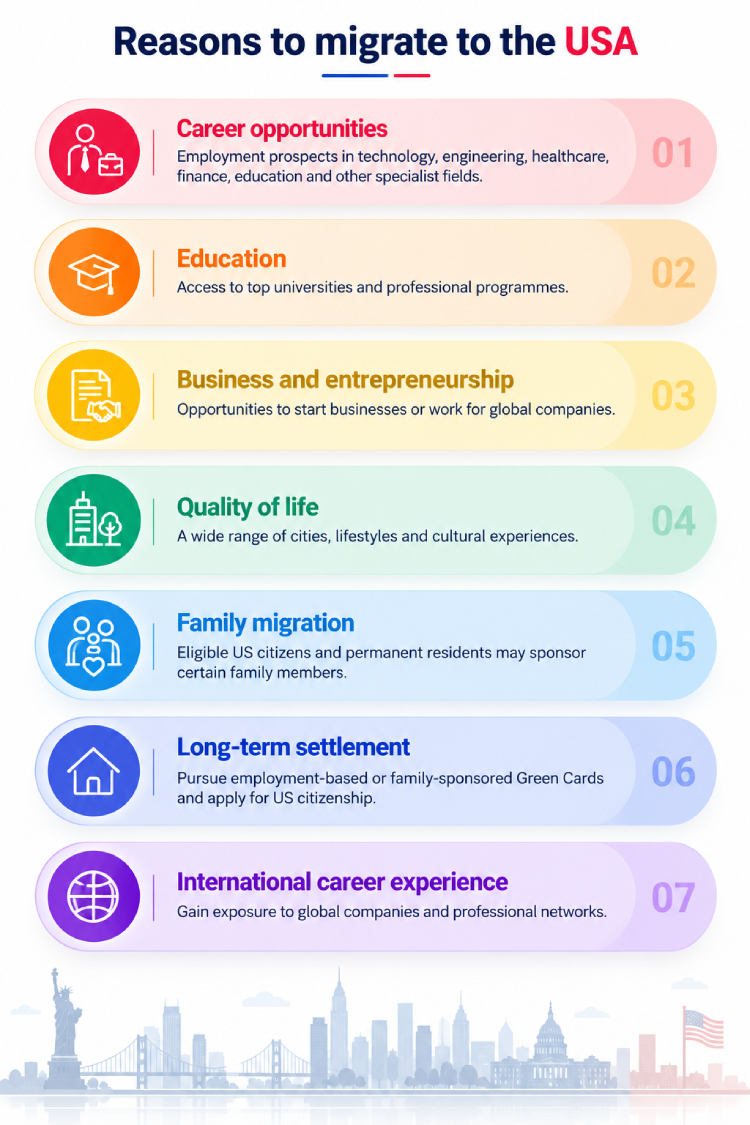
- Career opportunities: Employment prospects in technology, engineering, healthcare, finance, education, research and other specialist fields.
- Education: Access to universities, research institutions and professional programmes, including courses for international students.
- Business and entrepreneurship: Opportunities to establish businesses, pursue investment activities or work for international companies, subject to the relevant immigration rules.
- Quality of life: A wide range of cities, lifestyles, cultural experiences and recreational opportunities.
- Family migration: Eligible US citizens and permanent residents may sponsor certain family members, subject to immigration requirements and processing availability.
- Long-term settlement: Eligible applicants can pursue employment-based or family-sponsored Green Cards and, if they later meet the requirements, apply for US citizenship.
- International career experience: Working in the USA can provide exposure to global companies, specialist industries and professional networks.
Important: ESTA and visitor visas are intended for eligible temporary visits, not ordinary employment or permanent settlement. Australians planning to work in the USA should identify the appropriate employment visa or immigrant pathway before making relocation plans.
Types of US Visas and Immigration Pathways
1. USA Work Visa for Skilled Professionals
This route is for Australians who have a suitable job offer and meet the requirements of an eligible US employment visa category. The appropriate visa depends on the role, qualifications, employer and intended length of stay. Common options include the E-3 visa for Australian professionals, the H-1B visa for eligible specialty occupations and certain other employer-sponsored work visas.
You generally need to:
- Have a job offer from a qualifying US employer, where required.
- Meet the educational, professional or experience requirements for the visa category.
- Obtain employer sponsorship or an approved petition, if applicable.
- Meet any state licensing requirements for regulated professions.
- Apply for the appropriate visa and satisfy the relevant entry requirements.
The exact requirements depend on the visa category and the nature of the employment.
2. E-3 Visa for Australian Citizens
The E-3 visa is a dedicated temporary work visa for Australian nationals who intend to work in a qualifying specialty occupation in the United States. It can be a useful option for Australians with suitable academic qualifications and a job offer from a US employer. Unlike the H-1B category, the E-3 has a separate annual allocation and its own application process.
E-3 visa requirements
- Australian citizenship.
- A genuine job offer for a qualifying specialty occupation in the United States.
- Academic qualifications or qualifying equivalent credentials appropriate for the position.
- A certified Labour Condition Application (LCA) from the US Department of Labor, obtained by the employer.
- Any required professional licence or authorisation.
- Evidence that you meet the visa requirements and intend to comply with the conditions of your temporary stay.
A specialty occupation generally requires the application of specialised knowledge and a bachelor's degree or higher, or its equivalent, in a directly related field. Not every professional job automatically qualifies.
E-3 visa allocation and duration
| Category | Key information |
|---|---|
| Annual allocation | Up to 10,500 new E-3 visas annually, subject to applicable rules |
| Initial period of admission | Generally up to two years |
| Extensions | Generally available in two-year increments, subject to eligibility |
| Employer requirement | A qualifying US job offer and employer-prepared LCA |
| Family members | Eligible spouses and unmarried children under 21 may qualify for dependent E-3 status |
The annual allocation is not a salary threshold or a guarantee that an application will be approved. Visa issuance and admission remain subject to the applicable rules.
3. USA Employment-Based Green Card
An employment-based Green Card allows eligible applicants to become lawful permanent residents of the United States. Depending on your qualifications and circumstances, you may qualify through an employment-based immigrant category.
Common pathways include:
EB-1: Priority workers
This category may suit individuals with extraordinary ability, outstanding professors or researchers, and certain multinational executives or managers.
EB-2: Advanced degree or exceptional ability
This category generally covers professionals with advanced degrees or individuals who demonstrate exceptional ability in qualifying fields. Some applicants may qualify for a National Interest Waiver, which can waive the job-offer and labour-certification requirements when the legal criteria are met.
EB-3: Skilled workers, professionals and other workers
This category covers qualifying skilled workers, professionals and certain other workers. Many applicants require a permanent job offer and labour certification, subject to the applicable exceptions.
Employment-based Green Card requirements
- Qualify for the relevant immigrant category.
- Obtain an employer-sponsored job offer and labour certification when required.
- Meet the category's education, experience or achievement requirements.
- Have an immigrant visa number available when required.
- Complete the applicable immigrant visa or adjustment-of-status process.
- Satisfy admissibility and other immigration requirements.
Not all applicants need employer sponsorship. Certain EB-1 applicants and eligible EB-2 National Interest Waiver applicants may self-petition.
4. H-1B Visa for Specialty Occupations
The H-1B visa is designed for eligible specialty occupations that generally require highly specialised knowledge and at least a bachelor's degree or equivalent in a directly related field.
This route may be suitable for Australian professionals offered qualifying employment by a US employer.
Applicants generally need:
- A qualifying job offer from a US employer.
- A role that meets the specialty occupation requirements.
- Relevant academic qualifications or equivalent credentials.
- An employer willing and able to complete the required petition and labour-condition procedures.
- Selection under the applicable registration and cap process, where required.
Some employers and positions may be exempt from the annual numerical cap. Selection is not guaranteed for applicants subject to the cap. The H-1B visa may provide a route to longer-term employment and, where eligible, an employment-based Green Card. However, permanent residence requires a separate application and approval.
This route is for Australians who want to study at an eligible US educational institution.
The main categories include:
- F-1 visa: For academic study at an eligible institution, such as a university or college.
- M-1 visa: For eligible vocational or nonacademic study.
- J-1 visa: For approved exchange visitor programmes, including certain educational, research and training programmes.
Applicants generally need:
- Acceptance by an eligible school or approved programme.
- The relevant Form I-20 or Form DS-2019, depending on the category.
- Proof of sufficient funds for tuition and living expenses.
- Evidence of academic preparation and any required language proficiency.
- Payment of applicable visa and programme fees.
- Compliance with the requirements of the chosen student or exchange category.
Some eligible F-1 students may qualify for Optional Practical Training (OPT), which can provide temporary practical work experience related to their field of study. Additional rules apply to extensions and employment authorisation. A student visa does not automatically provide permanent residence. Graduates must qualify separately for any subsequent work visa or Green Card pathway.
6. USA Family-Sponsored Immigration
Family-sponsored immigration may allow eligible relatives of US citizens or lawful permanent residents to immigrate to the United States.
Potential pathways include:
- Spouses of US citizens.
- Unmarried children of US citizens or permanent residents.
- Parents of US citizens who meet the relevant age requirements.
- Certain siblings and other qualifying family relationships under applicable categories.
Requirements generally include:
- Proof of the qualifying family relationship.
- A petition filed by the eligible US sponsor.
- Evidence of the sponsor's US citizenship or permanent resident status.
- Financial sponsorship where required.
- Civil documents and any necessary supporting evidence.
- Completion of the immigrant visa or adjustment-of-status process.
Immediate relatives of US citizens are not subject to the same annual numerical limits as family preference categories. Other family categories may have substantial waiting periods, depending on the relationship and visa availability. Not every relative qualifies for family-sponsored immigration, and eligibility depends on the specific relationship and sponsor's status.
Australian passport holders may be eligible to travel to the United States under the Visa Waiver Program using an approved Electronic System for Travel Authorization (ESTA). This option is intended for eligible short visits for tourism or permitted business activities, not for ordinary employment or permanent settlement.
Key points include:
- Eligible travellers may generally visit for up to 90 days per admission under the Visa Waiver Program.
- An approved ESTA is required before travelling under the programme.
- ESTA approval does not guarantee admission; US border officials make the final decision.
- ESTA does not permit ordinary employment or a change to another immigration status within the United States.
- A B-1/B-2 visitor visa may be appropriate for eligible travellers who do not qualify for ESTA or whose circumstances require a visitor visa.
A visitor visa or ESTA should not be used as a substitute for a work visa or immigrant visa.
8. Exchange and Temporary Work Programmes for Australians
The United States does not have a general Working Holiday visa equivalent to Germany's programme for Australians. However, some Australians may qualify for specific exchange or temporary work opportunities.
Options can include:
- J-1 Exchange Visitor visa: For participants accepted into an approved exchange programme, such as qualifying internships, training, research or other designated activities.
- Summer Work Travel: An approved J-1 programme for eligible post-secondary students who meet the programme's requirements.
- Other temporary employment visas: Depending on the occupation, employer and circumstances, additional categories may be available.
Applicants generally need acceptance by an authorised programme sponsor or a qualifying employment arrangement, together with the relevant supporting documents. Eligibility, age requirements, permitted activities and duration vary by programme. Approval under one programme does not automatically qualify you for another visa category.
*Willing to work in the US? Y-Axis will guide you in all the steps.
Permanent Residence in the USA
A US Green Card allows eligible individuals to live and work permanently in the United States. Australians can pursue permanent residence through employment-based or family-sponsored immigration, depending on their eligibility.
Permanent residence for E-3 and H-1B visa holders
Eligible workers may apply for a Green Card through:
- EB-1: For individuals with extraordinary ability, qualifying academics and researchers, or certain multinational executives.
- EB-2: For advanced-degree professionals or individuals with exceptional ability, including eligible National Interest Waiver applicants.
- EB-3: For eligible skilled workers and professionals.
Employer sponsorship and labour certification may be required.
Permanent residence through family sponsorship
Eligible relatives of US citizens or Green Card holders may qualify through family-sponsored immigration, subject to relationship, financial sponsorship and visa availability requirements.
Applying for US citizenship
Green Card holders can generally apply for citizenship after five years of permanent residence, or after three years in certain qualifying marriages to US citizens, provided all eligibility requirements are met.
Important: E-3, H-1B, student and visitor visas do not automatically grant permanent residence. A separate qualifying immigration pathway is required.
*Also read...
Eligibility Requirements to Migrate to the USA from Australia
Australians planning to migrate to the United States must meet the eligibility requirements for their chosen visa or immigration category. Requirements vary depending on whether you intend to work temporarily, study, join family or obtain permanent residence.
General eligibility requirements
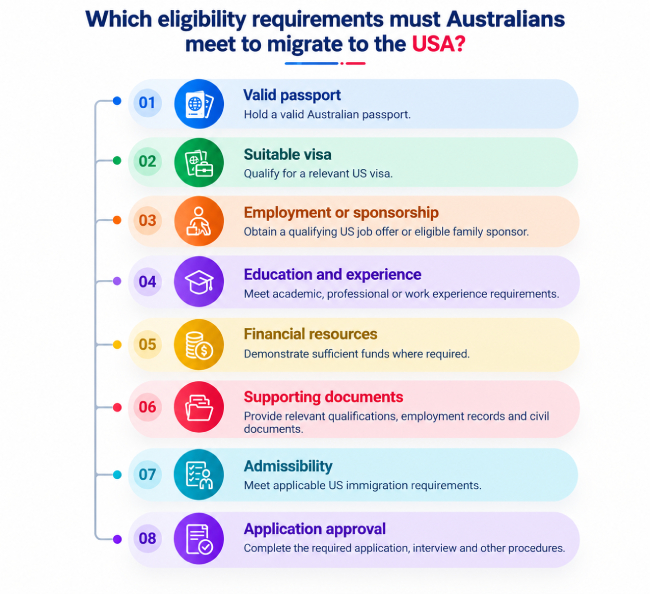
- Valid passport: Hold a valid Australian passport if applying as an Australian citizen, or the appropriate travel document for your circumstances.
- Suitable visa category: Qualify for a relevant visa, such as the E-3, H-1B, student visa or employment-based immigrant visa.
- Employment or sponsorship: Obtain a qualifying US job offer or eligible family sponsor where required.
- Education and experience: Meet the academic, professional or work experience requirements of your chosen category.
- Financial resources: Demonstrate sufficient funds where required for study, family sponsorship or other immigration purposes.
- Supporting documents: Provide relevant qualifications, employment records, civil documents and other requested evidence.
- Admissibility: Meet applicable US immigration requirements, including any required medical examination and background checks.
- Application approval: Complete the required application, interview and other procedures before travelling under the relevant visa.
Steps to Migrate to the USA from Australia
Step 1: Determine whether you intend to work temporarily, study, join family or obtain permanent residence. Australians with qualifying professional job offers may consider the E-3 visa, while eligible applicants seeking long-term settlement can explore employment-based or family-sponsored Green Cards.
Step 2: Review the requirements for your chosen visa category, including citizenship, qualifications, employment, sponsorship and financial evidence where applicable.
Step 3: Secure a job offer or eligible sponsor. For work visas, find a US employer willing to meet the relevant sponsorship requirements. For family migration, confirm that your relative can sponsor you under the applicable immigration category.
Step 4: Gather your passport, qualifications, employment offer, supporting financial documents and other evidence required for your application. The exact document list depends on the visa type.
Step 5: Submit the appropriate forms and supporting evidence. For example, many temporary work visa applicants complete Form DS-160, while employment-based immigrant visa applicants generally complete Form DS-260 after their case reaches the relevant stage.
Step 6: Attend the required appointment and provide any additional evidence requested by the consular officer. Some applicants may be subject to additional processing.
Step 7: Wait for the relevant authority to make a decision. Approval is not guaranteed, and you should avoid making irreversible relocation arrangements before the appropriate authorisation is granted.
Step 8: Once authorised to travel, arrange your flights, accommodation, health insurance and other relocation requirements. On arrival, US border officials determine whether you may be admitted under the applicable rules.
Step 9: Follow the conditions of your visa or immigration status. If your goal is permanent residence, assess whether you qualify for a Green Card pathway and complete the separate application process when eligible.
Important: Temporary work visas and student visas do not automatically grant permanent residence. Your long-term options depend on your visa category, eligibility and any subsequent immigration approvals.
*Read about...
USA Job Outlook for next 10 years
Cost of a US Visa
US visa fees depend on the category you apply for. The following are the standard government application fees listed by the US Department of State.
US Visa Application Fees
| Visa type | Application fee (USD) |
|---|---|
| Visitor Visa (B-1/B-2) | US$185 |
| Student Visa (F-1/M-1) | US$185 |
| H-1B Work Visa | US$205 |
| E-3 Visa for Australian professionals | US$315 |
| Employment-Based Immigrant Visa | US$345 per applicant |
| Family-Sponsored Immigrant Visa | US$325 per applicant |
Additional costs to consider
- Student visa applicants may need to pay the SEVIS fee, depending on their category.
- Work visa petitions may involve additional employer-paid government fees and other costs.
- Green Card applicants may need to pay petition, medical examination and other applicable fees.
- Travel, document preparation and professional legal services may add to the total cost.
US Visa Processing Time
US visa processing times vary depending on the visa category, interview appointment availability, application review and any additional administrative processing. The following table provides general guidance for Australians applying to travel to or work in the United States.
| Visa type | Estimated processing timeline |
|---|---|
| Visitor Visa (B-1/B-2) | Around 2 weeks to 16 months or longer, including possible interview wait |
| Student Visa (F-1/M-1) | Around 2–6 weeks or longer, depending on admission and visa processing |
| H-1B Work Visa | Around 3–9 months or longer, depending on petition processing and interview availability |
| E-3 Visa for Australians | Around 2–8 weeks or longer, depending on appointment availability and processing |
| Employment-Based Green Card | Several months to several years or longer, depending on the category and visa availability |
How can Y-Axis help you?
Y-Axis is the immigration consultant of choice for serious applicants for USA immigration. Our thorough process and end-to-end support ensure you take the right action at every step. We help you with:
- Free eligibility check through Immigration Points Calculator
- Expert guidance for USA Immigration
- Getting an ECA (Educational Credential Assessment)
- Coaching services: Expert CELPIP coaching, IELTS proficiency Coaching ,PTE Coaching
- Free career counselling; book your slot today
- Complete guidance for PR visa
Looking For Inspiration
Explore what Global Citizens have to say about Y-Axis in shaping their future
Frequently Asked Questions

