


Don't know what to do ?.
Get Free Counseling
Last Updated: 16 July 2026
Canada Work Visa from Australia
Canada work visa allows foreign nationals to legally work in Canada, providing opportunities for skilled professionals, temporary workers, and international students. It serves as a pathway to gain valuable Canadian work experience and can lead to permanent residency. Each year, Canada issues hundreds of thousands of work permits, supporting its diverse and growing labor market. The visa process involves obtaining a job offer, sometimes requiring a Labour Market Impact Assessment (LMIA), and meeting eligibility criteria set by the Canadian government.
- IRCC issued 4% fewer work permits in 2024 than in 2023, as the government works to bring temporary residents below 5% of Canada's population by 2027.
- Canada had 490,500 job vacancies as of April 2026, with the vacancy rate down to 2.7% — 3.4% lower than the year before.
- Work permit rules have actually gotten stricter since late 2024, not easier — low-wage work permits now run for shorter periods, and fewer spouses qualify for open work permits.
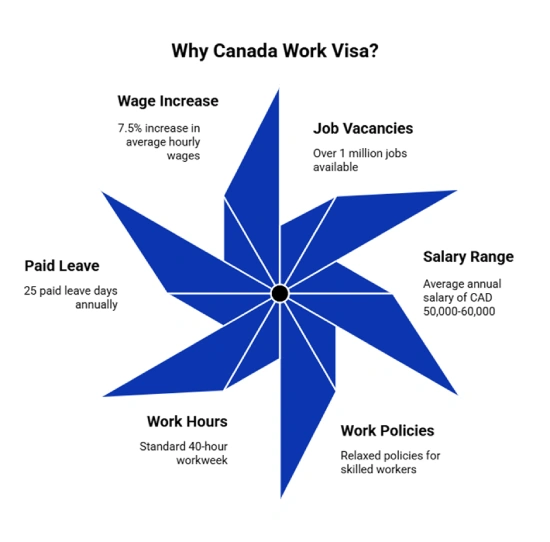
- The average worker in Canada earns around CAD 70,000 a year (about CAD 1,345 a week), up 3.8% from last year.
- Average hourly wages sit at CAD 37.73, up 4.7% year-over-year.
- A standard workweek is still 40 hours under the Canada Labour Code.
- Paid vacation starts at 2 weeks in your first year and grows with tenure — it varies by province, so there's no single fixed number of days.
- There are currently 3.2 unemployed people for every job vacancy in Canada, which gives a sense of how competitive things are right now.
What is a Canada Work Permit?
A Canada work permit is a legal document issued by Immigration, Refugees and Citizenship Canada (IRCC) that authorizes foreign nationals to work legally in Canada for a specified period. It is distinct from a visa, which allows entry into Canada; a work permit specifically grants employment authorization. There are two main types: employer-specific work permits, which tie the worker to a particular employer, and open work permits, which allow work for any eligible employer in Canada. Work permits are typically temporary but can often be extended or serve as a stepping stone to permanent residency.
Benefits of Canada Work Permit Visa
Holding a Canada work permit visa offers numerous benefits:
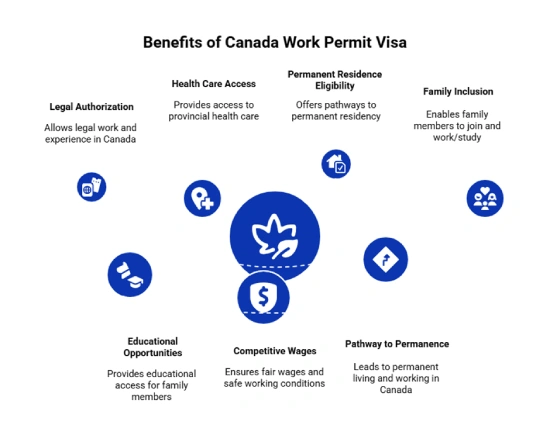
- Legal authorization to work and gain Canadian work experience.
- Access to provincial health care in many provinces.
- Eligibility to apply for permanent residence through programs like the Canadian Experience Class and Federal Skilled Worker Program.
- Ability to bring family members, including spouse or common law partner and dependent children, who may also be eligible for open work permits or study permits.
- Opportunity to attend Canadian educational institutions for family members.
- Competitive wages and safe working conditions protected by Canadian labor laws.
- Pathway to live and work in Canada permanently.
Canada Work Visa
Australia gets one of the best deals of any country in Canada's International Experience Canada (IEC) program, the youth mobility agreement that lets young Australians work in Canada without needing a job offer first. Most IEC countries have a capped number of Working Holiday spots each year, so applicants compete for limited invitations. Australia doesn't have that cap. Australians can also apply up to age 35, while many other countries in the program stop at 30. The Working Holiday permit itself is an open work permit valid for up to 24 months, so you can work for almost any employer, anywhere in the country, without lining up a job in advance.
There's a second pathway worth knowing about if you're not going the IEC route. Australia and Canada both belong to the CPTPP trade agreement, and it opens up an LMIA-exempt work permit for eligible Australian professionals, intra-company transferees, and investors. In plain terms, that means skipping the Labour Market Impact Assessment that most other applicants have to go through. It's most useful if you're already working for a multinational with a Canadian office, or if your occupation falls under the agreement's professional and technical categories.
For skilled Australians outside of IEC or a corporate transfer, the standard route is an employer-specific work permit, either through the LMIA-based Temporary Foreign Worker Program or an LMIA-exempt stream under the International Mobility Program. Right now, the sectors showing the strongest demand line up well with common Australian qualifications: healthcare (particularly nursing and aged care), skilled trades like electricians, welders, and heavy equipment operators, plus construction, engineering, and mining and resources.
Canada Work Permit Requirements and Eligibility
Most foreign nationals need a work permit to work in Canada legally. A few groups are exempt, including certain international students, spouses of work permit holders, and applicants covered by a free trade agreement (like Australians applying under IEC or the CPTPP). For everyone else, here's what you'll actually need:
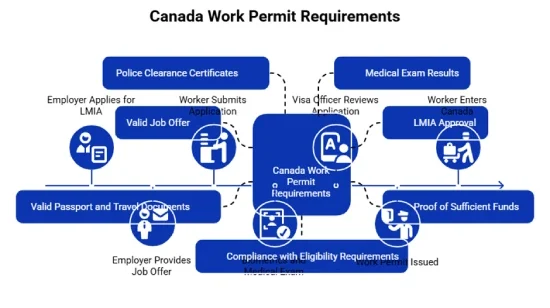
- A job offer from a Canadian employer. For an employer-specific permit, this needs to be a genuine, confirmed offer tied to a specific role and employer.
- A Labour Market Impact Assessment (LMIA), unless you're exempt. Employment and Social Development Canada (ESDC) issues an LMIA to confirm that hiring a foreign worker won't negatively affect the Canadian job market. Some routes skip this entirely, including IEC, CPTPP-eligible categories, and other LMIA-exempt work permits.
- Proof you can support yourself financially, including any family members coming with you.
- A valid passport or travel document that covers your intended stay.
- A police clearance certificate showing no criminal record.
- A medical exam, if your job or length of stay requires one (healthcare, childcare, and some other sectors always require this).
- Intent to leave Canada when your permit expires, unless you're on a pathway to permanent residency.
Age and language requirements apply to some specific programs (like IEC, which caps eligibility at 35 for Australians), so it's worth checking the exact criteria for whichever pathway fits your situation.
Canada Work Permit Process
The process to obtain a Canada work permit generally involves:
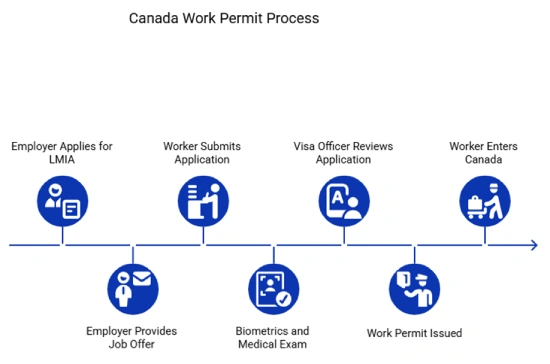
Step 1: Employer applies for a Labour Market Impact Assessment (LMIA) if required.
Step 2: Employer provides a job offer letter and LMIA approval to the foreign worker.
Step 3: Foreign worker submits a work permit application online or at a visa application center with documents required.
Step 4: Biometrics and medical exam are completed if necessary.
Step 5: Visa officer reviews the application and issues a temporary resident visa or electronic travel authorization if required.
Step 6: Work permit is issued at the port of entry or mailed if applying from inside Canada.
Step 7: Worker enters Canada and begins employment under the conditions of the permit.
Canada Work Permit Processing Time
Processing times vary a lot depending on the type of work permit, where you're applying from, and how complete your documents are — and in 2026, these numbers are moving around more than usual. As a general guide:
- Employer-specific work permits (LMIA-based), applied for from outside Canada: roughly 6–16 weeks, though this ranges much wider by country.
- Applications submitted from inside Canada currently take considerably longer, often 6–8 months.
- Open work permits, including spousal and PGWP applications, typically fall somewhere in the 8–16 week range.
Canada Work Visa Costs and Fees
The fees for Canada work permits include:
- Work permit application fee: CAD 155.
- Open work permit holder fee: additional CAD 100.
- Biometrics fee: CAD 85 per person.
- Medical exams vary by provider but typically range from CAD 100 to CAD 300.
- Police certificate fees depend on the issuing country. These fees are non-refundable regardless of the application's outcome.
If your job offer requires a Labour Market Impact Assessment (LMIA), your employer pays a separate CAD 1,000 fee to Employment and Social Development Canada per position. This is entirely the employer's responsibility, and by law it cannot be passed on to you. It's worth knowing about even though it doesn't come out of your own pocket, since it's part of the total cost of hiring you and can affect how willing an employer is to sponsor a work permit in the first place.
Jobs in Canada for Australians
Canada and Australia have a lot in common when it comes to the labour market: both countries are dealing with skills shortages in similar sectors, and Australian qualifications often translate well because the work culture, safety standards, and English language requirement are already familiar ground. As of 2026, the sectors with the strongest ongoing demand include:
- Healthcare, particularly nursing, aged care, and allied health roles, where Canada's ageing population is driving sustained hiring.
- Skilled trades, including electricians, welders, plumbers, and heavy equipment operators. Many Australian trade qualifications have a clear pathway to Canadian recognition through provincial licensing bodies.
- Mining and resources, a sector where Australian experience is genuinely valued given how closely the two countries' resource industries overlap.
- Construction and engineering, especially in provinces with major infrastructure projects underway.
- Information technology, where demand remains steady across most provinces despite broader hiring slowdowns in tech globally.
Most provinces run their own Provincial Nominee Program (PNP), which lets them nominate skilled workers in occupations facing local shortages. This is often a faster route to permanent residency than the federal Express Entry system alone, and provinces regularly update their in-demand occupation lists based on real labour market data. If you're already working in Canada on a temporary permit, whether through IEC, an LMIA-based job offer, or a CPTPP pathway, gaining Canadian work experience in one of these sectors can meaningfully strengthen a later PNP or Express Entry application.
Types of Canada Work Permits
Canada issues several types of work permits:
- Employer-Specific Work Permit: Tied to a specific employer and job, usually requiring an LMIA.
- Open Work Permit: Allows work for any eligible employer; often issued to spouses, international graduates, or under certain programs.
- Post -Graduation Work Permit: For international students graduating from Canadian institutions.
- LMIA-Exempt Work Permits: For workers under free trade agreements or other exemptions. Each type has specific eligibility criteria and application processes.
LMIA Canada
The Labour Market Impact Assessment (LMIA) is a document issued by Employment and Social Development Canada (ESDC) that verifies there is a need for a foreign worker and no Canadian citizen or permanent resident is available to do the job. Employers must obtain a positive LMIA before hiring most foreign workers. The LMIA process involves recruitment efforts and assessing the impact on the Canadian labor market. Some work permits are LMIA-exempt under international agreements or specific categories.
Canada Open Work Permit
An open work permit allows foreign nationals to work for any eligible employer in Canada without the need for a job offer or LMIA. Common recipients include:
- Spouses or common law partners of skilled workers or international students.
- International graduates with a Post Graduation Work Permit.
- Participants in certain international mobility programs. Open work permits provide flexibility but may have conditions restricting work in certain sectors such as escort services.
How can Y-Axis help you?
Y-Axis is a leading immigration and visa consultancy that specializes in assisting individuals with their Canada work visa applications. With expert guidance and personalized support, Y-Axis helps simplify the complex process of obtaining a Canadian work permit, ensuring a smooth and successful application experience.
Our services include:
- Expert evaluation of your eligibility for various Canada work permit programs.
- Assistance in securing a valid job offer and preparing the necessary employment contract
- Guidance through the Labour Market Impact Assessment (LMIA) process when required.
- Support with document preparation, including police certificate proof and medical exam results.
- Step-by-step help with online application submission and managing your online account for tracking progress.
With Y-Axis, you gain access to experienced professionals dedicated to helping you work in Canada legally and efficiently.
Our Accreditations



.webp)
Proud Sponsor of

.webp)


Don't know what to do ?.
Get Free Counseling
Looking for Inspiration
Explore what Global Citizens have to say about Y-Axis in shaping their future
Frequently Asked Questions