

Study in France

Don't know what to do?
Get Free Counseling
Last Update: 06 November 2026
Study in France from Australia: Tuition Fees, Student Visa and Work Rights
France is a popular destination for international students looking for quality education, recognised universities and opportunities to experience European culture. Students from Australia can choose from a wide range of bachelor's, master's and doctoral programmes at public and private institutions. Before applying, it is important to understand the admission process, tuition fees, student visa requirements, work rights and options after graduation.
Study in France: Key Facts
| Key Information | Details |
|---|---|
| Bachelor's tuition at public universities | €2,902/year |
| Master's tuition at public universities | €3,950/year |
| Minimum funds for a student visa | €877.50/month |
| Student work allowance | 964 hours/year |
| Post-study job search option | Up to 12 months |
| CVEC for 2026–2027 | €105 |
*Need assistance to Study Abroad? Y-Axis is here to assist you in all the ways.
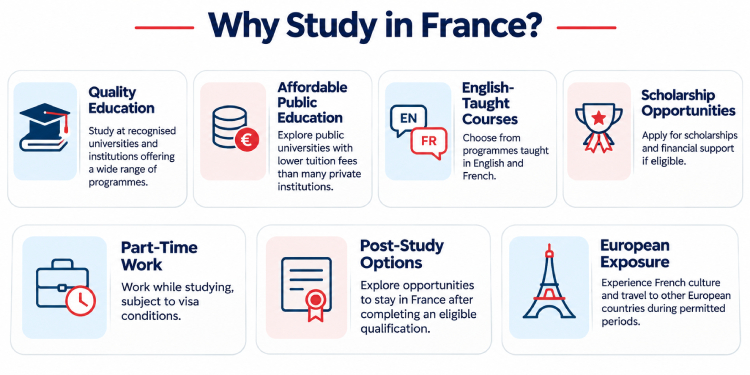
Why Study in France?
- Quality Education: Study at recognised universities and institutions offering a wide range of programmes.
- Affordable Public Education: Explore public universities with lower tuition fees than many private institutions.
- English-Taught Courses: Choose from programmes taught in English and French.
- Scholarship Opportunities: Apply for scholarships and financial support if eligible.
- Part-Time Work: Work while studying, subject to visa conditions.
- Post-Study Options: Explore opportunities to stay in France after completing an eligible qualification.
- European Exposure: Experience French culture and travel to other European countries during permitted periods.
Top Universities to Study in France
France is home to several internationally recognised universities offering a wide range of programmes in business, engineering, science, technology, arts and social sciences. These institutions attract students from around the world through their academic programmes, research opportunities and international learning environments. The following table highlights 10 French institutions and their positions in the QS World University Rankings, helping students compare some of the leading study options in France.
| University | QS Ranking 2027 |
|---|---|
| Université PSL | 34 |
| Institut Polytechnique de Paris | 43 |
| Sorbonne University | 73 |
| Université Paris-Saclay | 76 |
| École Normale Supérieure de Lyon | 235 |
| Université Paris 1 Panthéon-Sorbonne | 246 |
| Université Paris Cité | 303 |
| Sciences Po | 354 |
| Université Grenoble Alpes | 387 |
| Aix-Marseille University | 443 |
Affordable Universities in France
Students can explore public universities in France that offer different study programmes at competitive tuition rates.
- University of Lille
- Université Grenoble Alpes
- University of Strasbourg
- University of Bordeaux
- Aix-Marseille University
- Université de Lorraine
- University of Rennes
- University of Montpellier
- University of Poitiers
- Université Paris-Saclay
Tuition fees depend on the programme, student category and any fee exemption offered by the university.
Top Courses to Study in France
France offers a wide range of study programmes across business, engineering, technology, fashion, hospitality and creative industries. It is particularly well known for its business schools, engineering institutions, luxury brand programmes and culinary education. Australian students can choose from bachelor's and master's degrees based on their academic background and career goals.
The following table highlights some of the popular courses to study in France.
| Course | Popular Specialisations | Typical Duration |
|---|---|---|
| Business and Management | MBA, International Business, Marketing, Entrepreneurship, Management | 1–3 years |
| Engineering and Technology | Aerospace, Mechanical, Civil, Electrical, Renewable Energy Engineering | 2–5 years |
| Computer Science and IT | Artificial Intelligence, Data Science, Cybersecurity, Software Engineering | 2–3 years |
| Finance and Economics | Banking, Financial Management, International Finance, Economics | 1–2 years |
| Fashion and Luxury Management | Fashion Design, Luxury Brand Management, Fashion Marketing, Retail Management | 1–3 years |
| Hospitality and Tourism | Hotel Management, Tourism Management, Event Management, Restaurant Management | 1–3 years |
| Culinary Arts and Gastronomy | Culinary Arts, Pâtisserie, Bakery, French Cuisine, Food Management | 1–3 years |
| Arts, Design and Architecture | Graphic Design, Interior Design, Architecture, Animation, Fine Arts | 2–5 years |
| International Relations and Political Science | International Relations, Public Policy, European Studies, Diplomacy | 2–3 years |
| Environmental Science and Sustainability | Climate Science, Renewable Energy, Environmental Management, Sustainable Development | 1–3 years |
*Confused about what course to opt for studying in France? Avail Y-Axis country specific admission to make a right choice.
Cost of Studying in France
Tuition fees depend on whether you choose a public or private institution, the course and your eligibility for an exemption.
Public University Tuition Fees
From the 2026–2027 academic year, the differentiated tuition fees for many non-EU students at public institutions are:
| Study Programme | Annual Tuition Fee |
|---|---|
| Bachelor's Degree | €2,902 |
| Master's Degree | €3,950 |
| Doctoral Degree | €398 |
Australian students are generally treated as non-EU students for these fees. However, some students may qualify for full or partial fee exemptions, depending on the institution and their circumstances.
Public vs Private University Fees
| Institution Type | Tuition Fee Information |
|---|---|
| Public Universities | Many non-EU students pay the differentiated fees listed above, unless they qualify for an exemption. |
| Private Universities | Fees are set by each institution and vary depending on the course and qualification. |
Private university fees can be much higher than public university fees. Students should check the exact amount with their chosen institution.
Other Student Expenses
- CVEC: €105 for the 2026–2027 academic year, where applicable.
- Living expenses: Students applying for a long-stay visa must show at least €877.50 per month in available financial resources.
- Additional expenses: Accommodation, food, transport, books and other personal costs.
Scholarships to Study in France
International students can access several scholarships to help cover tuition fees and living costs while studying in France. Funding may be available through the French government, universities, regional authorities, European Union programmes and private organisations.
Popular scholarships for Australian Students
| Scholarship | Eligibility / Study Level | Benefits |
|---|---|---|
| France Excellence Eiffel Scholarship | High-achieving international students applying for eligible Master's and PhD programmes | Monthly allowance of €1,200 for Master's students and €2,100 for PhD students, plus certain services. Tuition fees are not covered. |
| Erasmus Mundus Joint Master's Scholarship | International students admitted to eligible joint Master's programmes | May cover participation costs, travel and living expenses, subject to programme conditions. |
| France Excellence Major Scholarship | High-performing international students who graduated from eligible French high schools abroad | Supports eligible students pursuing higher education in France. |
| University-specific scholarships | International students applying to participating French universities | May provide partial or full tuition-fee support, or other financial assistance. |
| Regional scholarships | International students enrolled in eligible programmes in specific French regions | Financial support for study, research or mobility, depending on the regional scheme. |
| Doctoral and research grants | Eligible PhD candidates and researchers | Funding may be available through doctoral schools, research institutions and research projects. |
France Student Visa
A France student visa allows international students to live and study in France for an approved course or programme. Students applying from Australia must meet the visa requirements, provide proof of admission and sufficient funds, and complete the relevant application process before travelling.
Types of Student Visas for France
Students from Australia must choose the right visa based on their course duration and purpose of travel.
| Visa Type | Purpose |
|---|---|
| Short-Stay Student Visa | For courses or study programmes lasting up to 3 months. |
| Long-Stay Student Visa (VLS-TS) | Generally for courses lasting more than 3 months. It is usually issued for 4 months to 1 year. |
| Temporary Long-Stay Visa (VLS-T) | For certain temporary study or training programmes, generally lasting 3 to 6 months. |
| Student Examination Visa | For eligible students travelling to France to take an entrance examination. |
The Talent Passport is a separate residence option for eligible professionals, researchers and other categories. It is not a general student visa for doctoral students.
France Student Visa Eligibility
To apply for a long-stay student visa, Australian applicants generally need to:
- Receive an offer from a recognised French educational institution.
- Meet the academic entry requirements.
- Choose an eligible course or study programme.
- Show enough money to support themselves during their stay.
- Provide accommodation details, where required.
- Meet the relevant health and other visa conditions.
Documents Required for a France Student Visa
Applicants may need to provide:
- Valid Australian passport.
- University offer or enrolment letter.
- Completed visa application form.
- Recent passport photographs.
- Proof of financial resources.
- Accommodation details.
- Academic certificates and transcripts.
- Insurance documents, where required.
- Any additional documents requested during the application process.
The exact document list depends on the applicant's circumstances and course.
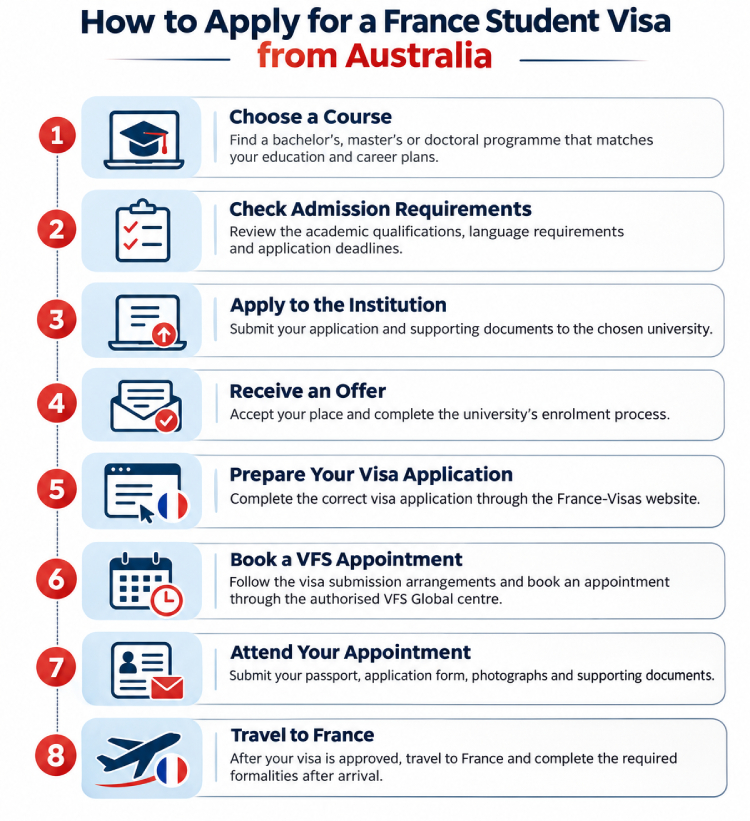
How to Apply for a France Student Visa from Australia
Australian students can apply to French universities and colleges directly, depending on the course and institution.
Step 1: Choose a Course
Find a bachelor's, master's or doctoral programme that matches your education and career plans.
Step 2: Check Admission Requirements
Review the academic qualifications, language requirements and application deadlines.
Step 3: Apply to the Institution
Submit your application and supporting documents to the chosen university.
Step 4: Receive an Offer
Accept your place and complete the university's enrolment process.
Step 5: Prepare Your Visa Application
Complete the correct visa application through the France-Visas website.
Step 6: Book a VFS Appointment
Applicants living in Australia must follow the visa submission arrangements and book an appointment through the authorised VFS Global centre.
Step 7: Attend Your Appointment
Submit your passport, application form, photographs and supporting documents.
Step 8: Travel to France
After your visa is approved, travel to France and complete the required formalities after arrival.
France Student Visa Fees for Australian Applicants
Visa fees depend on the type of visa and the application arrangements.
| Fee Type | Amount |
|---|---|
| Long-Stay Student Visa | €99 |
| VFS Global service fee in Sydney | €40 |
| VFS Global service fee at other Australian centres | €70 |
| VLS-TS validation tax after arrival | Additional fee applies |
The VFS service fee is separate from the French government visa fee. Students must also pay the applicable validation tax when completing the online validation of their VLS-TS after arriving in France.
France Student Visa Processing Time
The French visa authorities indicate that applications submitted in Australia take an average of around 3 weeks to process, provided the application is complete.
| Application Stage | Time or Guidance |
|---|---|
| Visa appointment planning | Apply between 3 weeks and 6 months before planned arrival. |
| Average visa processing time | Around 3 weeks |
| Additional checks | May take longer depending on the application. |
Important points:
- Processing times are estimates and are not guaranteed.
- Missing documents can delay the decision.
- Some applications may need additional checks.
- There is no guaranteed fast-track visa processing service.
Students should apply early and allow enough time for university admission, document preparation and visa appointments.
Can International Students Work While Studying in France?
Yes. International students with a valid student residence permit or VLS-TS can work part-time while studying in France.
Work Rights:
- Students can work up to 964 hours per year.
- This is around 20 hours per week on average.
- Students can work on or off campus.
- Part-time work should not affect their studies.
- Students must follow French employment rules and visa conditions.
Post-Study Work Options in France
International students who complete an eligible qualification in France may be able to stay in the country to look for a job or start a business. The main option for eligible graduates is the Residence Permit for Job Search or Business Creation (RECE).
Eligibility Highlights
- Complete an eligible French qualification, such as a professional bachelor's degree or a master's degree or equivalent.
- Have studied in France under an eligible student residence status.
- Apply within the required period.
- Look for a job related to your studies or prepare to start a business.
- Meet the relevant application requirements.
Key Facts About RECE
- Allows eligible graduates to stay in France for up to 12 months.
- Is generally non-renewable.
- Allows graduates to look for suitable employment or prepare a business project.
- Eligible graduates who find suitable employment or establish a business may apply to change to an appropriate work or business residence status.
Certain nationality-specific agreements may provide different arrangements, so graduates should check which rules apply to them.
Australia-France Working Holiday Visa
Australian citizens aged 18 to 35 can apply for a France Working Holiday Visa under the Australia-France agreement. This visa allows eligible young Australians to visit France for tourism and cultural experiences while taking paid work to support their stay.
Eligibility Highlights:
- Be an Australian citizen.
- Be aged 18 to 35 when applying, before turning 36.
- Have a valid Australian passport.
- Make tourism and cultural experiences the main purpose of the stay.
- Meet the financial and other programme conditions.
- Apply for the appropriate long-stay Working Holiday Visa.
Key Facts:
- The visa is generally valid for up to 12 months.
- It allows paid work as a secondary activity during the stay.
- It is generally not extendable.
- It is different from a student visa and does not replace the requirements for a full-time study programme.
How Can Y-Axis Help You?
Y-Axis is the immigration consultant of choice for serious applicants for Australia. Our thorough process and end-to-end support ensure you take the right action at every step. We help you with:
- Expert guidance for Studying Abroad
- Coaching services: Expert CELPIP coaching, IELTS proficiency Coaching , PTE Coaching
- Free career counseling; book your slot today
- Course recommendation services for building a bright future
Talk to us to evaluate your chances and make an informed decision.
Looking for inspiration
Explore what Global Citizens have to say about Y-Axis in shaping their future
Frequently Asked Questions

