

Study
Study abroad allows every student to discover and broaden their horizons. Become an adaptable global contender by Studying Abroad!
You are a

Don't know What to do ?
Get Free Counselling
Study Opportunity


How it Works?
Discovering your perfect career or stream cannot get easier than our unique, scientific approach to career guidance.

Enquiry
You’re already here... Welcome!



Expert counselling
Our expert will talk to you and guides you based on your requirements.
Documentation
Expert assistance in arranging the requirements.

Eligibility
Sign-up with us to check your eligibility

Processing
Assists you in every step while filing the visa application.
Study Visa
Studying abroad is one of the most transformative and life-changing experiences. Find the right course and university with Y-Axis.


Why choose Y-Axis study counsellor?
Helps the students to execute their educational experience with intelligence and integrity...

Right course. Right path
Choosing the right course plays a crucial role in Studying Abroad!

One stop shop
Y-Axis guides you at every step of your journey (from admissions, coaching, visa application and post-landing support) to study abroad.

Serve students not universities
We do not partner with any universities but provides unbiased advice to our students.
Last Updated: 23 July 2026
Study Abroad: Top Countries, Universities & Student Visas for International Students
Studying abroad is a life-changing step that builds your professional skills, independence, and connections you'll carry into your career, but choosing the right country can feel overwhelming without the right guidance. Australia alone hosted over 680,000 international students, alongside top destinations like Canada, the UK, the USA, Germany and Japan, each offering different universities, costs, visa requirements, and post-study work options. The right choice depends on your course, budget, and career goals.
Why Study Abroad?
Studying abroad gives you access to world-ranked universities, stronger career opportunities, and valuable practical skills. Many students choose to study abroad for international job markets, post-study work options, and pathways to permanent residency.
- Degrees from top-ranked universities, recognized globally
- Post-study work opportunities in Australia, Canada, the UK, the USA, Germany, and Japan
- Work part time while studying
- Scholarships and financial aid for international students
- Connect with peers from 100+ countries
- Pathway to permanent residency in Australia, Canada, and Germany
- Employers value skills gained abroad
*Want to study abroad? Book Free consultation with Y-Axis to check your eligibility
Top 6 Countries to Study Abroad for International Students
Australia, Canada, the UK, the USA, Germany and Japan are the top destinations for international students, offering globally ranked universities, post-study work rights ranging from 1 to 4 years, and genuine pathways to build an international career. Tuition, living costs, and visa processing time vary by country, so your choice should depend on your course, budget, and career goals.
Study in Australia - High employability, straightforward visa process
Australia is known for globally ranked universities, a straightforward Subclass 500 student visa, and strong graduate employability across most fields. The Temporary Graduate visa lets eligible graduates stay and work in Australia for 2 to 4 years after completing their studies, and 72% of Australian employers now actively recruit international graduates. Major intakes run in February and July.
Top Universities in Australia
Australia has nine universities ranked in the world's top 100, according to the QS World University Rankings, out of 37 Australian institutions assessed overall. UNSW Sydney, the University of Melbourne, and the University of Sydney lead the list, and several Australian universities also rank in the global top 10 for specific subjects, including engineering, pharmacy, and sports science.
|
Name of the University |
QS Ranking |
|
University of New South Wales |
19 |
|
University of Melbourne |
22 |
|
University of Sydney |
28 |
|
Australian National University |
31 |
|
Monash University |
40 |
|
University of Queensland |
77 |
|
University of Western Australia |
79 |
|
Adelaide University |
87 |
|
University of Technology Sydney |
119 |
*Want to study in Australia? Let Y-Axis help you through application process.
Study in Canada - Affordable tuition, clear pathway to residency
Canada combines relatively affordable tuition with one of the clearest pathways to permanent residency of any major study destination. Graduates can work for up to 3 years through the Post-Graduation Work Permit, and then apply for permanent residency through Express Entry. Most programs start in September, with smaller January intakes.
Top Universities in Canada
McGill University holds Canada's top spot in the QS World University Rankings, backed by a 98.2 academic reputation score and a 9th-place global ranking for sustainability. McGill's own student body represents more than 150 countries, making it one of the most internationally diverse campuses in North America. The University of Toronto and University of British Columbia round out Canada's top three, with UBC posting a near-perfect 99.6 academic reputation score despite ranking lower overall.
|
Name of the University |
QS Ranking |
|
McGill University |
30 |
|
University of Toronto |
32 |
|
University of British Columbia |
45 |
|
University of Alberta |
96 |
|
University of Waterloo |
113 |
|
Western University |
142 |
|
Université de Montréal |
162 |
|
McMaster University |
174 |
|
Queen's University |
179 |
*Want to study in Canada? Let Y-Axis help you through application process.
Study in the UK - Shorter degrees, world-renowned universities
The UK offers some of the world's oldest and most respected universities, along with shorter course durations, many master's degrees are completed in just 1 year, saving both time and cost compared to other destinations. The Graduate Route currently allows international graduates to stay and work for 2 years after finishing their course. The main intake is September, with a smaller January entry point.
Top Universities in the UK
The UK is home to some of the world's most respected universities, with Imperial College London ranked 2nd globally, and Oxford, Cambridge, and UCL all firmly established in the world's top 10. Sixteen UK universities feature among the world's top 100, giving students an outstanding range of world-class options.
|
Name of the University |
QS Ranking |
|
Imperial College London |
2 |
|
University of Oxford |
4 |
|
University of Cambridge |
6 |
|
UCL |
8 |
|
University of Edinburgh |
35 |
|
King's College London |
37 |
*Want to study in the UK? Let Y-Axis guide you through application process.
Study in the USA - World's top universities, largest student population
The USA hosts more international students than any other country and is home to several of the world's top-ranked universities. Graduates can apply for Optional Practical Training (OPT), which allows up to 12 months of post-study work, extended to 36 months for STEM graduates. Intakes typically run in August/September and January.
Top Universities in the USA
MIT holds the world's #1 spot for the 15th consecutive year, with Stanford University tied for 2nd place alongside Imperial College London. Harvard and Caltech also rank among the world's top 10, giving the USA 14 universities in the global top 50, more than any other country.
|
Name of the University |
QS Ranking |
|
Massachusetts Institute of Technology (MIT) |
1 |
|
Stanford University |
2 |
|
Harvard University |
5 |
|
California Institute of Technology (Caltech) |
7 |
|
Yale University |
18 |
|
UC Berkeley |
20 |
|
University of Chicago |
24 |
*Want to study in USA? Let Y-Axis guide you through application process.
Study in Germany - Low-cost education, strong STEM programs
Germany's public universities charge little to no tuition fees, making it one of the most cost-effective destinations for high-quality education, particularly in engineering, technology, and research-focused fields. Graduates can apply for an 18-month Job Seeker Visa to find skilled employment after completing their studies. Main intakes are in October (winter) and April (summer).
Top Universities in Germany
The Technical University of Munich (TUM) is Germany's highest-ranked institution and the top-ranked university in the entire European Union, placing 25th globally. Four German universities feature in the world's top 100, led by TUM, LMU Munich, Heidelberg University, and Freie Universität Berlin. Most German public universities, including several of these, offer tuition-free education even for international students.
|
Name of the University |
QS Ranking |
|
Technical University of Munich (TUM) |
25 |
|
Ludwig Maximilian University of Munich (LMU) |
61 |
|
Heidelberg University |
86 |
|
Freie Universität Berlin |
98 |
|
RWTH Aachen University |
104 |
|
Karlsruhe Institute of Technology (KIT) |
110 |
*Want to study in Germany? Let Y-Axis guide you through application process.
Study in Japan - Affordable education, fast visa processing
Japan stands out for significantly lower tuition than the USA, UK, or Australia, combined with visa processing that typically takes just 2 to 4 weeks. A growing number of programs are now taught entirely in English, making it accessible even without Japanese language proficiency. Major intakes run in April, with a smaller January intake.
Top Universities in Japan
Japan has four universities ranked in the world's top 100, led by the University of Tokyo and Kyoto University, both recognised for strong research output and rising academic reputation scores.
|
Name of the University |
QS Ranking |
|
University of Tokyo |
39 |
|
Kyoto University |
64 |
|
Institute of Science Tokyo |
97 |
|
Tohoku University |
102 |
*Want to study in Japan? Let Y-Axis guide you through application process.
Who Is Eligible to Study Abroad?
Eligibility for studying abroad depends on your academic qualifications, English language proficiency, financial capacity, and genuine study intent. Exact requirements vary by country, course, and university.
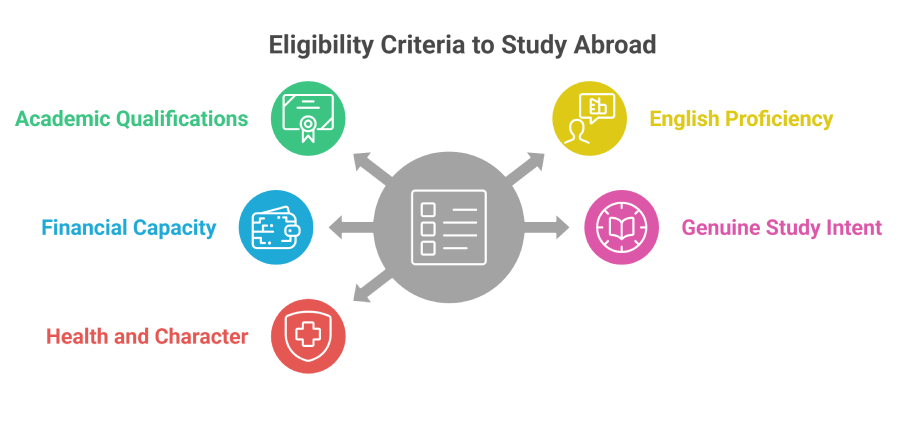
- Academic qualifications: Grades from your previous level of education that meet your target course's minimum requirement.
- English language proficiency: A minimum score on IELTS, PTE, or TOEFL, unless you're a native speaker or studied previously in English.
- Financial capacity: Proof you can cover tuition and living costs for at least your first year.
- Genuine study intent: Evidence your course choice aligns with your background and goals, assessed differently by country.
- Health and character requirements: A clean police record and, in some cases, a medical exam.
Document Checklist to Study Abroad
Most study abroad visa applications ask for proof of admission, financial evidence, English test results, and identity documents. Having these ready in advance makes your application faster and reduces the chance of delays.
- Valid passport
- Letter of offer or acceptance from your institution
- Confirmation of enrolment (CoE) or equivalent
- English language test results (IELTS, PTE, TOEFL, or equivalent)
- Proof of funds (GIC, blocked account, or bank statements, depending on destination)
- Health insurance (OSHC, or destination-specific equivalent)
- Statement of purpose or study intent responses
- Academic transcripts and certificates
- Passport-sized photographs
*Need help with your Letters of Recommendation? Avail Y-Axis expert support to get it right.
How to Get a Student Visa to Study Abroad?
Getting a student visa involves six main steps for most countries, from confirming your enrolment to receiving your final decision. Exact requirements and processing times vary by destination, so it helps to know what to expect before you apply.
Step 1: Confirmation of Enrolment
Accept your offer from a recognised institution and receive your confirmation of enrolment.
Step 2: English Language Test
Take an accepted test like IELTS, PTE, or TOEFL and meet your course's minimum score.
Step 3: Study Intent Requirement
Complete your destination country's study intent assessment, showing your course fits your goals.
Step 4: Submit Your Visa Application
Gather your enrolment, financial, and health insurance documents, then apply through the immigration portal.
Step 5: Health and Character Checks
Complete any required medical exam and provide police clearance if requested.
Step 6: Visa Decision
Receive your visa outcome, including work rights and course validity dates.
Popular Courses to Study Abroad
The most popular courses for international students are MBA, Master of Science (MS), Engineering, Computer Science, and Arts and Humanities. Business and STEM programs are especially in demand due to strong job prospects and clear post-study work pathways in major destinations like the USA, Germany, UK, Canada, Japan and Australia.
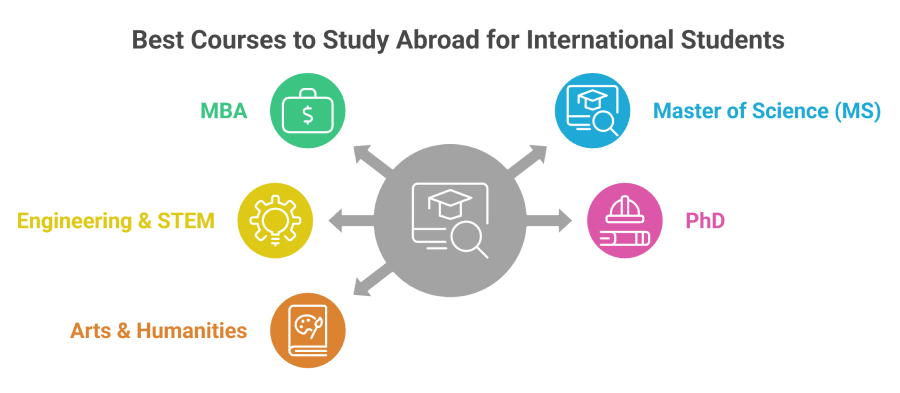
- MBA: Builds leadership and business skills, typically requiring 2-5 years of prior work experience and standardized test scores like the GMAT or GRE.
- Master of Science (MS): Ideal for specializing further in a technical or scientific field after your undergraduate degree.
- Engineering & STEM: The most sought-after fields for international students, with strong job market demand across nearly every major destination.
- PhD: Suited for research-focused careers, often with funded positions, stipends, and reduced or waived tuition.
- Arts & Humanities: A strong option for literature, history, design, and social sciences, with growing demand in creative and policy-related careers.
*Confused which course to study abroad? Avail Y-Axis Course Recommendation service to find the right course for you.
Study Abroad Application Deadlines
Applying 6 to 8 months before your intake gives you enough time to complete English tests, finish visa processing, and secure your preferred course. Intake schedules vary by country, and missing the window for your target intake often means waiting several months, or up to a year, for the next one.
|
Country |
Main Intake |
Secondary Intake |
|
Australia |
February, July |
November (select universities) |
|
Canada |
September |
January |
|
UK |
September |
January |
|
USA |
August/September |
January |
|
Germany |
October (Winter) |
April (Summer) |
|
Japan |
April |
January |
English Language Test Requirements
Most study abroad destinations require proof of English proficiency through a standardized test, and the required score depends on your course and university.
- IELTS: The most widely accepted test across Australia, Canada, the UK, and the USA.
- PTE Academic: Accepted by most Australian and UK universities, with fast turnaround on results.
- TOEFL iBT: Widely accepted across the USA and many other destinations.
- OET: Designed specifically for healthcare professionals, accepted for nursing and medical courses.
- CELPIP: Accepted for Canadian study and immigration pathways.
- Germany and Japan: Many English-taught programs accept IELTS, PTE, or TOEFL, though some universities waive this requirement depending on the course.
Post-Study Work Opportunities after Studying Abroad
Post-study work rights let graduates stay in their destination country after finishing their course, gaining real international work experience before deciding on their next step, whether that's returning home, pursuing further study, or applying for permanent residency. Duration and eligibility vary significantly by country.
- Australia: 2 to 4 years through the Temporary Graduate visa.
- Canada: Up to 3 years through the Post-Graduation Work Permit, with a pathway to permanent residency through Express Entry.
- UK: Currently 2 years through the Graduate Route, reducing to 18 months for applications submitted from January 2027.
- USA: 12 months through Optional Practical Training (OPT), extended to 36 months for STEM graduates.
- Germany: 18 months through the Job Seeker Visa to find skilled employment.
- Japan: Up to 1 year through the Designated Activities (job-seeking) visa, after which graduates switch to a standard work visa.
Cost of Living to Study Abroad
Living costs vary significantly by country and city, and each destination sets its own minimum you'll need to prove before your visa is approved, separate from tuition fees. This is typically shown through bank statements, education loans, or dedicated accounts like Canada's GIC or Germany's blocked account.
|
Country |
Estimated Living Cost |
|
Australia |
AUD 28,000–30,000 per year |
|
Canada |
CAD 20,000–23,000 per year |
|
UK |
GBP 1,100–1,550 per month |
|
USA |
USD 10,000–25,000 per year |
|
Germany |
€11,000–12,000 per year (blocked account) |
|
Japan |
¥800,000–1,200,000 per year |
Top Scholarships for International Students to Study Abroad
Several government-funded scholarships offer full or partial funding for international students each year, covering everything from monthly living stipends to full tuition, airfare, and health insurance. Eligibility, amounts, and application deadlines vary widely by program, so it's worth applying to more than one if you meet the criteria.
|
Scholarship |
Amount |
Award |
|
Chevening Scholarship |
£1,378–£1,690/month |
Full tuition, living stipend, airfare |
|
Fulbright Foreign Student Program |
Varies by program |
Tuition, travel, living expenses |
|
Australia Awards |
Fully funded |
Tuition, living costs, travel |
|
DAAD Scholarships |
€861–€1,400/month |
Stipend, health insurance, tuition waiver |
|
Vanier Canada Graduate Scholarships |
CAD 50,000/year |
Doctoral funding, up to 3 years |
How Can Y-Axis Help You?
Y-Axis Australia is a MARA and CICC accredited Registered Migration Agency based in Melbourne and Sydney, with 50+ offices worldwide and over 1 million successful applicants supported since 1999.
Here's how Y-Axis supports you at each stage:
- Free Counselling: Get personalized guidance on countries, courses, and universities based on your goals.
- Application Support: Get help preparing your SOP, transcripts, CV, and university applications, reviewed before submission.
- Test Preparation: Coaching for IELTS, TOEFL, PTE, GMAT, and GRE to help you meet entry requirements.
- Visa Guidance: Get support aligning your application with current visa rules, plus guidance on scholarships and financial aid.
- Pre-Departure Support: Practical guidance on accommodation, foreign exchange, and settling in before you travel.
*Sign up with Y-Axis to know more about study abroad consultancy!
Our Accreditations



.webp)
Proud Sponsor of

.webp)


Frequently Asked Questions