


Don't know what to do ?.
Get Free Counseling
Last Updated: 29 September 2026
Schengen Visa from Australia: Eligibility, Fees & How to Apply
A Schengen visa from Australia gives you access to 29 European countries with a single application, for stays of up to 90 days in any 180-day period. Australian citizens can travel to Europe for short tourist or business trips visa-free. Foreign nationals living in Australia need to apply for a visa before travelling to any Schengen country.
Schengen Visa: Key Updates
- 12 million+ Schengen visa applications annually
- Over 51% of visas issued are multiple-entry
- Travel insurance and biometrics required
- Processing typically takes 15 calendar days
- Apply up to 6 months before you travel
- Covers tourism, business, and family visits
*Want to apply for Schengen Visa? Book a free consultation with Y-Axis to check your eligibility.
What is a Schengen Visa?
A Schengen visa is a short-stay travel permit for non-EU nationals, letting you cross between 29 European countries without separate border checks or approvals at each crossing. It's issued by the embassy or consulate of your main destination country, but once granted, it's valid for travel throughout the entire Schengen Area.
Types of Schengen Visa
There are four types of Schengen visa, and the right one depends on why and how long you're travelling. Type A covers airport transit only, Type B allows short land or sea transit, Type C is the most common, for stays up to 90 days, and Type D suits longer stays for work, study, or family reunification.
|
Type |
Purpose |
Duration |
Entry |
|
Type A |
Airport transit only |
Length of transit stay |
Not applicable |
|
Type B |
Land or sea transit |
Up to 5 days |
Single or double |
|
Type C |
Tourism, business, or family visits |
Up to 90 days in any 180-day period |
Single, double, or multiple |
|
Type D |
Work, study, or family reunification |
Long-term stay in issuing country |
Not applicable |
Who is Eligible for a Schengen Visa?
To qualify for a Schengen visa, you need a valid passport for at least 3 months beyond your trip, sufficient funds to cover your stay, a genuine travel purpose such as tourism or business, and proof of ties to your country of residence, such as employment or property.
- Recent bank statements, payslips, or a sponsor's financial guarantee
- A detailed travel itinerary matching your stated purpose
- A visa interview at your consulate or application centre
- Meeting basic health and security requirements
- A clean Schengen travel history
Schengen Visa Requirements
A Schengen visa application requires a completed form, recent photographs, valid travel insurance, proof of your employment or study status, and payment of the visa fee.
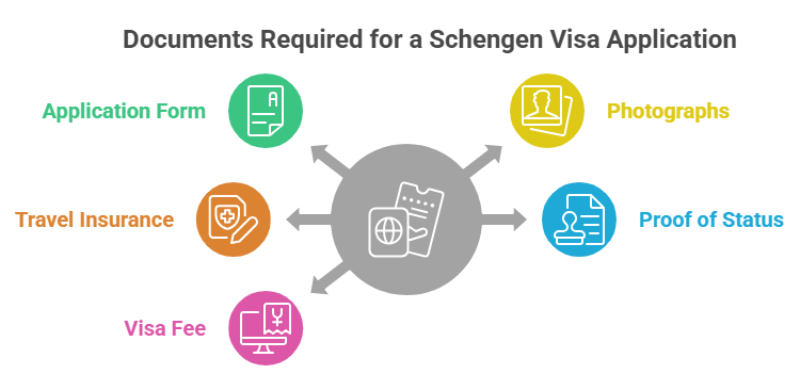
- Application form: Completed and signed, matching the details on your passport exactly
- Photographs: Two recent passport-sized photos: plain white background, no glasses or headwear (religious headwear excepted)
- Travel insurance: Minimum €30,000 coverage, valid for your entire trip across all Schengen countries, covering medical emergencies and repatriation
- Proof of employment or study: An employer's leave letter and employment contract, or an enrolment letter if you're a student
- Visa fee payment: Receipt or proof of payment, paid at your appointment or through the visa application centre
How to apply for a Schengen visa from Australia?
To apply for a Schengen visa from Australia, book an appointment with the consulate of your main destination country, gather your required documents, and attend in person to submit your application and biometrics.
Step 1: Check your eligibility
Confirm you meet the eligibility criteria before booking your appointment.
Step 2: Choose your consulate
Identify the consulate of the Schengen country that's your main destination, or your first point of entry if you're visiting multiple countries.
Step 3: Book your appointment
Schedule an appointment directly with the consulate or through their authorised visa application centre. Apply between 15 days and 6 months before your trip.
Step 4: Prepare your documents
Gather your passport, application form, photographs, travel insurance, proof of employment or study, and your visa fee payment.
Step 5: Attend your appointment
Submit your application and provide your fingerprints and photograph at the consulate or application centre.
Step 6: Wait for processing
Processing typically takes 15 calendar days, extending up to 45 days in individual cases.
Step 7: Collect your passport and travel
Collect your passport with the visa stamp, or receive it by mail, then travel to your chosen Schengen destination.
*Want to apply for a Schengen visa? Book a free consultation with Y-Axis for expert guidance.
Schengen Visa Cost
A Schengen visa costs €90 for adults, €45 for children aged 6-11, and is free for children under 6, set by the European Commission and applied the same way across all 29 Schengen countries. In addition to this fee, the visa application centre charges a separate service fee, typically €15-40.
|
Applicant Category |
Standard Visa Fee (Type C) |
|
Adult (12+ years) |
€90 |
|
Child (6-11 years) |
€45 |
|
Child (under 6 years) |
Free |
Schengen Visa Processing Time
A Schengen visa typically takes 15 calendar days to process from your appointment date, extending up to 45 days in individual cases.
- Standard processing: Around 15 calendar days
- Extended processing: Up to 45 days during peak seasons or further checks
- Apply 15 days to 6 months before your trip
Tips to Improve Your Chances for Schengen Visa Approval
A strong Schengen visa application has complete documentation, clear proof of funds, and a travel itinerary that matches your stated purpose.
- Apply 3-6 weeks before your trip
- Provide 3 months of bank statements showing consistent funds
- Match your itinerary to your visa type and stated purpose
- Add a short cover letter with your travel dates and purpose
- Show ties to Australia, such as employment or property, to demonstrate you'll return
*Want to book a Schengen visa appointment? Get expert guidance from Y-Axis professionals.
Schengen Visa Validity
A Schengen visa is typically valid for 90 days within any 180-day period, though multiple-entry visas can be issued for up to 1, 2, or 5 years depending on your travel history.
- Single-entry: One trip during the visa's validity
- Double-entry: Two separate trips during the visa's validity
- Multiple-entry: Unlimited trips during the visa's validity, typically issued once you've held 2-3 single or double-entry Schengen visas with a clean travel history
- You can stay up to 90 days total across all visits, within any 180-day period
Schengen Visa Insurance from Australia
A Schengen visa requires travel insurance with at least €30,000 coverage, valid across all Schengen countries for your entire trip.
- Minimum coverage: €30,000, covering medical emergencies and repatriation
- Must be valid for every day of your trip, including transit days
- Look for a policy that states it's Schengen visa compliant
List of Schengen Countries
A single Schengen visa lets you visit 29 European countries: Austria, Belgium, Bulgaria, Croatia, Czech Republic, Denmark, Estonia, Finland, France, Germany, Greece, Hungary, Iceland, Italy, Latvia, Liechtenstein, Lithuania, Luxembourg, Malta, Netherlands, Norway, Poland, Portugal, Romania, Slovakia, Slovenia, Spain, Sweden, and Switzerland.
Ireland and Cyprus are EU members but not part of the Schengen Area, so a Schengen visa doesn't cover travel to either country.
New Schengen Border Rules: EES vs ETIAS
The EES and ETIAS are two separate EU border systems, and they don't apply to every traveller the same way. The EES applies to everyone entering the Schengen Area, regardless of nationality or visa status. ETIAS only applies to visa-free travellers, such as Australian citizens. If you hold a Schengen visa, you don't need ETIAS.
Entry/Exit System (EES)
- Fully operational since April 2026 across all Schengen borders
- Records fingerprints and a photo on your first crossing; later trips are verified automatically
- Applies to all travellers, including both Australian citizens and Schengen visa holders
ETIAS (European Travel Information and Authorisation System)
- Expected to launch in late 2026
- Applies only to visa-free travellers, such as Australian citizens
- Not required if you hold a Schengen visa
- Applied for online before travel, costs around €20, valid for up to three years
How Can Y-Axis Help You?
Y-Axis is Australia's leading immigration consultancy, with over 25 years of experience helping thousands of applicants apply for a Schengen visa, from booking VFS Global appointments to preparing complete documentation.
- Visa Consultation: Assessing your eligibility and recommending the most suitable visa type
- Document Review: Preparing your documents to meet embassy requirements
- Application Assistance: Completing your application form and scheduling your appointment
- Visa Tracking: Giving you timely updates on your application status
*Want to travel to Europe? Sign up with Y-Axis to get started on your Schengen visa application.
Our Accreditations


.webp)
Proud Sponsor of

.webp)


Don't know what to do ?.
Get Free Counseling
Looking for Inspiration
Explore what Global Citizens have to say about Y-Axis in shaping their future
Frequently Asked Questions