

Posted on July 24 2026
Top 10 Countries for Doctors to Work Abroad: Salary, Demand & PR Opportunities Compared

By , Editor & Director
Updated July 24 2026
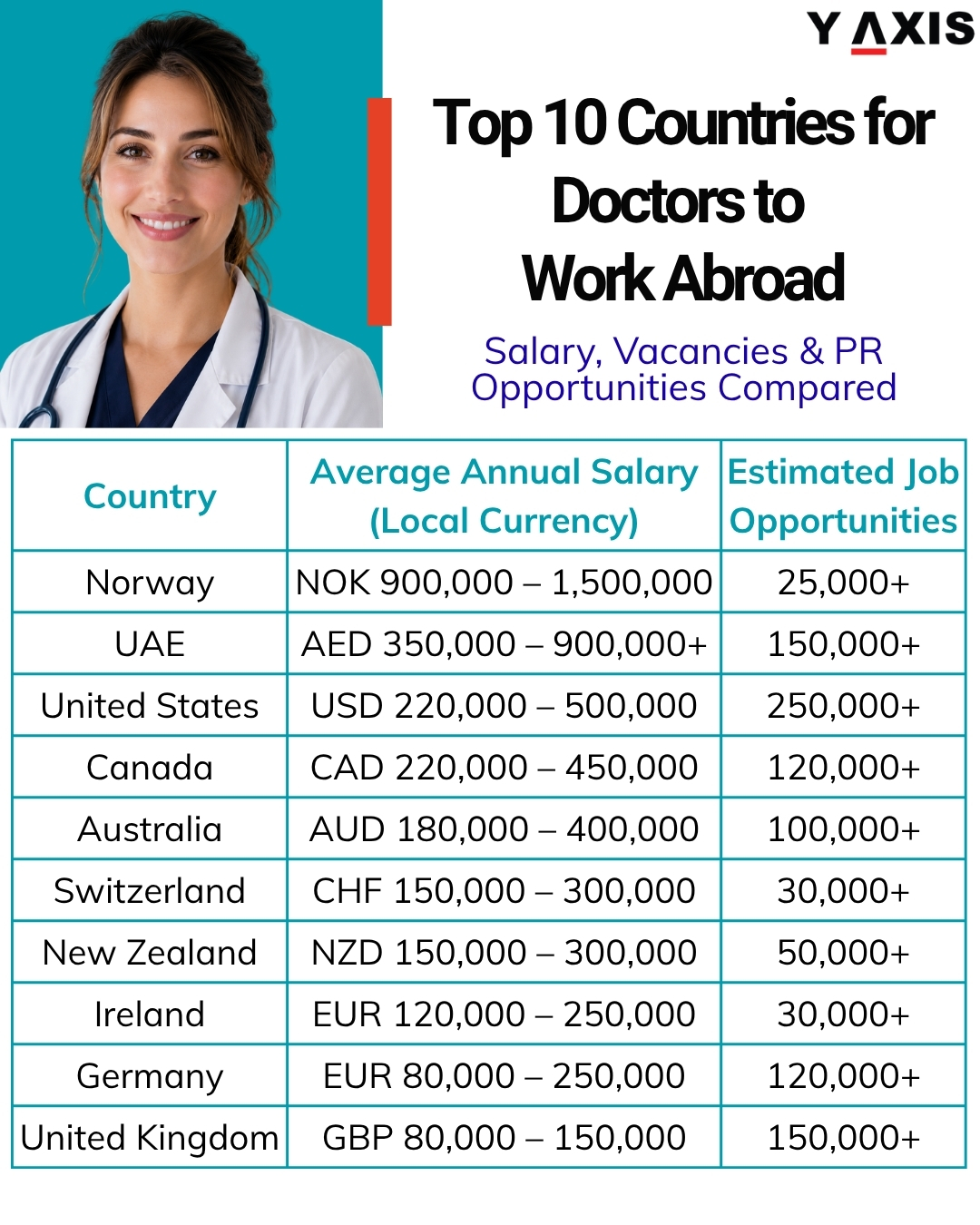
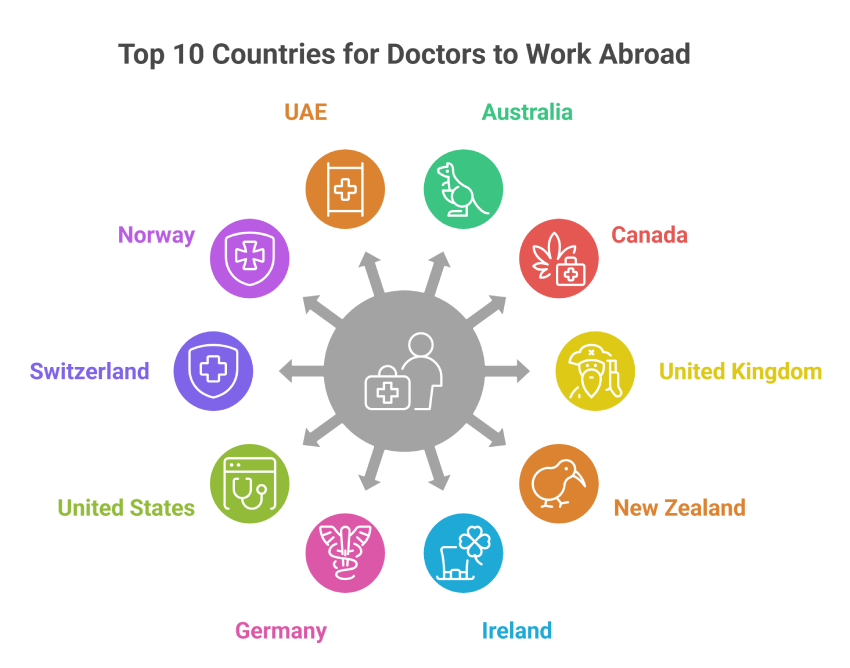
The top 10 countries for doctors to work abroad include Canada, New Zealand, the UK, Australia, the USA, Ireland, Germany, Switzerland, Norway, and the UAE. These countries combine competitive doctor salaries with demand across general practice and specialist medicine, opportunities for internationally trained doctors, and permanent residence pathways in several destinations.
Demand for doctors remains high across hospitals, primary care, emergency medicine, and specialist services. The World Health Organization projects a global shortage of 11 million health workers by 2030. General practitioners, psychiatrists, emergency physicians, anaesthetists, radiologists, and surgeons are the medical roles seeing the strongest demand, giving doctors more opportunities to work across international healthcare systems.
*Want to work abroad? Sign up with Y-Axis Resume Marketing Services to find right job faster.
Benefits of Working Abroad as a Doctor
Growing healthcare workforce needs are creating opportunities for doctors to build international careers across hospitals, primary care, specialist medicine, and underserved areas. Working abroad can provide better earning potential, broader clinical exposure, career progression, and long-term settlement opportunities.
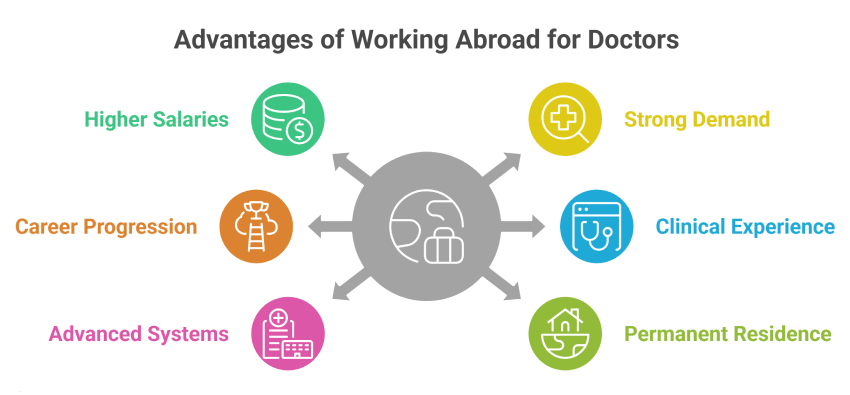
- Higher salaries and employment benefits
- Strong demand across medical specialties
- Specialist and consultant career progression
- International clinical experience
- Access to advanced healthcare systems
- Permanent residence opportunities in several countries
How to Choose the Right Country for Doctor Jobs Abroad?
The right country for doctor jobs abroad should match your medical specialty, salary expectations, registration eligibility, and long-term immigration plans. Comparing these factors before applying can help identify countries where your medical qualifications and career goals have the strongest fit.
- Medical registration: Qualification recognition, licensing exams, and registration process.
- Salary: Doctor pay, taxes, benefits, and living costs.
- Specialty demand: Job availability for your medical specialty.
- Work visa: Visa eligibility and employer sponsorship options.
- PR pathway: Eligibility and route to permanent residence.
- Career growth: Specialist training and senior medical roles.
Top 10 Countries for Doctors to Work Abroad
Doctors have strong job opportunities abroad across general practice, hospital medicine, emergency care, and specialist services, with annual salaries ranging from around AUD 100,000 to more than AUD 400,000. Countries such as New Zealand, Canada, the UK, and Germany continue to recruit internationally trained doctors to meet healthcare workforce needs. General practitioners, psychiatrists, emergency physicians, anaesthetists, radiologists, and surgeons are among the medical roles in demand across public and private healthcare settings.
|
Country |
Average Annual Salary |
Estimated Doctor |
|
New Zealand |
NZD 150,000 – 300,000 |
50,000+ |
|
Canada |
CAD 220,000 – 450,000 |
120,000+ |
|
United Kingdom |
GBP 80,000 – 150,000 |
150,000+ |
|
United States |
USD 220,000 – 500,000 |
250,000+ |
|
Ireland |
EUR 120,000 – 250,000 |
30,000+ |
|
Germany |
EUR 80,000 – 250,000 |
120,000+ |
|
UAE |
AED 350,000 – 900,000+ |
150,000+ |
|
Australia |
AUD 180,000 – 400,000 |
100,000+ |
|
Switzerland |
CHF 150,000 – 300,000 |
30,000+ |
|
Norway |
NOK 900,000 – 1,500,000 |
25,000+ |
*Want to work abroad? Sign up with Y-Axis Resume Marketing Services to find right job faster.
Best Countries for Doctors to Work and Settle Abroad
Canada, New Zealand, Germany, Ireland, the UK, and Australia are among the strongest countries for doctors who want to work and settle abroad. These destinations combine demand for doctors with competitive salaries and pathways to permanent residence or long-term settlement. Opportunities are available across general practice, hospital medicine, emergency care, and specialist services, giving doctors options for both career progression and long-term residence abroad.
Doctor Jobs in New Zealand
New Zealand is one of the strongest options for overseas-trained doctors because international doctors already make up a large share of its medical workforce. General practice is a key area for recruitment, particularly in regional communities, alongside psychiatry, emergency medicine, anaesthetics, radiology, and other hospital specialties. Doctors can work in public hospitals, community practices, Māori health providers, and rural health services. The Medical Council of New Zealand manages registration through routes based on where a doctor trained and their clinical background. Medical roles also feature in New Zealand’s skilled residence system, giving doctors a practical route from overseas recruitment to long-term residence.
|
Factor |
Details |
|
Doctor Job Market & Job Vacancies for the Next Decade |
New Zealand is expected to offer over 50,000 doctor job opportunities over the next decade, with demand across public hospitals, general practice, primary care, mental health services, and aged care. |
|
Investment in Healthcare Sector |
New Zealand is investing over $5.5 billion in digital health, hospital infrastructure, and healthcare workforce development. A further $14 billion is required for hospital upgrades over the next decade, alongside investment in AI and integrated healthcare systems. |
|
In-Demand Doctor Roles & Skills |
General practitioners (GPs), specialist doctors, and hospital doctors are among the key medical roles, with clinical care, diagnosis, patient assessment, treatment planning, and patient management among the core skills. |
|
Work Visa Options for Doctors |
Doctors can work in New Zealand through the Accredited Employer Work Visa (AEWV) and other employer-supported pathways available for medical employment. |
|
Fast-Track Hiring Options |
Doctor roles on the Green List can provide a faster route to residence through Straight to Residence or Work to Residence, based on the medical role. |
|
PR / Long-Term Residence Opportunities |
Doctors can pursue long-term settlement through the Green List and Skilled Migrant Category, which provide pathways to New Zealand residence. |
|
Licensing & Registration Requirements |
Registration with the Medical Council of New Zealand is mandatory before a doctor can practise medicine in New Zealand. |
|
Language Requirements |
Doctors must meet the Medical Council of New Zealand’s English language requirements through an accepted English test or recognised medical training pathway. |
|
Eligibility for Dependents |
Spouses and dependent children can accompany doctors to New Zealand through the family visa options connected to the main applicant’s visa. |
|
Benefits for Family Members |
Family members can receive spouse work rights, access to public education for children, and public healthcare access based on the visa held and New Zealand’s applicable rules. |
Doctor Jobs in Canada
Family medicine is at the centre of doctor recruitment in Canada. Family physicians provide primary care across communities, while psychiatry, anaesthesiology, emergency medicine, radiology, surgery, and other specialties provide additional routes into hospital and specialist practice. The process for working as a doctor is province-specific rather than controlled through one national licence. International medical graduates may enter through residency or practice-ready assessment, depending on their medical training and previous practice. Canada has also created immigration measures specifically for physicians and healthcare occupations in Express Entry draws, alongside Provincial Nominee Program routes. This combination makes Canada particularly useful for doctors looking for primary-care or specialist work with a pathway to permanent residence.
|
Factor |
Details |
|
Doctor Job Market & Job Vacancies for the Next Decade |
Canada is expected to offer over 120,000 doctor job opportunities over the next decade, with demand across hospitals, family practices, long-term care facilities, and community healthcare services throughout the country. |
|
Investment in Healthcare Sector |
Canada is investing up to $14.3 million to address healthcare labour shortages and nearly $200 billion over 10 years to strengthen the healthcare system, supporting medical services across hospitals, primary care, and community healthcare. |
|
In-Demand Doctor Roles & Skills |
Family physicians, general practitioners, specialist doctors, and hospital doctors are among the key roles, with clinical assessment, diagnosis, treatment planning, patient management, and specialised medical care among the important skills. |
|
Work Visa Options for Doctors |
Doctors can work in Canada through employer-specific work permits and immigration pathways connected to Express Entry and Provincial Nominee Programs (PNPs). |
|
Fast-Track Hiring Options |
Category-based Express Entry draws, provincial healthcare streams, and priority healthcare recruitment pathways can provide faster immigration options for doctors and other healthcare occupations. |
|
PR / Long-Term Residence Opportunities |
Doctors can pursue Canadian permanent residence through Express Entry and Provincial Nominee Programs (PNPs), including immigration pathways that prioritise healthcare occupations. |
|
Licensing & Registration Requirements |
Doctors must obtain registration from the provincial medical regulatory authority, such as the College of Physicians and Surgeons in the province where they intend to practise. |
|
Language Requirements |
Doctors must demonstrate English or French language proficiency through the language requirements accepted for medical licensing and immigration. |
|
Eligibility for Dependents |
Spouses and dependent children can accompany doctors to Canada through the family immigration provisions connected to the main applicant’s status. |
|
Benefits for Family Members |
Family members can access spouse work rights, public healthcare, and public education for children according to their immigration status and provincial requirements. |
*Want to Work in Canada? Let Y-Axis guide you through the application process.
Doctor Jobs in the UK
The NHS makes the UK one of the most established destinations for doctors moving abroad. International doctors work throughout NHS hospitals and GP services in psychiatry, emergency medicine, general practice, anaesthetics, internal medicine, radiology, surgery, and numerous other specialties. The route into clinical work starts with General Medical Council registration, followed by employment at the appropriate grade based on training and experience. Doctors can develop from hospital or specialty posts into specialist and consultant careers without being limited to one type of healthcare setting. The Skilled Worker route also allows overseas doctors to build towards Indefinite Leave to Remain while continuing their medical careers in the UK.
|
Factor |
Details |
|
Doctor Job Market & Job Vacancies for the Next Decade |
The UK is expected to offer over 150,000 doctor job opportunities over the next decade, with recruitment across NHS hospitals, GP practices, community health services, mental health services, and private healthcare providers. |
|
Investment in Healthcare Sector |
The UK invests over £200 billion annually in the NHS, funding hospital services, community healthcare, workforce expansion, medical technology, and digital health initiatives that support the delivery of healthcare across the country. |
|
In-Demand Doctor Roles & Skills |
General practitioners (GPs), specialist doctors, and hospital doctors are key medical roles, with clinical assessment, diagnosis, treatment planning, patient management, and specialist care among the important skills. |
|
Work Visa Options for Doctors |
Doctors can explore the Health and Care Worker Visa, Skilled Worker Visa, Global Talent Visa, Scale-Up Visa, and UK employer-sponsored work routes based on the type of medical employment. |
|
Fast-Track Hiring Options |
The Health and Care Worker Visa provides a dedicated immigration route for doctors and other healthcare workers, with priority processing and reduced visa fees for applications under this route. |
|
PR / Long-Term Residence Opportunities |
Doctors can progress to Indefinite Leave to Remain (ILR) after completing the required period of continuous residence under a qualifying UK immigration route. |
|
Licensing & Registration Requirements |
Registration with the General Medical Council (GMC) is mandatory before a doctor can practise medicine in the UK. |
|
Language Requirements |
Doctors must demonstrate English language proficiency through an accepted route, including approved tests such as IELTS or recognised UK qualifications. |
|
Eligibility for Dependents |
Spouses and dependent children can accompany doctors to the UK under the dependant provisions of the doctor’s visa route. |
|
Benefits for Family Members |
Family members can access spouse work rights, public education for children, and NHS healthcare according to the conditions of their UK immigration status. |
*Want to Work in the UK? Let Y-Axis guide you through the steps.
Doctor Jobs in the USA
The USA is a leading choice for doctors who want access to residency training, fellowships, and highly specialised areas of medicine. International medical graduates can pursue family medicine, internal medicine, psychiatry, emergency medicine, paediatrics, anaesthesiology, radiology, surgery, and numerous subspecialties. The usual route begins with ECFMG certification and USMLE requirements before progressing into an accredited residency program. Doctors can then continue into independent practice or undertake fellowship training in fields such as cardiology, oncology, gastroenterology, or critical care. Large teaching hospitals, academic medical centres, private practices, and research institutions give doctors several different environments in which to develop a medical career.
|
Factor |
Details |
|
Doctor Job Market & Job Vacancies for the Next Decade |
The United States is expected to offer over 250,000 doctor job opportunities over the next decade, across large hospital systems, physician practices, outpatient centres, academic medical centres, and specialised healthcare facilities. |
|
Investment in Healthcare Sector |
US healthcare spending is expected to exceed $5 trillion by the early 2030s, alongside expanding investment in AI, digital healthcare, value-based care, preventive medicine, telehealth, remote monitoring, and data-driven healthcare models that are reshaping medical care and physician practice. |
|
In-Demand Doctor Roles & Skills |
Primary care physicians, specialist doctors, surgeons, and hospital doctors are important across the US healthcare system. Clinical diagnosis, treatment planning, patient management, specialist care, and evidence-based medical decision-making are key skills. |
|
Work Visa Options for Doctors |
International doctors can use routes such as the H-1B Visa, O-1 Visa, and employer-sponsored immigration pathways for medical employment in the United States after completing the requirements for clinical practice. |
|
Fast-Track Hiring Options |
H-1B sponsorship and employment-based immigration routes support US healthcare employers recruiting international doctors, while specific physician immigration provisions can support doctors working in designated shortage areas. |
|
PR / Long-Term Residence Opportunities |
Doctors can pursue permanent residence through employment-based Green Card routes, including EB-2 and EB-3, with additional immigration provisions available for certain physician roles and service arrangements. |
|
Licensing & Registration Requirements |
Doctors must obtain a medical licence from the state where they intend to practise and complete the required medical education, examinations, residency, and certification requirements for their route into US clinical practice. |
|
Language Requirements |
International doctors must demonstrate the English-language ability required for medical training, certification, licensing, and patient communication in the United States. |
|
Eligibility for Dependents |
Spouses and dependent children can accompany doctors under the dependent visa category linked to the primary applicant’s US visa status. |
|
Benefits for Family Members |
Dependents can receive residence and education benefits, while spouse work rights depend on the visa category and employment-authorisation requirements. |
Doctor Jobs in Ireland
Ireland is a practical European option for doctors who want to work in an English-speaking hospital system. International doctors have a strong presence across Irish hospitals, particularly in general medicine, emergency medicine, psychiatry, anaesthetics, paediatrics, surgery, and other clinical specialties. Many overseas doctors enter through non-consultant hospital doctor roles and can later move through specialist training or towards consultant practice. General practice provides another route outside hospital medicine. Registration with the Medical Council is required before clinical work begins, while Ireland’s employment permit and residence systems allow doctors to continue living and working in the country as their medical careers develop.
|
Factor |
Details |
|
Doctor Job Market & Job Vacancies for the Next Decade |
Ireland is expected to offer over 30,000 doctor job opportunities over the next decade, across public hospitals, general practice, primary care, community health services, and aged care. |
|
Investment in Healthcare Sector |
Ireland is making its largest-ever healthcare investment, with €9.25 billion under the National Development Plan and a record €27.4 billion health budget. Investment covers new hospital capacity, digital health, community care, healthcare infrastructure, and workforce expansion across the Irish health system. |
|
In-Demand Doctor Roles & Skills |
General practitioners (GPs), specialist doctors, and hospital doctors are important across Ireland’s health service. Clinical assessment, diagnosis, treatment planning, patient management, and specialist medical care are key skills for these roles. |
|
Work Visa Options for Doctors |
Doctors can work in Ireland through the Critical Skills Employment Permit, General Employment Permit, and employer-sponsored work permit routes available for medical employment. |
|
Fast-Track Hiring Options |
The Critical Skills Employment Permit provides a streamlined employment route for doctors in occupations covered by Ireland’s Critical Skills Occupations List. |
|
PR / Long-Term Residence Opportunities |
Doctors can progress to Stamp 4 after completing the required period under the applicable employment permit route, allowing them to live and work in Ireland without an employment permit. |
|
Licensing & Registration Requirements |
Registration with the Medical Council of Ireland is mandatory before a doctor can practise medicine in Ireland. |
|
Language Requirements |
Doctors must demonstrate English language proficiency through the tests or recognised qualifications accepted by the Medical Council of Ireland for medical registration. |
|
Eligibility for Dependents |
Spouses and dependent children can join doctors in Ireland through the family reunification provisions connected to the main applicant’s immigration permission. |
|
Benefits for Family Members |
Family members can access spouse work rights, public education for children, and healthcare services according to their immigration permission and Ireland’s applicable rules. |
Doctor Jobs in Germany
Germany has built a substantial international doctor workforce, with foreign-trained physicians working across hospitals throughout the country. Internal medicine is a major area of hospital practice, alongside surgery, anaesthesiology, psychiatry, neurology, and general medicine. Regional hospitals and smaller cities provide an important part of the employment market, rather than opportunities being concentrated only in Berlin, Munich, or other major centres. The route into practice is centred on recognition of the medical degree and obtaining an Approbation licence. German is also necessary for clinical communication. Doctors who complete the recognition and licensing process can work across university hospitals, regional hospitals, specialist clinics, and medical practices.
|
Factor |
Details |
|
Doctor Job Market & Job Vacancies for the Next Decade |
Germany is expected to offer over 120,000 doctor job opportunities over the next decade, particularly across hospitals, general medical practices, elderly care services, and specialised medical facilities. |
|
Investment in Healthcare Sector |
Germany’s healthcare spending exceeds €538 billion, alongside a €50 billion Hospital Transformation Fund to modernise hospitals by 2030. Investment in hospital infrastructure, digital health, AI, telemedicine, and healthcare workforce expansion is supporting the continued development of medical services across the country. |
|
In-Demand Doctor Roles & Skills |
General practitioners (GPs), specialist doctors, and hospital doctors are in demand across Germany. Clinical diagnosis, patient assessment, treatment planning, patient management, and specialised medical care are important skills for medical practice. |
|
Work Visa Options for Doctors |
Doctors can work in Germany through routes including the EU Blue Card, Skilled Worker Visa, and employer-sponsored work visas for medical employment. |
|
Fast-Track Hiring Options |
The Accelerated Skilled Worker Procedure (ASPV) can speed up qualification recognition and visa procedures when initiated by a German employer for a doctor recruited from abroad. |
|
PR / Long-Term Residence Opportunities |
Doctors can progress to permanent residence in Germany after completing the required residence period and meeting the applicable German language and immigration requirements. |
|
Licensing & Registration Requirements |
Doctors trained abroad must complete qualification recognition (Anerkennung) and obtain the required medical licence before practising. The State Medical Association (Ärztekammer) oversees professional medical matters within the relevant German state. |
|
Language Requirements |
Doctors generally need German language proficiency at B1–B2 level, together with the medical language proficiency required for clinical practice and patient communication. |
|
Eligibility for Dependents |
Spouses and dependent children can join doctors in Germany through the family reunification provisions connected to the main applicant’s residence status. |
|
Benefits for Family Members |
Family members can access spouse work rights, public education for children, and Germany’s healthcare system according to their residence status and applicable rules. |
Doctor Jobs in the UAE
Dubai and Abu Dhabi have developed into major healthcare centres where international doctors work across private hospitals, specialist clinics, and government health facilities. The UAE market is particularly strong for specialist and consultant doctors in cardiology, orthopaedics, dermatology, radiology, surgery, anaesthesiology, emergency medicine, and other specialist services. Large private hospital groups and specialist medical centres account for a significant part of doctor employment, giving the UAE a different market from countries dominated by public healthcare. Licensing depends on where the doctor intends to practise, with separate health authorities covering different emirates. Doctors and medical specialists can also access long-term residence through the UAE Golden Visa.
|
Factor |
Details |
|
Doctor Job Market & Job Vacancies for the Next Decade |
The UAE is expected to offer over 150,000 doctor job opportunities over the next decade, supported by continued expansion of hospitals, private clinics, specialist medical centres, and healthcare services across the country. |
|
Investment in Healthcare Sector |
The UAE healthcare market is projected to exceed $50 billion by 2029, with investment expanding across digital health, AI, personalised medicine, medical tourism, and specialised healthcare services as the country develops its healthcare sector toward 2030. |
|
In-Demand Doctor Roles & Skills |
General practitioners, specialist doctors, and hospital doctors are among the main medical roles, with clinical assessment, diagnosis, patient management, treatment planning, and specialised medical care among the key skills. |
|
Work Visa Options for Doctors |
Doctors can work and reside in the UAE through an employer-sponsored UAE Work Visa, while the Green Visa and Golden Visa provide additional residence options under their respective requirements. |
|
Fast-Track Hiring Options |
The UAE Work Visa supports employer-sponsored recruitment of doctors for healthcare roles, with employers handling the work permit and residence process for recruited medical staff. |
|
PR / Long-Term Residence Opportunities |
The UAE does not operate a traditional permanent residence system. Doctors can secure long-term residence through the Golden Visa or continue residing in the country through renewable employment-based residence visas. |
|
Licensing & Registration Requirements |
Doctors must obtain professional licensing from the Dubai Health Authority (DHA), Department of Health – Abu Dhabi (formerly HAAD), or Ministry of Health and Prevention (MOHAP), based on the emirate where they intend to practise. |
|
Language Requirements |
English proficiency is required for medical practice and patient communication, while Arabic is beneficial but not mandatory for many doctor roles. |
|
Eligibility for Dependents |
Doctors can sponsor their spouse and dependent children to live with them in the UAE under the applicable family residence rules. |
|
Benefits for Family Members |
Family members can receive residence sponsorship and access to private education and healthcare, with long-term residence options available through the main applicant’s residence status. |
Doctor Jobs in Australia
Regional medicine is a major source of doctor jobs in Australia, especially for general practitioners and rural generalists working outside the largest cities. Public hospitals also employ psychiatrists, emergency physicians, anaesthetists, radiologists, surgeons, and other specialists across metropolitan and regional health services. Overseas-trained doctors have several routes into Australian practice, including pathways for general registration and specialist recognition through the Medical Board of Australia and Ahpra. Location can also influence both employment and migration options, particularly for doctors taking positions in regional areas. Employer-sponsored and skilled migration routes provide pathways to permanent residence, making Australia a strong option for doctors planning to remain long term.
|
Factor |
Details |
|
Doctor Job Market & Job Vacancies for the Next Decade |
Australia is expected to offer over 100,000 doctor job opportunities over the next decade, with demand across public and private hospitals, general practices, regional healthcare services, and aged care facilities. |
|
Investment in Healthcare Sector |
Australia is making record healthcare investments, with funding rising to $140 billion and $537 billion committed over four years. This funding supports Medicare, public hospitals, digital health, medical research, aged care, and healthcare workforce development across the country. |
|
In-Demand Doctor Roles & Skills |
General practitioners (GPs), specialist doctors, and hospital doctors are among the key medical roles. Clinical assessment, diagnosis, treatment planning, patient management, specialised care, and rehabilitation are important skills across these roles. |
|
Work Visa Options for Doctors |
Doctors can access the Skills in Demand Visa (Subclass 482), Skilled Independent Visa (Subclass 189), Skilled Nominated Visa (Subclass 190), Employer Nomination Scheme (Subclass 186), and Skilled Work Regional Visa (Subclass 491). |
|
Fast-Track Hiring Options |
Employer-sponsored visas and state or territory nomination pathways support the recruitment of doctors, particularly for healthcare roles in regional areas and locations with medical workforce needs. |
|
PR / Long-Term Residence Opportunities |
Doctors can pursue permanent residence through points-based pathways (Subclass 189 and 190), employer-sponsored PR (Subclass 186), and the regional Subclass 491 pathway leading to PR. |
|
Licensing & Registration Requirements |
Registration with the Australian Health Practitioner Regulation Agency (AHPRA) is mandatory before a doctor can practise medicine in Australia. |
|
Language Requirements |
Doctors must demonstrate English language proficiency, typically through IELTS or another approved English language test accepted for medical registration. |
|
Eligibility for Dependents |
Spouses and dependent children can be included in the doctor’s Australian visa application under the conditions of the selected visa subclass. |
|
Benefits for Family Members |
Family members can receive spouse work rights, access to public education, and Medicare access, based on the conditions and entitlements attached to the visa held. |
Doctor Jobs in Switzerland
Switzerland is primarily attractive to doctors seeking specialist hospital and private medical practice within a highly developed European healthcare system. Careers are available across internal medicine, cardiology, psychiatry, radiology, anaesthesiology, surgery, and other specialties in university hospitals, cantonal hospitals, and private clinics. Where a doctor trained matters significantly because medical degree recognition determines the route into Swiss practice. Language is equally important: German is used across much of the country, while French and Italian are required in their respective regions. For doctors entering the Swiss system, the combination of recognised medical training and the language of the canton determines where they can practise.
|
Factor |
Details |
|
Doctor Job Market & Job Vacancies for the Next Decade |
Switzerland is expected to offer over 30,000 doctor job opportunities over the next decade, across hospitals, specialist clinics, medical practices, and regional healthcare services. |
|
Investment in Healthcare Sector |
Switzerland’s healthcare expenditure is projected to reach CHF 109.6 billion by 2027. The Health2030 Strategy supports investment through 2030 in digital healthcare, medical technologies, health data, healthcare quality, and the continued development of the Swiss healthcare system. |
|
In-Demand Doctor Roles & Skills |
General practitioners (GPs), specialist doctors, and hospital doctors have opportunities across the Swiss healthcare system. Clinical assessment, diagnosis, patient management, treatment planning, and specialised medical care are important skills for these roles. |
|
Work Visa Options for Doctors |
Doctors can work in Switzerland through the L Permit, B Permit, and employer-sponsored Swiss work permits, with the applicable route determined by the employment arrangement and residence period. |
|
Fast-Track Hiring Options |
Employer-led recruitment and cantonal work permit processing support the hiring of doctors for positions in hospitals, clinics, and other healthcare facilities across Switzerland. |
|
PR / Long-Term Residence Opportunities |
The C Permit (settlement permit) provides a route to permanent residence after completing the required period of residence in Switzerland. |
|
Licensing & Registration Requirements |
Doctors must complete medical qualification recognition or registration through MEBEKO and obtain the required entry in the MedReg register before practising medicine in Switzerland. |
|
Language Requirements |
Doctors need proficiency in German, French, or Italian, based on the canton and the language used for patient care and medical practice. |
|
Eligibility for Dependents |
Spouses and dependent children can join doctors in Switzerland through the country’s family reunification provisions. |
|
Benefits for Family Members |
Family members can access education and healthcare services, while spouse work rights are determined by the residence permit and applicable Swiss rules. |
Doctor Jobs in Norway
Primary care in Norway is organised heavily around municipalities, which makes general practice an important route for doctors entering the country’s healthcare system. Doctors also work in public hospitals across psychiatry, internal medicine, surgery, anaesthetics, radiology, and other specialist departments. Medical employment is spread across regional health services and smaller communities as well as Oslo and other larger cities. International doctors need Norwegian authorisation before practising, while Norwegian language skills are necessary for patient-facing medical work. Norway therefore offers a distinctive doctor market centred on public healthcare, municipal general practice, regional hospitals, and specialist services rather than a large private healthcare sector.
|
Factor |
Details |
|
Doctor Job Market & Job Vacancies for the Next Decade |
Norway is expected to offer over 25,000 doctor job opportunities over the next decade, with demand across public hospitals, general practice, specialist healthcare services, and rural and regional healthcare. |
|
Investment in Healthcare Sector |
Norway is investing NOK 500 billion in healthcare services over the next 10 years, covering hospital development, digital health systems, healthcare technology, and improvements to medical services across the country. |
|
In-Demand Doctor Roles & Skills |
General practitioners (GPs), specialist doctors, and hospital doctors are among the main medical roles in Norway. Patient diagnosis, clinical treatment, medical decision-making, treatment planning, and patient management are important skills across these roles. |
|
Work Visa Options for Doctors |
Doctors can work in Norway through the Skilled Worker Residence Permit and employer-sponsored work permits after securing employment with a Norwegian healthcare organisation. |
|
Fast-Track Hiring Options |
Employer-led hiring and healthcare recruitment programmes support the recruitment of doctors for hospitals, general practice, specialist healthcare, and medical services across Norway. |
|
PR / Long-Term Residence Opportunities |
Doctors can apply for permanent residence in Norway after completing the required residence period and meeting the applicable employment and Norwegian language requirements. |
|
Licensing & Registration Requirements |
Doctors must obtain medical authorisation from the Norwegian Directorate of Health (Helsedirektoratet) before practising medicine in Norway. |
|
Language Requirements |
Doctors need Norwegian language proficiency for patient consultations, clinical documentation, communication with healthcare teams, and day-to-day medical practice. |
|
Eligibility for Dependents |
Spouses and dependent children can join doctors in Norway through the country’s family immigration routes. |
|
Benefits for Family Members |
Family members can access Norway’s education and healthcare systems, while spouse work rights are based on the conditions attached to the applicable residence permit. |
Job Outlook for Doctors over the Next Decade
The job outlook for doctors over the next decade remains strong, with continued demand across primary care, hospitals, emergency medicine, mental health, and specialist services. The World Health Organization projects a global shortage of 11 million health workers by 2030, highlighting the need for a larger medical workforce. Ageing populations, rising cases of chronic diseases, and wider access to medical care will increase the need for doctors. Growth in specialist treatment, new hospital capacity, telemedicine, digital health, and AI-assisted diagnostics will also create new opportunities and reshape how doctors diagnose, treat, and manage patients.
*Want to work abroad? Sign up with Y-Axis Resume Marketing Services to find right job faster.
FAQs
Which country is best for doctors to work abroad?
Australia, New Zealand, Canada, the UK, the USA, Ireland, Germany, the UAE, Switzerland, and Norway are leading destinations for doctors. Australia and New Zealand have strong GP and regional demand, the UK recruits extensively through the NHS, the USA has a large specialist market, while Canada continues to need family physicians and medical specialists.
Which countries pay doctors the highest salaries?
The USA, Switzerland, Canada, Australia, and the UAE are among the highest-paying destinations for doctors. Annual earnings can exceed AUD 400,000 in some senior and specialist positions. Surgeons, anaesthetists, radiologists, psychiatrists, and other specialist doctors generally command higher salaries than junior hospital doctors and many general medical roles.
Which countries have the highest demand for doctors?
Canada, the UK, Australia, New Zealand, Germany, Ireland, and Norway have significant demand for doctors. GPs and family physicians are particularly needed in primary and regional care, while psychiatrists, emergency physicians, anaesthetists, radiologists, and surgeons have opportunities across hospitals and specialist services.
Which countries recognise Australian medical qualifications?
New Zealand, the UK, Ireland, Canada, and several other destinations assess Australian medical degrees and training for registration. Doctors must still register with the destination’s medical authority, such as the Medical Council of New Zealand, UK General Medical Council (GMC), or Medical Council of Ireland, before practising.
Where can doctors find the most job opportunities abroad?
The USA, UK, Canada, Germany, Australia, and New Zealand have large markets for doctor employment. Jobs are available in public and private hospitals, GP practices, emergency departments, mental health services, specialist clinics, and regional healthcare, covering both general medicine and specialist practice.
Which medical specialties are most in demand abroad?
General practice, psychiatry, emergency medicine, anaesthetics, radiology, internal medicine, and surgery are among the most in-demand fields internationally. GPs are particularly important in primary and regional healthcare, while psychiatrists, emergency physicians, anaesthetists, radiologists, and surgeons are frequently required across hospital and specialist services.
Which countries offer doctor jobs with visa sponsorship?
The UK, Australia, New Zealand, Ireland, Germany, Canada, and the UAE recruit doctors through employer-supported immigration routes. Key options include the UK Health and Care Worker Visa, Australia Skills in Demand Visa (Subclass 482), New Zealand Accredited Employer Work Visa (AEWV), and Ireland Critical Skills Employment Permit.
Which countries offer permanent residence pathways for doctors?
Australia offers Subclass 189, 190 and 186 permanent residence pathways, Canada provides Express Entry and Provincial Nominee Programs (PNPs), and New Zealand provides Green List residence pathways. Germany and Ireland also provide routes from medical employment to permanent or long-term residence after completing their required residence periods.
Which country has the easiest medical licensing process for doctors?
New Zealand can provide a relatively straightforward registration route for doctors whose medical training and registration are recognised by the Medical Council of New Zealand. The UK also has defined GMC registration pathways for international doctors. The exact route is determined by the doctor’s medical degree, postgraduate training, registration history, and specialty.
Do doctors need to take licensing exams to work abroad?
Some countries require licensing examinations, while others provide registration routes based on recognised medical training. The USA uses the USMLE, while UK registration can involve PLAB for doctors using that route. Other countries may assess medical qualifications, postgraduate training, specialist credentials, language proficiency, and previous registration before granting permission to practise.
How can doctors get medical registration to work abroad?
Doctors first apply to the medical regulator in their destination, such as the GMC in the UK, AHPRA in Australia, Medical Council of New Zealand, or Medical Council of Ireland. Applications commonly require a medical degree, internship evidence, registration history, certificate of good standing, identity documents, clinical experience, and language evidence.
Can GPs work abroad?
Yes. GPs can work in Australia, New Zealand, Canada, the UK, Ireland, Norway, and other countries after completing the required medical registration. Opportunities are particularly strong across general practices, community health services, regional healthcare, primary care centres, and rural medical services.
Can specialist doctors practise their specialty overseas?
Yes. Surgeons, psychiatrists, anaesthetists, radiologists, emergency physicians, and other specialist doctors can practise abroad after their specialist training is recognised. The relevant medical or specialist authority assesses postgraduate training, fellowship credentials, clinical experience, registration history, and scope of practice before granting specialist recognition where required.
What qualifications are required to work abroad as a doctor?
Doctors normally need a recognised medical degree, completed internship or clinical training, medical registration, and certificate of good standing. Depending on the registration route, they may also need a licensing examination, specialist qualification, credential verification, language test, and evidence of recent clinical practice.
How much work experience do doctors need to work abroad?
Experience requirements vary by medical position. Doctors generally need to have completed their medical degree and required internship or postgraduate clinical training before independent medical practice. Specialist and consultant positions require completed specialist training and relevant clinical experience, while some hospital roles are available earlier in a doctor’s postgraduate career.
What documents are required for doctor jobs abroad?
Doctors commonly need a passport, medical degree, internship certificate, medical registration records, certificate of good standing, employment references, and clinical experience records. Specialist doctors may also need fellowship or specialist certificates. Language test results, credential verification, police clearance, medical examinations, and an employment contract may be required for registration or immigration.
How long does it take to get a medical licence to work abroad?
Medical registration can take several weeks to several months. The timeline includes primary-source verification of medical qualifications, registration checks, language requirements, examinations where applicable, specialist assessment, and final approval from the medical regulator. Applications requiring additional credential assessment or specialist recognition generally take longer.
Can doctors move abroad with their spouse and children?
Yes. Countries including Australia, New Zealand, Canada, the UK, Ireland, Germany, and the UAE allow doctors to bring spouses and dependent children under applicable family or dependant provisions. Spouses may receive work rights, while children can access schooling according to the immigration status and rules of the destination.
Which countries offer the best work-life balance for doctors?
New Zealand, Australia, Norway, and Switzerland are popular destinations for doctors seeking strong working conditions alongside career opportunities. New Zealand and Australia provide extensive options in general and regional medicine, while Norway has a predominantly public healthcare system. Actual working hours vary considerably between GPs, hospital doctors, surgeons, emergency physicians, and other specialties.
Is working abroad as a doctor worth it?
Working abroad can be worthwhile for doctors seeking higher salaries, specialist training, international clinical experience, or permanent residence. The USA and Switzerland stand out for earning potential, Australia and New Zealand for GP and regional opportunities, the UK for NHS careers, and Canada for family medicine and long-term immigration options.
Tags:
Doctors Abroad
Doctor Jobs Abroad
Overseas Doctor Jobs
International Medical Graduates
Doctor Salaries Abroad
Doctor Shortage
Medical Registration Abroad
Doctor Work Visas
PR for Doctors
International Doctor Careers
Share
Latest Article
Popular Post
Trending Article
Posted On September 15 2026
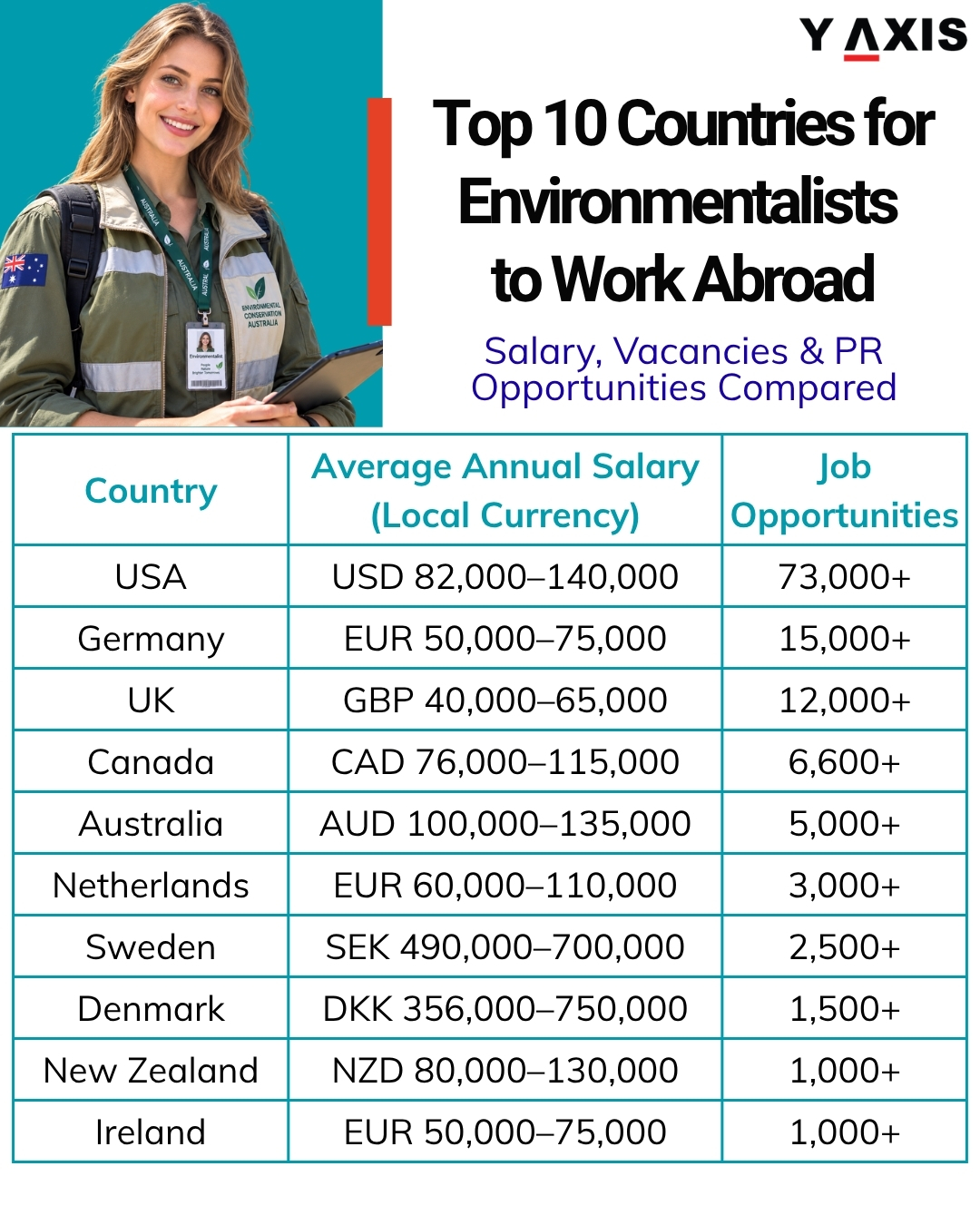
Top 10 Countries for Environmentalists to Work Abroad: Salary, Demand & PR Opportunities Compared