


Don't know what to do ?.
Get Free Counseling
Last Updated: April 2026
Subclass 186 Visa - Employer Nomination Scheme
If you are a skilled worker and an Australian employer is willing to sponsor you, the Subclass 186 visa is one of the most direct routes to permanent residency in Australia. Unlike temporary work visas, it grants permanent residence from the day it is approved. You can live anywhere in Australia, bring eligible family members, access Medicare, and eventually apply for Australian citizenship.
The Subclass 186 visa operates under the Employer Nomination Scheme (ENS). It is available through three separate streams depending on your current visa situation, work history with your employer, and how you were originally nominated. This page covers the requirements, fees, processing times, and application steps for all three streams, based on information current as of April 2026.
Why Choose the Subclass 186 Visa?
- Direct Australian PR: Gain permanent residency directly through employer nomination.
- Family Sponsorship: Bring eligible family members with you.
- Access Public Healthcare: Enjoy Australia’s healthcare benefits.
- Travel Flexibility: Enter and exit Australia freely for 5 years.
- Pathway to Citizenship: Eligible to apply for Australian citizenship after meeting residency requirements.
Looking to work and settle in Australia? Book your free consultationnow to start your journey!”
Subclass 186 Visa Streams: Choose the Right Pathway
The Subclass 186 Employer Nomination Scheme (ENS) visa offers skilled workers multiple pathways to live and work in Australia permanently. Depending on your current visa status, work experience, and employer arrangement, you can apply through one of three streams:
TRT Stream (Temporary Residence Transition)
Eligible Applicants:
Subclass 482 Skills in Demand (SID) visa or the older Subclass 457 visa, who have worked for the nominating employer in the same or substantially similar role for a minimum of 2 years within the 3 years before lodging the nomination.
Note: The Skills in Demand (SID) visa replaced the Temporary Skill Shortage (TSS) Subclass 482 from 7 December 2024. If you hold an older 482 TSS visa, you remain eligible for the TRT pathway. New applicants entering Australia on a temporary employer-sponsored visa from that date onward hold a SID visa.
Core Eligibility Criteria:
- Subclass 482 Skills in Demand (SID) or Subclass 457 visa, and have worked for the nominating employer in the same role for at least 2 years within the past 3 years.
- Complete the minimum work period with the nominating employer.
- Meet English language, health, and character requirements.
Employer Nomination Requirements:
- Employer must be a lawfully operating business in Australia.
- Offer a genuine full-time role for at least 2 years.
- Pay a salary that meets the Annual Market Salary Rate (AMSR).
- Cover the Skilling Australians Fund (SAF) levy and nomination charges.
Step-by-Step Process & Timeline:
- Preparation (1–3 weeks): Collect identity, employment, and employer documents.
- Nomination (1–2 weeks): Employer submits nomination with evidence of business operations and salary.
- Visa Application (1 week): Applicant lodges the visa application with health, police, and English documentation.
- Processing: Average 5–11 months, depending on complexity and priority.
Direct Entry Stream (DE)
Eligible Applicants:
Skilled workers inside or outside Australia with the required qualifications and a positive skills assessment in an eligible occupation.
Core Eligibility:
- Positive skills assessment (unless exempt).
- Minimum relevant work experience in the nominated occupation.
- Meet English language, health, and character requirements.
Employer Nomination Requirements:
- Offer a genuine full-time position for at least 2 years.
- Pay a salary meeting the Annual Market Salary Rate (AMSR).
- Cover the Skilling Australians Fund (SAF) levy and nomination charges.
Step-by-Step Process & Timeline:
- Skills & Eligibility (2–6 weeks): Obtain skills assessment and gather supporting evidence.
- Nomination (1–2 weeks): Employer lodges nomination with salary and business evidence.
- Visa Application (1 week): Applicant submits Subclass 186 DE visa application with supporting documents.
- Processing: Average 6–12 months, depending on occupation and priority.
Labour Agreement (LA) Stream
Eligible Applicants:
Workers nominated by employers under a Labour Agreement, including DAMA or other industry-specific agreements. Some concessions may apply for age, English proficiency, or occupation.
Core Eligibility:
- Must meet the conditions of the approved Labour Agreement.
- Occupation, English, and work experience requirements vary depending on the agreement.
Employer Nomination Requirements:
- Employer must hold an approved Labour Agreement.
- Provide a genuine full-time role.
- Salary must meet AMSR, unless a concession applies.
- Labour Market Testing may be required.
- Pay the SAF levy and nomination charges.
Step-by-Step Process & Timeline:
- Agreement Check (1–3 weeks): Verify employer’s Labour Agreement and applicable concessions.
- Nomination (1–2 weeks): Employer submits nomination under the agreement with supporting evidence.
- Visa Application (1 week): Applicant lodges the Subclass 186 LA visa application with required documents.
- Processing: Varies based on the agreement but generally similar to other streams.
| Feature | TRT | Direct Entry | Labour Agreement |
|---|---|---|---|
| Typical applicant | 482/457 visa holders with the same employer | Skilled workers in or outside Australia | Workers sponsored under a Labour Agreement |
| Occupation basis | Same as current 482/457 role | Must be on the eligible occupations list | Defined by the Labour Agreement |
| Skills assessment | Not required | Required | Determined by the Labour Agreement (concessions may apply) |
| Employer proof | Genuine, full-time role; AMSR met; minimum 2 years | Genuine, full-time role; AMSR met; minimum 2 years | Genuine, full-time role; AMSR required unless concession applies |
| English/Age | Standard ENS requirements | Standard ENS requirements | Concessions may apply (varies by agreement) |
| Processing time | 9 to 12 months | 5 to 12 months | 9 to 16 months |
Subclass 186 Visa Eligibility Requirements
The Subclass 186 visa is designed for skilled workers who want to live and work permanently in Australia. To be eligible, applicants must have the required skills and qualifications for an occupation listed on the Skilled Occupation List. Eligibility is demonstrated through a skills assessment, relevant license or registration, or membership with a governing body.
- Skilled Worker: Have the required skills, qualifications, and at least 3 years of relevant experience. Submit a skills assessment or hold a related license/registration.
- Employer Sponsorship: Be nominated by a legally operating Australia-based employer. Nominations can be rejected if withdrawn or invalid.
- Age Requirements: You must be under 45 years of age at the time of application. Exemptions apply in the following situations:
• High-income earners (TRT stream only): Applicants on a Subclass 482 Skills in Demand or 457 visa who received guaranteed earnings above the Fair Work High Income Threshold (FWHIT - currently AUD $175,000 per year) in at least 2 of the 3 years before the nomination is lodged.
• Academic staff: Nominated as a university lecturer or academic at Level A to E by an Australian university.
• Government scientists or researchers: Nominated as a scientist, researcher, or technical specialist (ANZSCO skill level 1 or 2) by an Australian government science agency or university.
• New Zealand visa holders: Currently hold a Subclass 444 or 461 visa and have worked for the nominating employer in the nominated role for at least 2 years in the past 3 years.
• Regional Labour Agreement concessions: Some DAMA and industry-specific Labour Agreements include age concessions for certain nominated occupations. Check the applicable agreement for details. - Health Insurance: Meet minimum health standards. Undergo a health check by a recognized provider.
- Good conduct: Must have good conduct. Criminal history or association with banned groups may lead to refusal.
- Police Clearance: Provide a police certificate from any country you’ve lived in and complete statutory declarations if required.
- Skilled Occupation List: Core Skills Occupation List (CSOL). The CSOL replaced the previous MLTSSL and STSOL from 7 December 2024 and currently covers 456 occupations across healthcare, construction, IT, engineering, education, and other sectors. For the TRT stream, your occupation must be the same or substantially similar to the role you held on your 482 SID or 457 visa.
- Salary Requirement: Your employer must pay you at or above the Core Skills Income Threshold (CSIT). The current CSIT is AUD $76,515 per year (excluding superannuation), effective until 30 June 2026. From 1 July 2026, this rises to AUD $79,499 due to annual indexation. Your salary must also meet the Annual Market Salary Rate - what an Australian worker in the same role and location would earn.
The Skilling Australians Fund (SAF) levy is paid by the employer at the time of nomination and cannot legally be passed on to the visa applicant. - English language requirement: You must demonstrate Competent English - a higher standard than is required for the temporary 482 (SID) visa. Accepted tests and minimum scores are:
| Test | Minimum Score Required |
|---|---|
| IELTS (Academic or General) | 6.0 in each of the four bands |
| PTE Academic | 50 in each communicative skill |
| TOEFL iBT | 12 Listening, 13 Reading, 21 Writing, 18 Speaking |
| Cambridge C1 Advanced (CAE) | 169 in each skill |
| OET (Occupational English Test) | B in each sub-test |
Passport exemptions: You do not need to provide an English test result if you are a passport holder of Australia, UK, USA, Canada, New Zealand, or Ireland.
How to apply for Subclass 186 Visa?
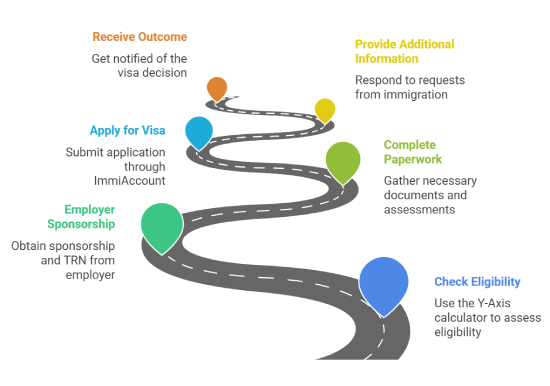
Step 1: Check your eligibility through Y-Axis Australia Immigration Points Calculator
Step 2: Make your employer sponsor you under the direct entry stream and obtain from them the TRN (Transaction Reference Number).
Step 3: Complete all of your paperwork by taking relevant skills assessments, tests in English language proficiency, and fulfilling all other tests for eligibility criteria.
Step 4: You need to apply for this visa within less than six months of getting nominated. Carry out this process through your ImmiAccount. You can do this even when you are out of Australia. Make the visa fee payment.
Step 5: If additional information, such as biometrics or other documents, or sought by the immigration department, it will be requested by them and you need to respond immediately.
Step 6: You will be told about your outcome. In case it has been rejected, they will state why and suggest that you can request a review of the decision.
Subclass 186 Visa Processing Time
Processing times for the Subclass 186 have increased significantly over the past two years and vary by stream. The figures below are based on latest data as of April 2026. They are indicative your actual wait depends on application completeness, occupation category, and whether your employer holds Accredited Sponsor status.
|
Stream |
Indicative Time (as at April 2026) |
Context |
|
Direct Entry |
12 to 20+ months |
Most congested stream. Standard cases lodged in early 2024 are currently being decided. |
|
TRT Stream |
13 to 18 months at the median |
Accredited Sponsor nominees generally move faster. |
|
Labour Agreement |
5 to 9 months |
Lower application volumes mean faster turnaround. |
Applications for regional occupations and healthcare or teaching roles are generally prioritised under Ministerial Direction No. 105 ahead of standard cases.
Important - health checks: Because processing now exceeds 12 months in most streams, DOHA advises ENS applicants to wait before completing medical examinations. Health checks are valid for 12 months from the date of examination. Completing them 2 to 3 months after lodging the application helps ensure they remain valid when a decision is made.
If you are in Australia when you lodge and hold a valid substantive visa, a Bridging Visa A (BVA) is automatically granted at lodgement. This allows you to remain in Australia and continue working while the application is being processed.
Subclass 186 Visa Fees and Charges
The visa application charge is the same across all three streams - Direct Entry, TRT, and Labour Agreement. The employer pays the nomination fee and SAF levy separately at the time of lodging the nomination.
|
Applicant |
Fee (AUD) |
Notes |
|
Primary applicant |
$4,770 |
All three streams |
|
Secondary applicant – 18 or older |
$2,385 |
Per person |
|
Secondary applicant – under 18 |
$1,190 |
Per person |
|
Nomination fee (paid by employer) |
$540 |
Employer pays this |
|
SAF levy – small business (turnover < $10M) |
$3,000 |
Employer pays – cannot be passed to applicant |
|
SAF levy – other business (turnover $10M+) |
$5,000 |
Employer pays – cannot be passed to applicant |
Budget separately for: skills assessment fees (Direct Entry stream), English language test fees, medical examination costs, and police clearance charges. These vary by provider. Verify the latest visa application charge at immi.homeaffairs.gov.au before lodging, as fees are indexed annually.
Can You Get Australian Citizenship from a Subclass 186 Visa?
Yes, you can! The Subclass 186 visa is a permanent residency (PR) visa, which means you can live, work, and settle in Australia for as long as you want. One of the biggest advantages of holding a Subclass 186 visa is that it opens the path to Australian citizenship.
Once you have held your PR status for a few years, met the residency requirements, and maintained a clean record, you can apply for citizenship and enjoy full rights as an Australian, including voting, access to government benefits, and holding an Australian passport.
If you’ve been dreaming of a secure future in Australia for yourself and your family, the Subclass 186 visa could be your first step toward becoming an Australian citizen.
Rights After Your Subclass 186 Visa Is Granted
Gaining a Subclass 186 visa means you become an Australian permanent resident, no matter which stream you applied through (TRT, Direct Entry, or Labour Agreement). Permanent residency offers a wide range of benefits for you and your family.
Key Rights and Benefits
- Live, work, and study in Australia indefinitely: enjoy the security of permanent residency.
- Access Medicare: Australia’s public healthcare system, reducing your medical expenses.
- Sponsor eligible relatives: help family members apply for visas to join you in Australia.
- Travel freely for 5 years: enter and leave Australia as often as you wish while your travel facility is valid. After 5 years, renew with a Resident Return Visa (RRV) if you’re not yet a citizen.
- Pathway to Australian citizenship: once you meet the residence requirements, you may apply to become a citizen and gain full rights, including an Australian passport.
How Can Y-Axis Help You?
- Free eligibility check throughAustralia Immigration Points Calculator
- Expert guidance/counseling for Australia Immigration
- Coaching services:Expert PTE coaching,IELTS proficiency Coaching
- Free career counseling, book your slot today
- Complete guidance forAustralia PR visa



.webp)

.webp)


Don't know what to do ?.
Get Free Counseling
Looking for Inspiration
Explore what Global Citizens have to say about Y-Axis in shaping their future
Frequently Asked Questions