

Posted on January 05 2026
Top 10 In-Demand Jobs in Alberta for Skilled Professionals

By , Editor & Director
Updated January 05 2026
Alberta is one of Canada’s strongest job markets, with over 2.6 million people employed in 2025. The province is facing significant labour shortages across healthcare, information technology, finance, skilled trades, construction, energy, and logistics, creating strong hiring demand for skilled professionals.
According to Alberta’s Occupational Outlook, the province is expected to generate around 133,000 job openings every year, resulting in more than 1.3 million employment opportunities by 2033.
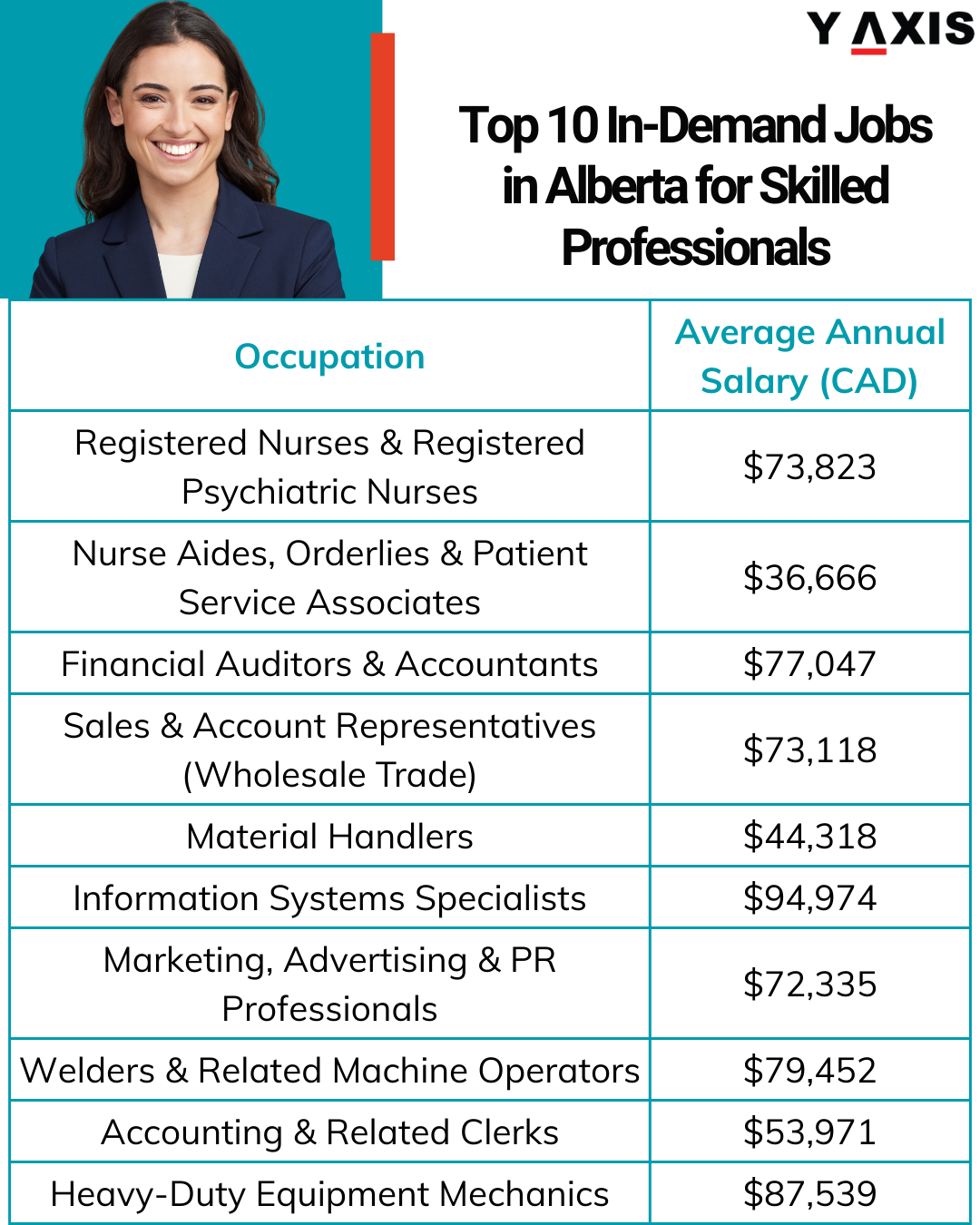
Top 10 In-demand Jobs in Alberta:
|
Occupation |
NOC Code |
Average Annual Salary (CAD) |
|
Registered Nurses & Registered Psychiatric Nurses |
31301 |
$73,823 |
|
Nurse Aides, Orderlies & Patient Service Associates |
33102 |
$36,666 |
|
Financial Auditors & Accountants |
11100 |
$77,047 |
|
Sales & Account Representatives (Wholesale Trade) |
64101 |
$73,118 |
|
Material Handlers |
75101 |
$44,318 |
|
Information Systems Specialists |
21222 |
$94,974 |
|
Marketing, Advertising & PR Professionals |
11202 |
$72,335 |
|
Welders & Related Machine Operators |
72106 |
$79,452 |
|
Accounting & Related Clerks |
14200 |
$53,971 |
|
Heavy-Duty Equipment Mechanics |
72401 |
$87,539 |
*Looking for jobs in Alberta? Let Y-Axis help you through application process.
Most In-demand Jobs in Alberta for Skilled Professionals
The most in-demand jobs in Alberta are in healthcare, information technology, skilled trades, construction, energy, finance, education, and logistics. Ongoing industry expansion, infrastructure development, and workforce retirements are driving labour shortages across these sectors.
With competitive salaries, employer-sponsored job opportunities, and provincial nomination pathways, Alberta offers strong prospects for long-term employment, career growth, and permanent residency in Canada.
List In-demand Careers and growing sectors in Alberta:
|
Sector |
In-Demand Job Roles |
|
Healthcare |
Registered Nurses, Licensed Practical Nurses, Nurse Aides, Medical Laboratory Technologists, Physiotherapists, Paramedics |
|
Information Technology (IT) |
Software Developers, Web Developers, IT Analysts, Cybersecurity Specialists, Data Analysts |
|
Construction & Skilled Trades |
Electricians, Welders, Heavy Equipment Operators, Construction Managers, Plumbers, Carpenters |
|
Energy & Natural Resources |
Mechanical Engineers, Process Operators, Petroleum Technologists, Geologists, Maintenance Technicians |
|
Finance & Accounting |
Accountants, Financial Analysts, Auditors, Tax Specialists, Payroll Officers |
|
Transportation & Logistics |
Truck Drivers, Logistics Coordinators, Supply Chain Managers, Warehouse Supervisors |
|
Education & Early Childhood |
Teachers, Early Childhood Educators, Education Assistants, Special Needs Educators |
|
Manufacturing |
Industrial Mechanics, Machine Operators, Quality Control Inspectors, Production Supervisors |
|
Retail & Wholesale Trade |
Sales Managers, Store Managers, Account Representatives, Inventory Coordinators |
|
Public Administration |
Policy Analysts, Program Officers, Administrative Officers, Compliance Specialists |
High-Demand Skills with Job Opportunities in Alberta
The most in-demand skills in Alberta are healthcare and patient care, information technology, skilled trades, construction, project management, transportation and logistics, and energy-related technical skills. Professionals with practical experience and recognised certifications have better job prospects, higher chances of employer sponsorship, and clearer pathways to permanent residency in Canada.
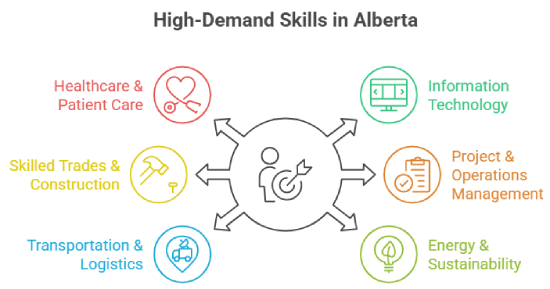
Most in-demand skills in Alberta for skilled professionals include:
- Healthcare & Patient Care: Clinical support, patient safety, teamwork, and communication skills for hospitals, aged care, and community health services.
- Information Technology: Software development, cloud computing, cybersecurity, data analysis, and IT system management driven by digital transformation.
- Skilled Trades & Construction: Welding, electrical work, heavy equipment operation, blueprint reading, and industrial maintenance.
- Project & Operations Management: Planning, budgeting, scheduling, and leadership skills for infrastructure, energy, and manufacturing projects.
- Transportation & Logistics: Safe driving, route planning, fleet management, warehouse operations, and supply chain coordination.
- Energy & Sustainability: Knowledge of renewable energy systems, environmental compliance, process optimisation, and technical maintenance.
High-Paying Jobs in Alberta for Skilled Professionals
Alberta offers some of the highest-paying jobs in Canada, especially in sectors facing long-term labour shortages. Skilled professionals with specialised experience, certifications, or technical expertise can earn higher wages due to strong employer demand, operational complexity, and limited local talent supply. Industries such as healthcare, IT, energy, skilled trades, and finance consistently offer competitive pay and long-term stability.
List of High-Paying Opportunities in Alberta for Skilled Professionals:
|
Sector |
Average Annual Salary (CAD) |
Job Outlook |
|
Information Technology (IT) |
85,000 – 120,000 |
Very High |
|
Construction & Skilled Trades |
75,000 – 105,000 |
High |
|
Healthcare |
70,000 – 100,000 |
Very High |
|
Finance & Accounting |
70,000 – 95,000 |
High |
|
Energy & Natural Resources |
90,000 – 130,000 |
High |
|
Manufacturing |
60,000 – 85,000 |
Moderate |
|
Transportation & Logistics |
65,000 – 90,000 |
High |
|
Education & Training |
55,000 – 80,000 |
Moderate |
|
Public Administration |
65,000 – 95,000 |
Moderate |
|
Retail & Wholesale Trade |
50,000 – 75,000 |
Moderate |
How to Get a Job in Alberta for Skilled Professionals?
Skilled professionals can get a job in Alberta by targeting in-demand occupations, meeting Canadian employment standards, and applying through trusted job channels. Alberta employers actively hire skilled workers in healthcare, IT, trades, construction, energy, finance, and logistics due to ongoing labour shortages.
Step by step application process for jobs in Alberta:
Step 1: Identify in-demand roles aligned with your skills
Step 2: Prepare a Canadian-standard resume and cover letter
Step 3: Apply through Job Bank, Indeed, LinkedIn, and employer websites
Step 4: Focus on employer-sponsored or LMIA-supported jobs
Step 5: Network with recruiters and professional groups
Step 6: Prepare for Canadian-style interviews
*Want to apply for jobs in Alberta Canada? Get expert guidance from Y-Axis.
Best Cities to Find Job Opportunities in Alberta
Alberta’s major cities offer strong job opportunities across healthcare, technology, energy, construction, and public services. Choosing the right city can improve job prospects, salary potential, and long-term career growth.
List of top 6 cities in Alberta with job opportunities:
|
City |
Key Sectors |
Why Consider this city? |
|
Calgary |
Energy, Finance, IT, Construction, Healthcare |
Corporate hub with strong private-sector hiring |
|
Edmonton |
Government, Healthcare, Education, IT |
Stable public-sector and infrastructure growth |
|
Red Deer |
Oil & Gas, Logistics, Construction |
Central location with strong trades demand |
|
Lethbridge |
Healthcare, Education, Manufacturing |
Growing regional job market |
|
Fort McMurray |
Energy, Engineering, Skilled Trades |
High-paying oil sands roles |
|
Grande Prairie |
Agriculture, Forestry, Logistics |
Consistent demand for technical workers |
Immigration Pathways for Alberta for Skilled Professionals
Alberta offers clear immigration pathways for skilled professionals through the Alberta Advantage Immigration Program (AAIP). These pathways help address labour shortages and support permanent residency in Canada.
Main immigration pathways include:
- Alberta Opportunity Stream (AOS): For temporary foreign workers in Alberta with a valid job offer in an eligible occupation.
- Alberta Express Entry Stream: For skilled workers with an active Express Entry profile. A provincial nomination adds 600 CRS points.
- Rural Renewal Stream: For professionals with job offers in designated rural Alberta communities facing labour shortages.
Step-by-Step Application Process to Move to Alberta for Skilled Professionals
Step 1: Secure a job offer from an Alberta employer
Step 2: Choose the right stream - Opportunity, Express Entry, or Rural Renewal depending on your eligibility
Step 3: Apply for provincial nomination
Step 4: Receive nomination approval
Step 5: Apply for a work permit or permanent residency through Immigration, Refugees and Citizenship Canada
Step 6: Complete medical exams, police checks, and biometrics
Step 7: Plan relocation (housing, healthcare, licensing)
Step 8: Move to Alberta and start work
*Want to migrate to Canada? Get step by step assistance from Y-Axis and end to end visa support.
Is It Worth Moving to Alberta for Skilled Professionals?
Yes. Alberta offers strong job demand, competitive salaries, and clear pathways to permanent residency. The province faces ongoing labour shortages across healthcare, IT, skilled trades, construction, energy, and logistics, creating steady hiring opportunities.
With a growing economy, lower cost of living than many major cities, high quality of life, and access to provincial nomination programs, Alberta is an attractive choice for skilled professionals looking for long-term career growth and settlement in Canada.
Job Outlook for Alberta for Skilled Professionals
Alberta has a strong and stable job outlook, with around 133,000 job openings expected each year until 2033. Growth is being driven by workforce retirements, population growth, infrastructure investment, and continued expansion across key sectors.
High-demand industries include healthcare, information technology, skilled trades, construction, energy, finance, logistics, and education. With consistent hiring, competitive wages, and employer demand, Alberta offers excellent long-term employment prospects for skilled professionals in Canada.
FAQs
What are the top 10 in-demand jobs in Alberta?
The top in-demand jobs in Alberta include registered nurses, nurse aides, financial auditors and accountants, sales and account representatives, material handlers, information systems specialists, marketing and PR professionals, welders, accounting clerks, and heavy-duty equipment mechanics. These roles are driven by labour shortages across healthcare, IT, construction, energy, and logistics, offering competitive salaries and strong long-term employment prospects in Canada.
Why is Alberta facing labour shortages across multiple sectors?
Alberta is facing labour shortages due to an ageing workforce, high retirement rates, population growth, and rapid expansion across key industries. Healthcare, information technology, skilled trades, construction, energy, and logistics are especially affected. Infrastructure development and ongoing industrial projects have increased hiring demand, while the local labour supply has not kept pace. As a result, employers are actively recruiting skilled professionals to fill critical roles.
What are the highest-paying jobs in Alberta right now?
Some of the highest-paying jobs in Alberta include information systems specialists, heavy-duty equipment mechanics, welders, financial auditors, accountants, engineers, and healthcare professionals. Salaries are particularly strong in energy, construction, IT, and skilled trades due to labour shortages and operational demand. Many roles also offer overtime, bonuses, and long-term stability, making them attractive for experienced professionals seeking high income potential.
Which sectors offer the most job opportunities in Alberta?
The sectors offering the most job opportunities in Alberta are healthcare, information technology, construction and skilled trades, energy and natural resources, finance and accounting, education, manufacturing, and transportation and logistics. These industries are expanding due to population growth, infrastructure investment, digital transformation, and replacement hiring. Targeting these high-demand sectors improves job prospects, salary potential, and access to employer-supported roles.
What skills are most in demand for jobs in Alberta?
The most in-demand skills in Alberta include nursing and patient care, software development, cybersecurity, cloud computing, welding, electrical work, heavy equipment operation, project management, trucking, logistics coordination, and energy-related technical skills. Employers prioritise hands-on experience and recognised certifications. Professionals with these skills have better hiring outcomes, stronger job security, and improved eligibility for employer sponsorship and immigration pathways.
Which cities in Alberta have the best job opportunities?
Cities with the best job opportunities in Alberta include Calgary, Edmonton, Fort McMurray, Red Deer, Lethbridge, and Grande Prairie. Calgary leads in energy, finance, and IT roles, while Edmonton offers strong opportunities in government, healthcare, education, and construction. Regional and rural cities also provide steady demand for skilled trades and technical workers, often with less competition and faster hiring.
Can international workers apply for jobs in Alberta?
Yes, international workers can apply for jobs in Alberta, especially in occupations facing labour shortages. Employers frequently recruit foreign workers for roles in healthcare, IT, skilled trades, construction, energy, and logistics. Some jobs may require employer sponsorship or LMIA approval. Meeting skill requirements, licensing standards, and language criteria increases the chances of securing employment and progressing toward permanent residency.
How does Alberta support skilled workers through immigration programs?
Alberta supports skilled workers through provincial immigration pathways that help address labour shortages. These programs allow eligible professionals with job offers or in-demand experience to apply for nomination, which significantly improves permanent residency prospects. The system prioritises occupations that contribute to economic growth, rural development, and workforce stability, making Alberta one of the more accessible provinces for skilled worker immigration.
Is Alberta a good place for long-term career growth?
Yes, Alberta offers strong long-term career growth due to consistent job demand, competitive wages, and economic diversification. Industries such as healthcare, IT, energy, construction, and finance continue to expand. With regular job openings, employer demand, and immigration support, professionals can build stable careers, advance into higher-paying roles, and benefit from a high quality of life.
What is the job outlook in Alberta for the next 10 years?
Alberta’s job outlook remains positive, with around 133,000 job openings expected each year until 2033. Growth will be driven by workforce retirements, population increases, infrastructure projects, and expansion in healthcare, IT, skilled trades, energy, logistics, and education. This sustained demand creates strong opportunities for employment, career stability, and long-term settlement.
Tags:
Jobs in Alberta
In-demand jobs in Alberta
Alberta job market
Work in Alberta
Alberta careers
Skilled jobs in Alberta
Share
Latest Article
Popular Post
Trending Article
Posted On September 29 2026
Top 10 Countries for Prompt Engineers to Work Abroad: Salary, Demand & PR Opportunities Compared