

.webp "What are the eligibility requirements for an Italy Work Visa?")
Posted on July 02 2026
What are the eligibility requirements for an Italy Work Visa?

By , Editor & Director
Updated August 06 2026
Working in Italy requires a confirmed job offer from an Italian employer, an approved Nulla Osta (work authorisation), and a Type D National Long Stay Visa. The two main pathways are the Standard Work Visa, which is subject to Italy's annual Decreto Flussi quota system, and the EU Blue Card, which is designed for highly qualified professionals with a recognised university degree and a minimum salary of approximately €35,000 per year. Once the Nulla Osta is approved, you can submit your visa application through the relevant Italian consulate. After arriving in Italy, you must apply for a Permesso di Soggiorno (residence permit) to live and work legally in the country.
|
Requirement |
Details |
|
Job Offer |
Confirmed offer from an Italian employer for both Standard Work Visa and EU Blue Card routes |
|
Permit Type |
Standard Work Visa (Lavoro Subordinato) or EU Blue Card depending on qualifications and salary |
|
Standard Visa Salary |
Must meet sector collective bargaining agreement (CCNL) minimum for the role |
|
EU Blue Card Salary |
Minimum approximately €35,000 per year for standard roles; €28,200 for shortage sectors |
|
Qualifications |
Relevant experience for Standard Visa; university degree or equivalent for EU Blue Card |
|
Nulla Osta |
Work authorisation applied for by the Italian employer before visa application |
|
Quota |
Standard Work Visa subject to annual Decreto Flussi quota; EU Blue Card is quota-free |
|
Processing Time |
2 to 6 months end-to-end for Standard Visa; 30 to 90 days Nulla Osta for EU Blue Card |
*Want to apply for an Italy Work Visa? Let Y-Axis guide you through every step of the process.
Eligibility Requirements for an Italy Work Visa
Eligibility for an Italy Work Visa depends on your occupation, qualifications, and the type of work permit sponsored by your employer. The Standard Work Visa is available for a wide range of employer-sponsored roles under Italy’s Decreto Flussi quota system, while the EU Blue Card is designed for highly qualified professionals with a recognised university degree and a salary meeting the required threshold.
To be eligible for an Italy Work Visa, you need:
- A confirmed job offer from an Italian employer willing to sponsor the Nulla Osta application
- A salary meeting the minimum collective bargaining agreement rate for the role under the Standard Work Visa
- A minimum annual salary of approximately €35,000 for the EU Blue Card route
- A recognised university degree of at least three years, or five years of highly qualified professional experience, for the EU Blue Card
- A valid passport with sufficient validity for the duration of your permit
- Availability within Italy’s annual Decreto Flussi quota for the Standard Work Visa route
- For the EU Blue Card: a role in a qualifying occupation with a binding job offer meeting the salary threshold
- Nulla Osta approval from the Italian immigration authority before applying for the visa
*Want to check your eligibility? Get a free eligibility assessment from Y-Axis today.
Documents Required for an Italy Work Visa
To apply for an Italy Work Visa, you must provide documents supporting your job offer, qualifications, identity, and financial stability. While your Italian employer applies for the Nulla Osta (work authorisation) on your behalf, you are responsible for submitting the visa application and supporting documents through the relevant Italian consulate in Australia.
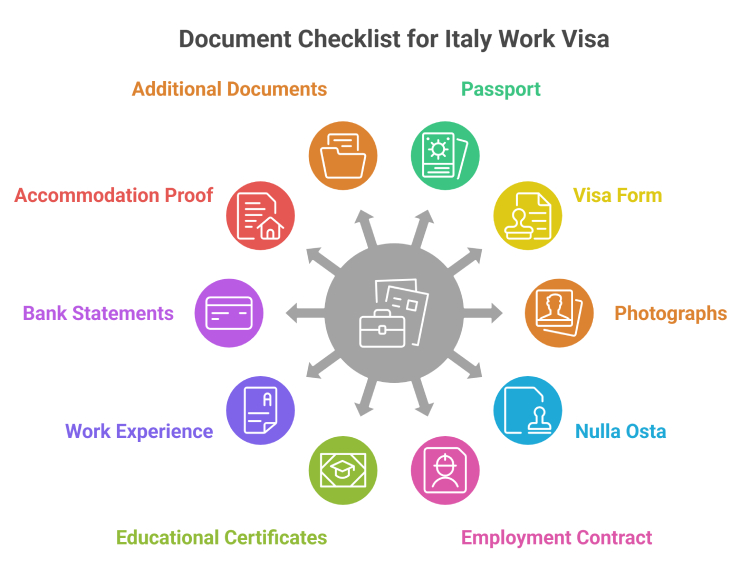
- Valid passport with at least three months validity beyond the intended return date
- Completed Type D National Long Stay Visa application form
- Recent passport-size photographs meeting Italian consulate specifications
- Nulla Osta approval letter issued by the Italian immigration authority
- Signed employment contract confirming job title, salary, and employment conditions
- Educational certificates, degrees, and professional qualification documents
- Evidence of relevant work experience such as reference letters or payslips
- Bank statements showing proof of sufficient funds to support yourself on arrival
- Proof of accommodation in Italy for the initial period of the stay
- Any additional documents requested by the Italian consulate handling the application
How to Apply for an Italy Work Visa from Australia?
The Italy Work Visa process begins with your Italian employer obtaining a Nulla Osta (work authorisation). Once approved, you can submit your Type D National Long Stay Visa application through the relevant Italian consulate. After arriving in Italy, you must apply for a Permesso di Soggiorno (residence permit) to live and work legally in the country.
Step 1: Secure a confirmed job offer from an Italian employer for a role that meets the eligibility and salary requirements for the Standard Work Visa or EU Blue Card.
Step 2: The employer submits the Nulla Osta (work authorisation) application to the Italian immigration authority on your behalf.
Step 3: Once the Nulla Osta is approved, gather all required documents including your passport, Nulla Osta approval letter, employment contract, qualification certificates, and financial documents.
Step 4: Book an appointment at the nearest Italian consulate in Australia — Sydney, Melbourne, Adelaide, Brisbane, or Perth depending on your state of residence — and submit your Type D visa application.
Step 5: Pay the visa application fee and attend the consulate appointment in person.
Step 6: Travel to Italy once your Type D visa is approved and begin employment.
Step 7: Within 8 working days of arriving in Italy, apply for your Permesso di Soggiorno (residence permit) at the local Questura or post office and register with your employer.
*Want to apply for an Italy Work Visa? Get expert guidance from Y-Axis professionals.
FAQs
Can Australians work in Italy without a job offer?
Australian citizens aged 18 to 35 can apply for the Italy Working Holiday Visa, which allows them to live and work in Italy for up to 12 months without a prior job offer. Work is limited to six months in total and no more than three months with the same employer. For long-term employment, a confirmed job offer is required.
What is the Decreto Flussi and how does it work?
The Decreto Flussi is Italy’s annual quota system that regulates the number of non-EU workers permitted to enter Italy for employment. Employers sponsoring a Standard Work Visa must apply during designated quota periods when places are available. Popular categories can fill quickly. The EU Blue Card is exempt from the quota system and can be applied for throughout the year.
What is the EU Blue Card Italy and who qualifies?
The EU Blue Card is a residence and work permit for highly qualified professionals with a recognised university degree and a qualifying job offer. Applicants generally require a minimum salary of approximately €35,000 per year, with reduced thresholds of around €28,200 for shortage occupations including IT, healthcare, and engineering. The permit is quota-free and provides EU mobility rights after 18 months.
What salary do I need for an Italy Work Visa?
Salary requirements depend on the visa type. Standard Work Visa applicants must receive the minimum salary set by the relevant collective labour agreement (CCNL) for their occupation. EU Blue Card applicants generally require a minimum salary of approximately €35,000 per year, with reduced thresholds of around €28,200 for shortage occupations such as IT, healthcare, and engineering.
Is Italian language required for an Italy Work Visa?
No. Italy does not require a language test for most work visa applications. Many professional roles in technology, finance, healthcare, and multinational companies are conducted in English, particularly in major cities such as Milan and Rome. Learning Italian can improve daily life and employment opportunities but is generally not a formal visa requirement.
What jobs are in demand in Italy for skilled workers?
Italy has strong demand for professionals in IT, software engineering, engineering, healthcare, construction, manufacturing, logistics, and tourism. Milan is a major hub for finance, technology, and fashion, while Rome offers opportunities in government, media, and international organisations. Technology, engineering, and healthcare professionals are particularly well positioned for EU Blue Card opportunities.
How long does Italy Work Visa processing take from Australia?
The Standard Work Visa process typically takes between 2 and 6 months, including Nulla Osta approval and visa processing. Once the work authorisation is issued, visa processing generally takes around 7 to 15 working days. EU Blue Card applications are often faster, with Nulla Osta approval usually completed within 30 to 90 days.
Which Italian consulate do Australians apply at?
The Italian consulate depends on your state or territory of residence. Applicants in New South Wales apply through Sydney, while Victoria, South Australia, Tasmania, and the ACT are served by Melbourne. Queensland and the Northern Territory fall under Brisbane, and Western Australia is served by Perth. Most applicants must attend an in-person appointment.
Can the Italy Work Visa lead to permanent residency?
Yes. After five years of continuous legal residence in Italy on a qualifying work permit, applicants become eligible for permanent residency. Italian citizenship generally requires ten years of legal residence. Both permanent residency and citizenship provide long-term settlement rights, while citizenship also grants full EU mobility rights.
How does Italy compare to other European work visa destinations for Australians?
Italy offers a quota-free EU Blue Card route with a minimum salary of approximately €35,000, which is lower than the threshold in several European countries. Workers benefit from a mandatory 13th-month salary payment, paid annual leave, public healthcare access, and a pathway to permanent residency and future EU mobility rights.
Tags:
Italy Work Visa
Italy Work Permit
Italy Work Visa Requirements
Italy Immigration
Work in Italy
Italy EU Blue Card
Italy Decreto Flussi
Italy Work Visa Australia
Italy PR
Italy Permesso di Soggiorno
Share
Latest Article
Popular Post
Trending Article
Posted On September 29 2026
Top 10 Countries for Prompt Engineers to Work Abroad: Salary, Demand & PR Opportunities Compared