
Posted on October 19 2026
How Can I Get Permanent Residency in Germany?

By , Editor
Updated October 19 2026
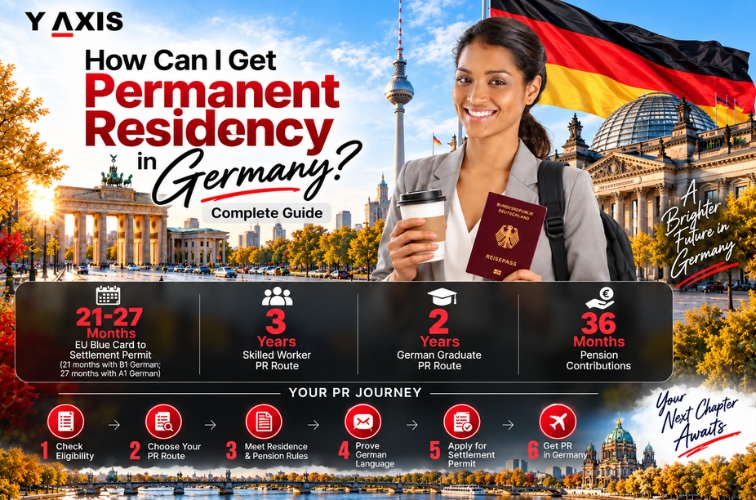
To get permanent residency in Germany, you must meet the eligibility requirements for a settlement permit (Niederlassungserlaubnis). Most applicants can qualify after five years of legal residence, while skilled workers may apply after three years and EU Blue Card holders can apply after 21 months with B1-level German or 27 months with A1-level German. Applicants must also meet the applicable requirements for employment, income, pension contributions, German language proficiency and adequate housing. Meeting these requirements can help you secure long-term residence and build your future in Germany.
*Want to apply for Germany PR? Let Y-Axis guide you through the application process.
Germany Permanent Residency Pathways
There are five main pathways to permanent residency in Germany: the Standard Settlement Permit, EU Blue Card, Skilled Worker Residence Permit, German university graduate route and self-employment route. Each pathway has different residence periods and eligibility requirements based on your employment, qualifications, income and German language proficiency.
- Standard Settlement Permit: For applicants who have generally lived in Germany for five years and meet the income, pension contribution, German language and housing requirements.
- EU Blue Card: Eligible holders can apply after 21 months of qualifying employment with B1-level German or 27 months with A1-level German.
- Skilled Worker Residence Permit: Skilled workers can generally apply after three years of holding a qualifying residence permit, with the required employment history, pension contributions and German language skills.
- German University Graduates: Graduates of German universities may qualify after two years of skilled employment in Germany and 24 months of pension contributions.
- Self-Employed Individuals: Business owners may qualify after three years of successful self-employment provided their business is sustainable and generates sufficient income to support their livelihood.
Who is Eligible for Germany Permanent Residency?
Eligibility for permanent residency in Germany depends on your residence permit and employment status. Most applicants can qualify after five years of legal residence, while eligible skilled workers may apply after three years and EU Blue Card holders after 21 or 27 months, depending on their German language proficiency. Applicants must also meet the applicable requirements for income, pension contributions and adequate housing.
- Residence period: Generally five years for the standard route, three years for eligible skilled workers, and 21 months or 27 months for eligible EU Blue Card holders.
- Employment: Hold a qualifying residence permit and meet the employment requirements for your pathway.
- Pension contributions: Provide proof of the required contributions to Germany’s statutory pension insurance.
- Financial stability: Earn sufficient income to cover your living expenses and those of your dependants.
- German language skills: Meet the required language level, which varies by pathway.
- Housing: Have adequate accommodation for yourself and your family.
- Integration: Meet any applicable integration or civic knowledge requirements.
- Legal requirements: Satisfy the relevant legal conditions for obtaining a settlement permit.
*Need help with Germany PR requirements? Book a free consultation with Y-Axis today.
Documents Required for Germany PR
Germany PR requires a valid passport, current residence permit, proof of employment and income, pension contribution records, health insurance and proof of adequate housing. Applicants may also need German language and integration certificates, depending on their residence permit category. Additional documents may be requested by the local immigration authority.
- Valid passport: A current passport confirming your identity and nationality.
- Current residence permit: A valid German residence permit, such as an EU Blue Card or Skilled Worker Residence Permit.
- Completed application form: The settlement permit application form issued by your local immigration authority.
- Employment contract: Proof of qualifying employment, where required.
- Recent payslips: Salary statements showing your regular employment income.
- Pension contribution record: Evidence of the required contributions to Germany’s statutory pension insurance.
- German language certificate: Proof of the required German proficiency level, where applicable.
- Proof of accommodation: A rental agreement or other evidence of adequate housing.
- Health insurance certificate: Proof of valid health insurance coverage in Germany.
- Integration certificate: Evidence of completing an integration course or meeting applicable civic knowledge requirements, where required.
- Proof of financial resources: Documents showing that you can cover your living expenses and those of your dependants.
How to Apply for Germany PR?
To apply for permanent residency in Germany, you must check your eligibility, prepare the required documents and submit your settlement permit (Niederlassungserlaubnis) application to the local immigration authority (Ausländerbehörde). The process involves an appointment, document verification and payment of the applicable fee.
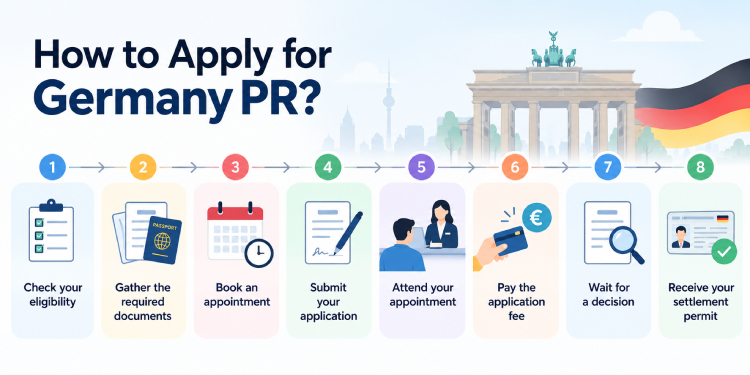
Step 1: Check your eligibility
Confirm that you meet the required residence period, employment, income, pension contribution and German language requirements for your residence permit category.
Step 2: Gather the required documents
Prepare your passport, current residence permit, employment contract, payslips, pension contribution records, health insurance proof and other supporting documents.
Step 3: Book an appointment
Contact your local immigration authority (Ausländerbehörde) to check the application procedure and schedule an appointment.
Step 4: Submit your application
Complete the settlement permit application form and submit it with the required documents.
Step 5: Attend your appointment
Present your original documents and provide biometric information if requested.
Step 6: Pay the application fee
Pay the applicable fee for your settlement permit category.
Step 7: Wait for a decision
The immigration authority reviews your application and may request additional documents before making a decision.
Step 8: Receive your settlement permit
Once your application is approved, follow the authority’s instructions to collect your residence permit card.
*Want to apply for Germany PR? Book a free consultation with Y-Axis today.
Cost of Germany Permanent Residency
The cost of permanent residency in Germany depends on the type of settlement permit. The application fee is generally €113 for a standard settlement permit, €147 for highly qualified applicants and €124 for self-employed applicants.
| Applicant Category | Application Fee |
|---|---|
| Standard settlement permit | €113 |
| Highly qualified applicants | €147 |
| Self-employed applicants | €124 |
Germany PR Processing Time
The processing time for a German settlement permit (Niederlassungserlaubnis) is typically estimated at 6 to 8 weeks after submitting a complete application, although timelines vary by city and application category. Missing documents, additional verification and high application volumes can cause delays. After approval, issuing the electronic residence permit card (eAT) may take another 4 to 6 weeks. Check with your local immigration authority (Ausländerbehörde) for the latest estimated timeline.
*Want to migrate to Germany permanently? Book a free consultation with Y-Axis today.
FAQs
What are the eligibility requirements for Germany PR?
To qualify for a German settlement permit (Niederlassungserlaubnis), you generally need a qualifying residence permit, sufficient income, pension contributions, German language skills and adequate housing. The standard route usually requires five years of residence, while eligible skilled workers and EU Blue Card holders can qualify sooner.
How long does it take to get permanent residency in Germany?
The qualifying period is generally five years for the standard route and three years for eligible skilled workers. EU Blue Card holders can qualify after 21 months with B1-level German or 27 months with A1-level German. Application processing takes additional time.
How much does permanent residency in Germany cost?
The application fee is generally €113 for a standard settlement permit, €147 for highly qualified applicants and €124 for self-employed applicants. Additional costs may include language tests, certified translations and document authentication.
What documents are required for Germany PR?
You generally need a valid passport, current German residence permit, employment contract, recent payslips, pension contribution records, proof of health insurance and evidence of adequate housing. A German language certificate and proof of civic knowledge may also be required.
How can I get Germany PR through an EU Blue Card?
Eligible EU Blue Card holders can qualify for a German settlement permit after 21 months of qualifying employment with B1-level German or 27 months with A1-level German. They must also meet the applicable pension contribution, employment and financial requirements.
Can I get permanent residency in Germany after studying there?
Yes. Graduates of German universities or vocational training programmes may qualify after holding a qualifying skilled-worker residence permit for two years and completing 24 months of pension contributions. They must also meet the other settlement permit requirements.
What German language level is required for Germany PR?
Eligible EU Blue Card holders need B1-level German for the 21-month route or A1-level German for the 27-month route. Skilled workers generally need B1-level German, although requirements may differ for other residence categories.
Can Australian citizens apply for permanent residency in Germany?
Yes. Australian citizens can move to Germany through an eligible visa route, such as skilled employment, and later apply for a settlement permit. They must meet Germany's residence, employment, financial and other eligibility requirements.
What is the difference between a German settlement permit and permanent EU residence?
A German settlement permit (Niederlassungserlaubnis) grants indefinite residence in Germany. The permanent EU residence permit (Daueraufenthalt-EU) also provides certain rights to move to other participating EU countries, subject to their immigration requirements.
Can I apply for Germany PR while living in Australia?
You generally need to move to Germany, hold a qualifying residence permit and complete the required residence period before applying for a settlement permit. Living in Australia does not count towards the German residence requirement.
Tags:
Germany PR
Germany Permanent Residency
Germany Settlement Permit
Germany PR Eligibility
Germany PR Requirements
Germany PR Application Process
Germany PR Fees
Germany PR Documents
Germany EU Blue Card
Germany Skilled Worker Visa
Share
Latest Article
Popular Post
Trending Article
Posted On October 19 2026
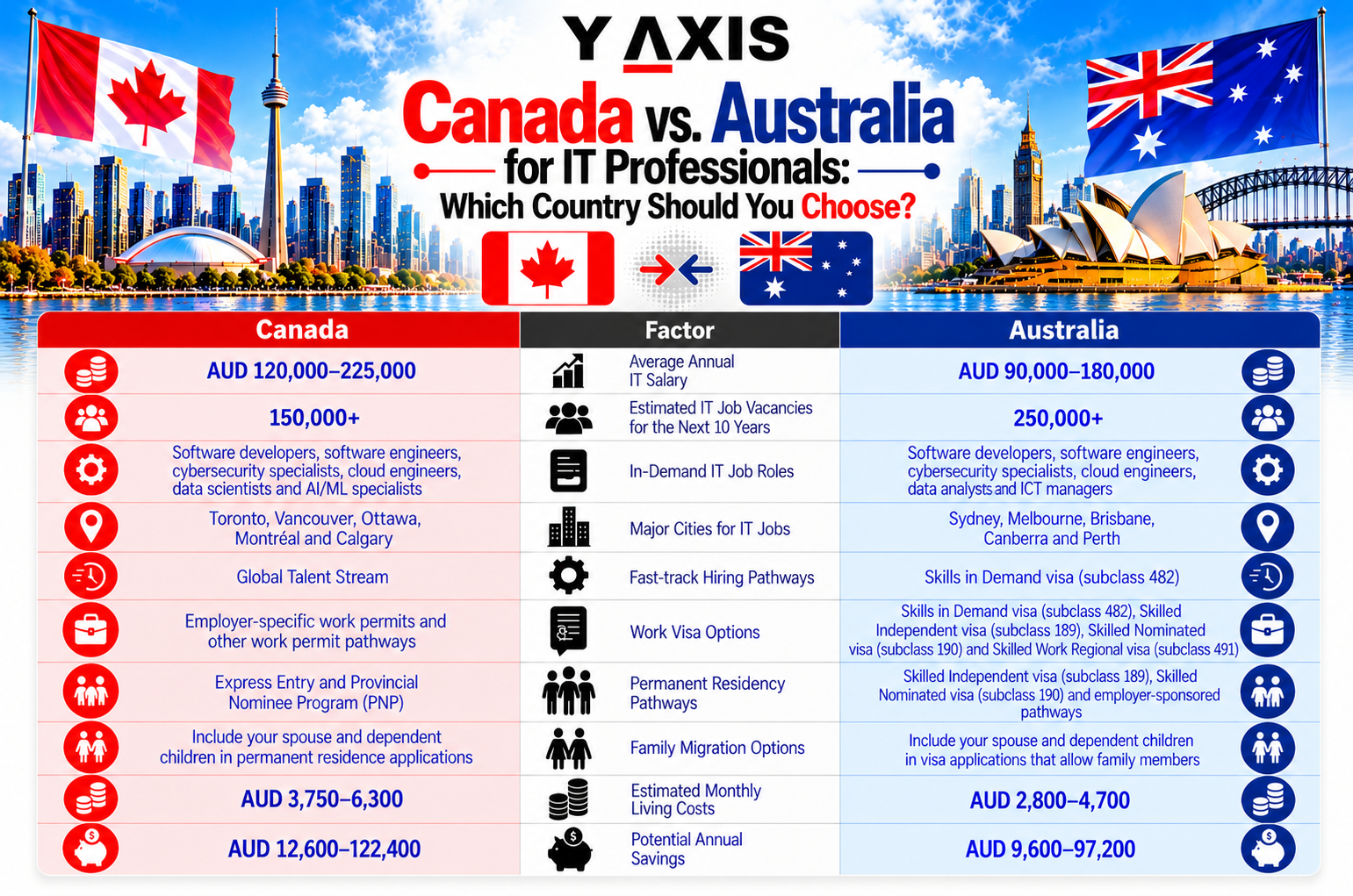
Canada vs. Australia for IT Professionals: Which Country Should You Choose?