

Posted on October 23 2026
What Are the Different Types of Germany Visas to Immigrate?

By , Editor & Director
Updated October 23 2026
Germany offers several visa options for moving from Australia for work, job searching, study, vocational training, family reunification or self-employment. The main pathways include the EU Blue Card, Skilled Worker Visa and Opportunity Card (Chancenkarte). The Opportunity Card allows eligible applicants to search for employment without a job offer, while the EU Blue Card and Skilled Worker Visa provide routes for qualified professionals to take up employment. After meeting the required residence period and other conditions, applicants can also apply for permanent residence through a German settlement permit.
Australian citizens can generally enter Germany without a visa for certain long-term purposes and apply for a residence permit after arrival, while other nationals may need a German national (D) visa before travelling.
*Want to migrate to Germany? Book a free consultation with Y-Axis today.
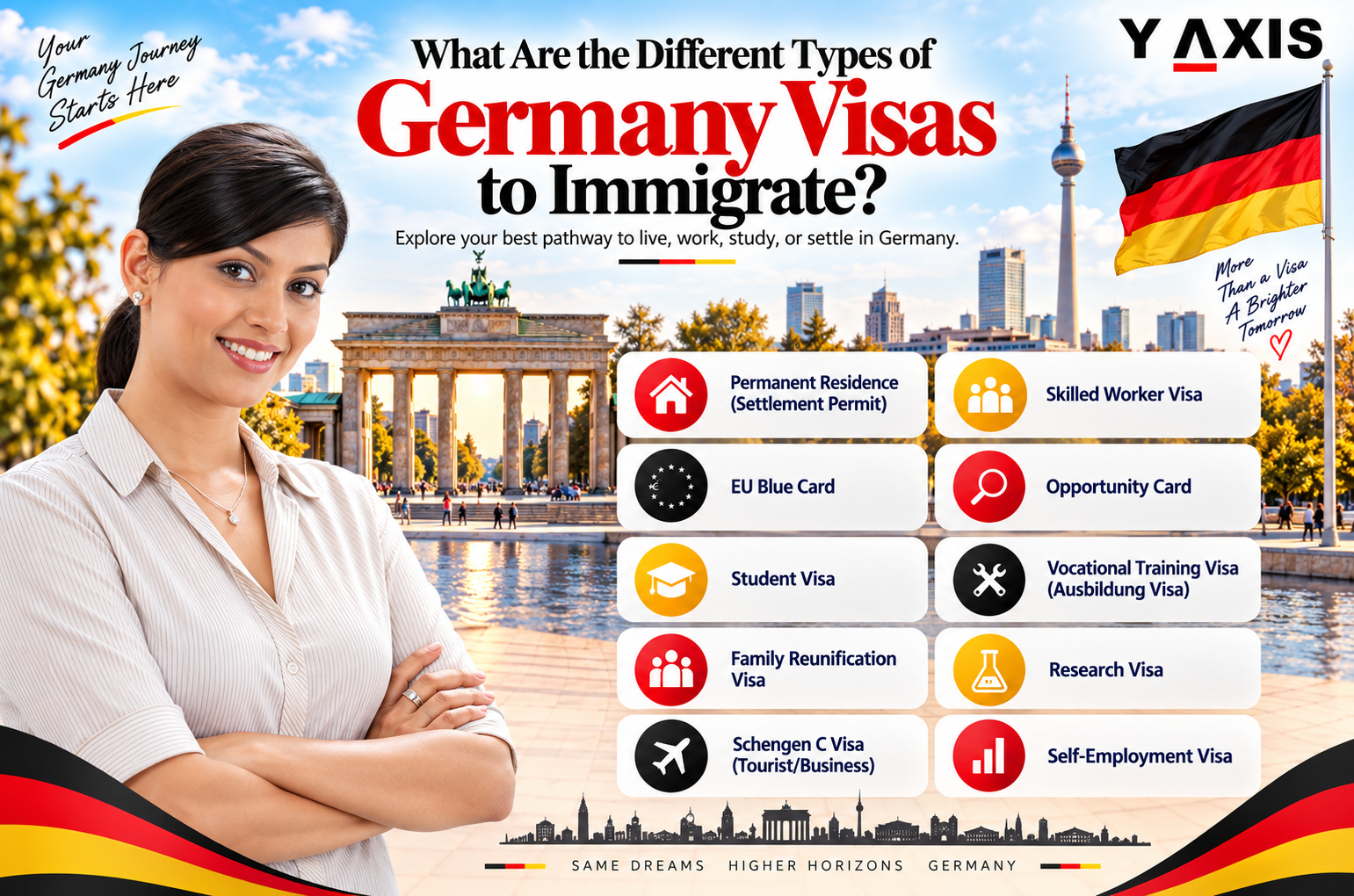
Types of Germany Visas for Immigration
Germany’s immigration system covers employment, job searching, education, vocational training, family reunification and business activities. Alongside the Skilled Worker Visa, EU Blue Card and Opportunity Card, applicants can explore study, training, family and self-employment routes based on their circumstances.
| Germany Visa Type | Who Can Apply? | Main Purpose |
|---|---|---|
| Skilled Worker Visa | Qualified professionals with a recognised qualification and a German job offer | To work in Germany |
| EU Blue Card | Qualified professionals with a qualifying job offer and the required salary | To work in a qualified role and access a faster route to permanent residence |
| Opportunity Card | Applicants meeting the qualification or points-based eligibility criteria | To search for employment in Germany without a job offer |
| Student Visa | Students admitted to a recognised German educational institution | To study in Germany |
| Vocational Training Visa | Applicants with a confirmed vocational training place who meet the requirements | To complete vocational training in Germany |
| Research Visa | Researchers with a hosting agreement or research contract | To conduct research in Germany |
| Family Reunification Visa | Eligible family members of people living in Germany | To join family in Germany |
| Self-Employment Visa | Entrepreneurs and freelancers meeting the relevant requirements | To start a business or work independently |
| Settlement Permit | Foreign nationals meeting the residence and settlement requirements | To obtain permanent residence in Germany |
Germany Visa Eligibility Requirements
To qualify for a Germany visa, applicants must meet the eligibility requirements for their chosen visa category. These may include a valid passport, recognised qualifications, a German job offer, proof of funds, health insurance or university admission. The exact requirements depend on whether you are applying for a work, study, job-search, family reunification or self-employment visa.
- Valid passport: Hold a passport valid for at least six months from your arrival in Germany.
- Recognised qualifications: Have the required academic or vocational qualifications for your chosen visa.
- Job offer: Provide a German employment contract for the Skilled Worker Visa or EU Blue Card.
- Proof of funds: Show you can cover your living expenses in Germany.
- Language skills: Meet the language requirements for your chosen visa.
- Admission or training place: Provide a university admission letter or vocational training contract, if applicable.
- Health insurance: Have health insurance that meets German requirements.
- Required documents: Submit the completed application form, photographs and supporting documents.
*Not sure which Germany visa suits you? Get free eligibility assessment from Y-Axis today.
How to Apply for a Germany Visa from Australia?
To apply for a Germany visa from Australia, choose your visa type, check the requirements, prepare the documents and submit your application through the relevant German visa service. Depending on your visa category, you may need to attend an appointment, provide biometrics and pay the visa fee before receiving a decision.
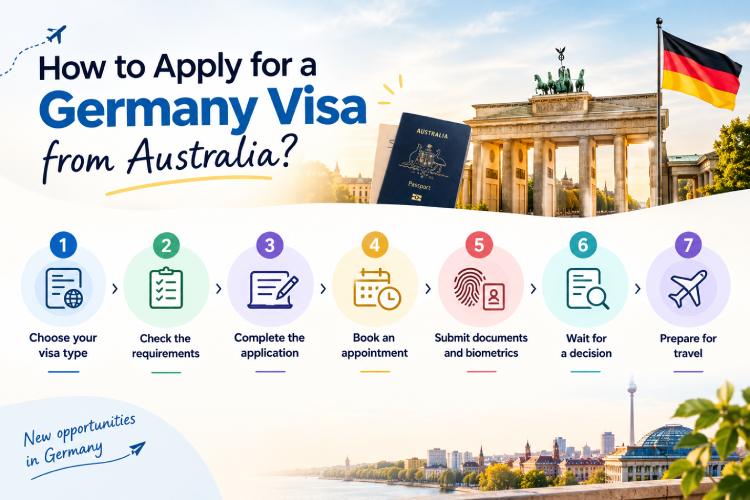
Step 1: Choose your visa type
Select the appropriate visa based on your purpose, such as work, job searching, study, vocational training or family reunification.
Step 2: Check the requirements
Review the eligibility criteria and document checklist for your chosen visa category.
Step 3: Complete the application
Fill out the visa application form or use Germany’s Consular Services Portal, where available.
Step 4: Book an appointment
Follow the instructions from the relevant German mission to schedule your appointment, if required.
Step 5: Submit documents and biometrics
Provide the required documents, fingerprints and photograph, and pay the applicable visa fee.
Step 6: Wait for a decision
Track your application and respond to any requests for additional documents.
Step 7: Prepare for travel
Once your visa is approved, check its validity and complete any required residence formalities after arriving in Germany.
*Want to apply for German Visa? Book a free consultation with Y-Axis today.
Germany Visa Fees and Processing Time
Germany's national visa (Type D) generally costs €75 for adults and €37.50 for applicants under 18. Processing times vary by visa category, the completeness of the application and any additional checks required. Apply well in advance of your intended travel date, as some applications may take several weeks or longer.
| Germany Visa Type | Estimated Processing Time |
|---|---|
| Skilled Worker Visa | 4–8 weeks |
| EU Blue Card | 2–6 weeks |
| Opportunity Card | 4–8 weeks |
| Student Visa | 4–12 weeks |
| Vocational Training Visa | 4–12 weeks |
| Family Reunification Visa | 8–16 weeks |
| Research Visa | 3–8 weeks |
| Self-Employment Visa | 8–16 weeks |
*Want to migrate to Germany? Book a free consultation with Y-Axis today.
FAQs
What are the different types of Germany visas for immigration?
Germany offers several visa types, including the Skilled Worker Visa, EU Blue Card, Opportunity Card (Chancenkarte), Student Visa, Vocational Training Visa, Family Reunification Visa, Research Visa and Self-Employment Visa. Each category supports a different purpose, such as employment, job searching, education, joining family or starting a business.
Do Australian citizens need a visa to move to Germany?
Australian citizens can generally enter Germany without a visa in advance for eligible long-term purposes and apply for a residence permit after arrival. However, they must obtain the required work authorisation before starting employment. Applying before travelling may be preferable if they plan to start work soon after arrival.
What is the Germany Opportunity Card, and how long is it valid?
The Opportunity Card (Chancenkarte) allows qualified applicants to travel to Germany to search for employment without a job offer. Applicants must meet the recognised qualification or applicable points-based criteria and demonstrate sufficient funds. The card can be issued for up to 12 months and permits secondary employment of up to 20 hours per week.
What is the difference between the Germany EU Blue Card and Skilled Worker Visa?
The EU Blue Card requires a qualifying job offer, the applicable salary threshold and the required qualifications. The Skilled Worker Visa is intended for applicants with recognised academic or vocational qualifications and a qualifying job offer. The EU Blue Card also offers a specific route to a settlement permit for applicants who meet the employment, pension contribution and language requirements.
What is the difference between a Germany Schengen visa and a national visa?
A Schengen visa (Type C) generally permits visits of up to 90 days within a 180-day period. A national visa (Type D) is intended for long-term stays, including employment, study and family reunification. People planning to live in Germany must meet the applicable long-term residence requirements.
What documents are required for a Germany visa from Australia?
Common documents include a valid passport, completed application form, passport photograph and proof of health insurance. Depending on the visa type, applicants may also need a German employment contract, recognised qualifications, proof of funds, university admission, a training agreement or documents proving family relationships. Non-Australian citizens may also need evidence of their legal residence in Australia.
How long does it take to get a Germany visa from Australia?
Processing times depend on the visa category, application completeness and additional checks. Some applications take a few weeks, while others may take several months. Check the relevant German mission's current processing guidance and apply well before your intended travel date.
How much does a Germany visa cost?
The standard German national visa fee is generally €75 for adults and €37.50 for applicants under 18. Additional expenses may include document translations, qualification recognition, health insurance and travel. Fees and exemptions vary by visa category and individual circumstances.
How long does it take to get permanent residence in Germany?
EU Blue Card holders may qualify for a settlement permit after 27 months of qualifying employment and pension contributions with A1 German, or after 21 months with B1 German, subject to the other requirements. Skilled workers may generally qualify after three years if they meet the applicable conditions. The qualifying period depends on the residence permit held.
Can Australian citizens apply for a Germany Working Holiday Visa?
Yes. Australian citizens aged 18 to 35 can apply for Germany's Working Holiday Visa, subject to the programme requirements. The visa allows a stay of up to 12 months and temporary employment to help fund the trip. Participation is generally permitted only once.
Tags:
Germany Visa
Germany Immigration
Germany Work Visa
Germany Opportunity Card
Germany EU Blue Card
Germany Skilled Worker Visa
Germany Student Visa
Germany Family Reunification Visa
Germany Working Holiday Visa
Germany Permanent Residence
Immigrate to Germany from Australia
Share
Latest Article
Popular Post
Trending Article
Posted On October 23 2026
What Are the Different Types of Germany Visas to Immigrate?