

Posted on October 26 2026
What is the Average Salary in the UAE?

By , Editor & Director
Updated October 29 2026
The average salary in the UAE is approximately AED 16,000 per month (AED 192,000 annually), while the median salary is around AED 10,000 per month. Salaries vary by job role, industry, experience and emirate, with finance, technology, engineering, oil and gas, and law among the higher-paying fields.
The UAE does not levy personal income tax on employment salaries. Dubai and Abu Dhabi offer opportunities across a range of industries, while planned investments of up to AED 200 billion in sustainable energy by 2030 could create more job opportunities in renewable energy and green technology. With competitive salaries and a growing range of career options, the UAE offers skilled professionals opportunities to develop their careers and gain international experience.
*Want to work in the UAE? Book a free consultation with Y-Axis today.
Average Salaries for Most In-Demand Jobs in the UAE
The UAE has strong demand for skilled workers in technology, healthcare, engineering and finance. Popular roles include software engineers, registered nurses, civil engineers and accountants, with salaries varying by experience, qualifications, specialisation and employer. Monthly earnings can range from around AED 7,000 for entry-level positions to AED 130,000 for senior leadership roles. More than 60% of white-collar roles reportedly offer AED 10,000 to AED 40,000 per month, although actual salaries vary across industries and job levels.
| Occupation | Average Annual Salary | Chances of Visa Sponsorship |
|---|---|---|
| IT & Software | AED 222,600 | Very High |
| Engineering | AED 201,400 | Very High |
| Healthcare | AED 185,400 | High |
| Nursing | AED 120,000 | Very High |
| Accounting & Finance | AED 195,600 | Moderate to High |
| Marketing & Sales | AED 191,400 | Moderate |
| Human Resources | AED 193,300 | Moderate |
| Logistics & Supply Chain | AED 172,000 | Moderate to High |
| Teaching | AED 167,600 | High |
| Construction & Real Estate | AED 198,300 | High |
| Hospitality & Tourism | AED 159,600 | Moderate to High |
Read More…
Most in-demand jobs in the UAE for the next 10 years
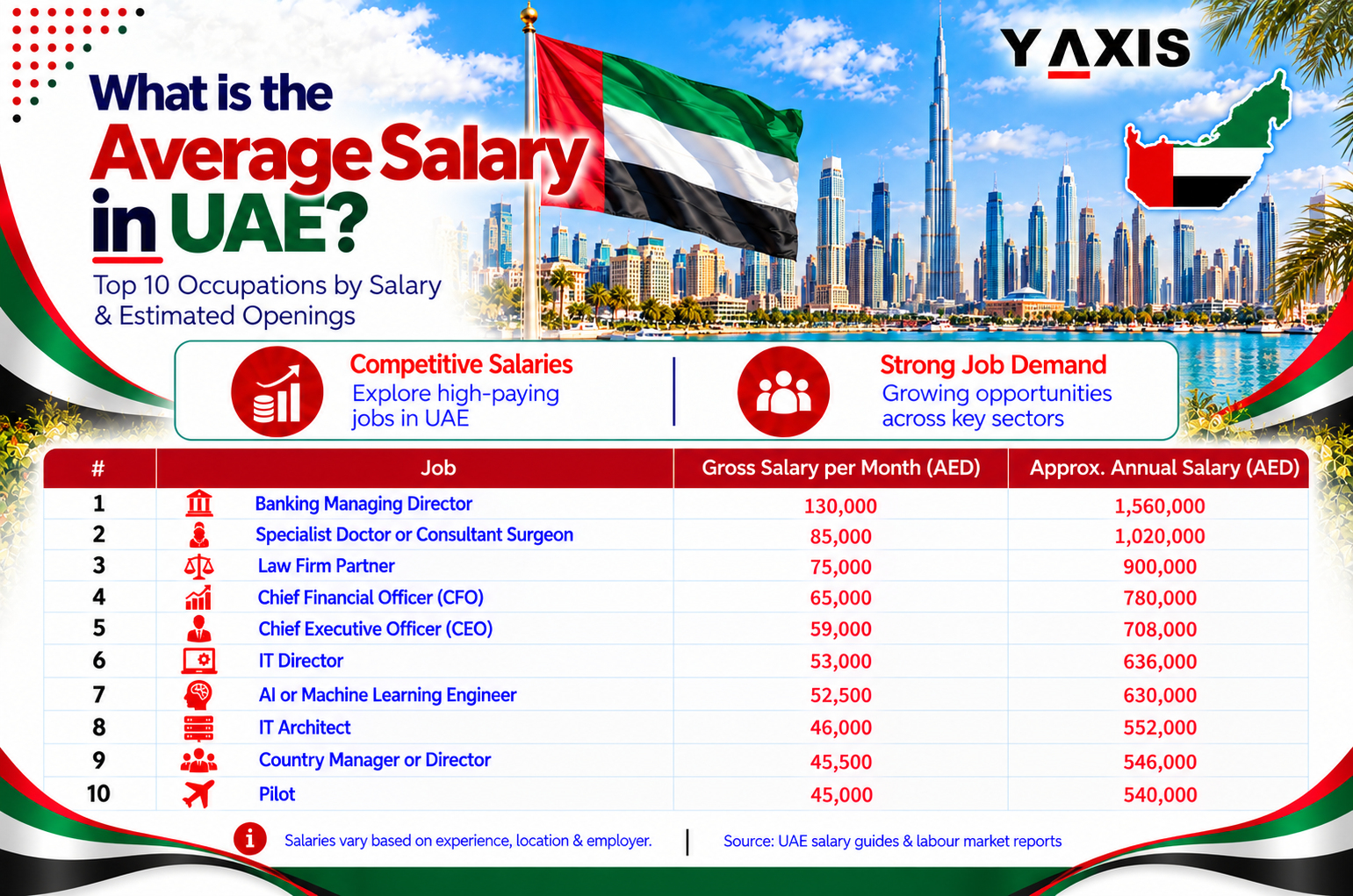
Top 10 Highest-Paying Jobs in the UAE
The highest-paying jobs in the UAE include senior roles in banking, healthcare, law, technology and business management, with monthly salaries reaching AED 130,000 for some executive positions. Banking managing directors, specialist doctors, law firm partners and chief financial officers are among the top earners. With no personal income tax on employment salaries, high-paying roles can offer strong earning potential and opportunities for career growth across the UAE.
| Job | Gross Salary per Month (AED) | Approx. Annual Salary (AED) |
|---|---|---|
| Banking Managing Director | 130,000 | 1,560,000 |
| Specialist Doctor or Consultant Surgeon | 85,000 | 1,020,000 |
| Law Firm Partner | 75,000 | 900,000 |
| Chief Financial Officer (CFO) | 65,000 | 780,000 |
| Chief Executive Officer (CEO) | 59,000 | 708,000 |
| IT Director | 53,000 | 636,000 |
| AI or Machine Learning Engineer | 52,500 | 630,000 |
| IT Architect | 46,000 | 552,000 |
| Country Manager or Director | 45,500 | 546,000 |
| Pilot | 45,000 | 540,000 |
*Looking for jobs in the UAE? Let Y-Axis guide you through application process.
Best Cities in the UAE with Most Job Opportunities
Dubai has strong demand in finance, technology, tourism and real estate, while Abu Dhabi offers roles in oil and gas, healthcare, engineering and renewable energy. Sharjah, Ajman and Ras Al Khaimah have opportunities in manufacturing, education, logistics, construction and hospitality.
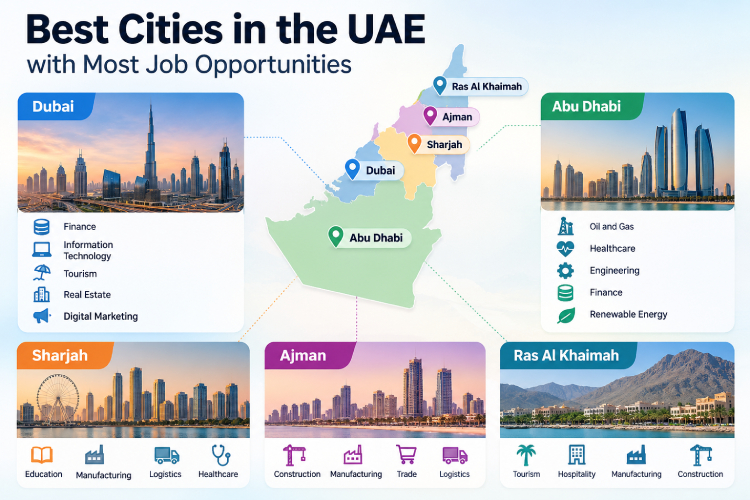
- Dubai: Finance, information technology, tourism, real estate and digital marketing.
- Abu Dhabi: Oil and gas, healthcare, engineering, finance and renewable energy.
- Sharjah: Education, manufacturing, logistics and healthcare.
- Ajman: Construction, manufacturing, trade and logistics.
- Ras Al Khaimah: Tourism, hospitality, manufacturing and construction.
UAE vs Australia: Salary, Tax and Savings
The UAE offers an average monthly salary of around AED 16,000, with no personal income tax on employment income. Australia also offers competitive salaries across industries such as healthcare, technology, engineering and finance, but income tax affects take-home pay. Comparing average salaries, tax rates and living costs in both countries helps you understand the differences in take-home earnings and potential savings.
| Factor | UAE | Australia |
|---|---|---|
| Gross monthly salary | AED 20,000 | AUD 7,760 |
| Gross annual salary | AED 240,000 | AUD 93,120 |
| Estimated monthly income tax and levy | AED 0 | AUD 1,693 |
| Estimated monthly take-home pay | AED 20,000 | AUD 6,067 |
| Estimated monthly living costs | AED 13,000 | AUD 4,004 |
| Estimated monthly savings | AED 7,000 | AUD 2,063 |
| Estimated annual savings | AED 84,000 | AUD 24,756 |
Cost of Living in the UAE
The monthly cost of living in the UAE for a single professional typically ranges from AED 5,200 to AED 12,600, depending on rent, location and lifestyle. Housing is usually the largest expense, followed by groceries, utilities, transport and dining. Dubai and Abu Dhabi tend to have higher rental costs, while Sharjah and Ajman can offer more affordable accommodation.
Job Outlook in the UAE
The UAE's job market is very strong across technology, manufacturing, education, retail and energy, creating opportunities for skilled workers through 2030. Technology employment is projected to grow by 54%, potentially adding more than 91,000 specialists, while manufacturing, education and retail could generate over 270,000 jobs combined. Energy and utilities employment is also projected to grow by 33%. These trends point to opportunities for software developers, AI specialists, cybersecurity analysts, engineers, healthcare professionals and teachers. Dubai and Abu Dhabi remain key employment centres, with additional opportunities in logistics, construction, tourism and manufacturing across other emirates.
*Want to work in the UAE? Get expert guidance from Y-Axis professionals.
FAQs
What is the average salary in the UAE?
The average salary in the UAE is around AED 16,000 gross per month, or AED 192,000 per year, while the median is around AED 10,000 per month. The average sits above the median because senior executives, doctors and finance professionals earn far more than most workers. No income tax is deducted from these salaries.
What is the average monthly salary in the UAE?
The average monthly salary in the UAE is around AED 16,000 gross, and the median is around AED 10,000. Half of all workers earn less than the median. Skilled professionals such as engineers, accountants and software developers typically earn AED 8,000 to AED 25,000 per month, depending on seniority.
What is the average salary in Dubai?
The average salary in Dubai is around AED 16,000 per month, or AED 192,000 per year, in line with the national average. Senior, finance, technology and specialist roles in Dubai pay well above this figure, while entry-level and support roles pay below it. Salaries are tax-free, so gross pay is take-home pay.
What is the minimum salary in the UAE?
The UAE does not have an official minimum wage. Salaries for private-sector employees are set in the employment contract and depend on the role and employer. Entry-level support and trade roles commonly start from AED 3,000 to AED 5,000 per month, and graduate roles usually start higher.
Is AED 10,000 a good salary in the UAE?
AED 10,000 matches the median UAE salary, so it is what a typical worker earns, and only 17.5% of international workers earn more than that. It supports a comfortable single lifestyle outside the most expensive areas of Dubai and Abu Dhabi. A family paying rent and school fees will usually need a higher salary.
What are the highest-paying jobs in the UAE?
The highest-paying jobs in the UAE are CEOs (AED 80,000 to AED 200,000+ per month), investment bankers (AED 35,000 to AED 120,000+), chief technology officers (AED 45,000 to AED 90,000), medical specialists and surgeons (AED 30,000 to AED 90,000) and chief financial officers (AED 45,000 to AED 85,000). Corporate lawyers and airline pilots also earn AED 25,000 to AED 80,000 per month.
Is salary tax-free in the UAE?
Yes. The UAE charges no personal income tax on salary, so gross and net salary are practically the same for most employees, whether Emirati or expat. Australians who move should confirm their Australian tax residency status with the Australian Taxation Office or a registered tax agent, because it can affect what they owe in Australia.
What is the average salary for expats in the UAE?
Skilled expat professionals typically earn AED 8,000 to AED 25,000 per month, depending on role and seniority. Only 17.5% of international workers earn more than AED 10,000 per month, compared with 76% of employed Emiratis. Expats in leadership, medical, finance and technology roles earn well above the typical range.
Which emirate pays the highest salaries, Dubai or Abu Dhabi?
On average, Abu Dhabi pays more, at about AED 21,000 per month against about AED 16,000 in Dubai. Sharjah averages AED 10,000 to AED 12,000, and the Northern Emirates pay AED 8,000 to AED 10,000 for professional jobs. Pay for individual roles varies by employer, so some jobs pay more in Dubai.
How does the average salary in the UAE compare with Australia?
Average weekly ordinary time earnings for full-time adults in Australia were AUD 2,051.10 in November 2025, or about AUD 106,600 per year before tax. The UAE average is AED 192,000 per year with no income tax. Because Australian income is taxed at progressive rates, compare take-home pay and living costs rather than gross salaries.
Tags:
Average Salary in the UAE
Average Monthly Salary in the UAE
Average Annual Salary in the UAE
UAE Salary by Job
UAE Salary by Industry
Average Salary in Dubai
Average Salary in Abu Dhabi
Highest-Paying Jobs in the UAE
UAE Salary After Tax
UAE vs Australia Salary Comparison
Share
Latest Article
Popular Post
Trending Article

Posted On November 03 2026
Australia vs. Europe for STEM Professionals: Which Country Should You Choose?