


Posted on June 09 2026
Australia End-of-Financial-Year Visa Planning: What to Do Before 30 June

By , Editor & Director
Updated June 09 2026
Australia's financial year ends on 30 June every year. The Australian government implements major migration policy updates, fee increases, and salary threshold changes from 1 July. For visa applicants, this is one of the most important dates in the immigration calendar.
State nomination rounds close, skilled migration invitation rounds close, and any unclaimed places from this year's migration program lapse until the next cycle begins. Skilled visa applicants, temporary visa holders, and employer-sponsored workers who lodge before 30 June secure lower fees, current salary thresholds, and a place in this year's program.
*Want to Migrate to Australia? Get a Free Eligibility Assessment from Y-Axis today.
Why 30 June Is Important for Australian Visa Applicants?
Every year on 1 July, the Department of Home Affairs resets visa quotas, increases application fees, and raises salary thresholds.
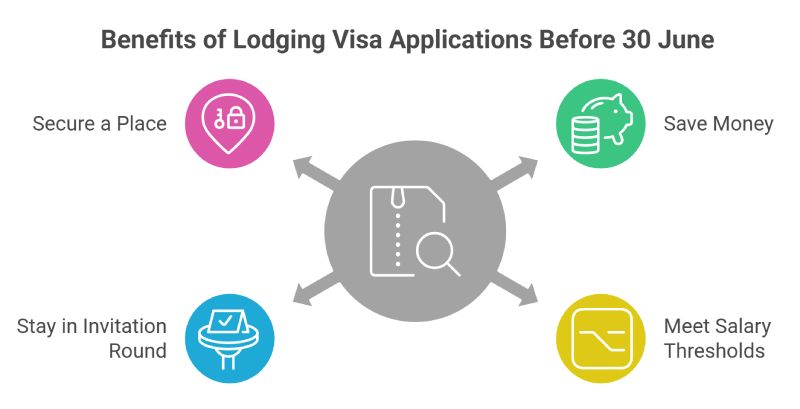
- Lock in current visa fees: Lodging before 30 June secures current application charges and saves you hundreds of dollars.
- Meet current salary thresholds: Nominations lodged before 30 June are assessed under current lower thresholds.
- Stay in the invitation round: An active and updated Expression of Interest before 30 June keeps you in consideration for the current program year.
- Secure your place before the cap resets: Lodging before the quota closes gives you the best chance of securing a place in this year's program.
Top Australian Visas to Apply for Before 30 June
Australia's migration program resets on 1 July every year. The visas below have direct EOFY deadline implications. Lodge before 30 June to secure your place in this year's program.
|
Visa Type |
What to Do Before 30 June |
|
Skilled Independent visa (subclass 189) |
Keep your Expression of Interest (EOI) updated before invitation rounds reset |
|
Skilled Nominated visa (subclass 190) |
Submit or update your state nomination interest before allocations close |
|
Skilled Work Regional visa (subclass 491) |
Secure state nomination before new program allocations begin |
|
Permanent Residence (Skilled Regional) visa (subclass 191) |
Apply before the financial year ends if eligible |
|
Temporary Graduate visa (subclass 485) |
Plan your PR pathway and check eligibility updates |
|
Skills in Demand visa (subclass 482) and Employer Nomination Scheme visa (subclass 186) |
Lodge employer nominations before salary thresholds may increase |
|
Student visa (subclass 500) |
Apply before possible fee increases and policy changes |
*Want to Migrate to Australia? Get a Free Eligibility Assessment from Y-Axis today.
Skilled Independent visa (subclass 189)
The Subclass 189 is Australia's points-tested permanent residency visa. It requires no employer or state sponsorship and grants the right to live and work anywhere in Australia permanently and is one of the most sought-after PR pathways for skilled professionals.
The visa operates under a four-tier occupation priority model — Tier 1 critical shortage occupations receive most invitations while IT, accounting, and general engineering roles have moved to Tier 3 or Tier 4. The final invitation window for the current program year closes on 30 June. Update your SkillSelect EOI, confirm your skills assessment is valid, and ensure your points score is as strong as possible before the year closes.
*Want to apply for the subclass 189 visa? Let Y-Axis help you through application process.
Skilled Nominated visa (subclass 190)
The Subclass 190 is a permanent residency visa requiring nomination from an Australian state or territory government. It adds 15 points to your score and is one of the most reliable PR pathways for skilled professionals who cannot compete for a Subclass 189 invitation.
State nomination allocations are finite and most states are in their final quota window for the current program year. When a state closes its nominations, it does not reopen until 1 July. Applicants who meet state occupation and points requirements should lodge their nomination interest before 30 June to be considered under the current year's allocation.
Skilled Work Regional visa (subclass 491)
The Subclass 491 is a five-year provisional regional visa with a direct pathway to permanent residency through the Subclass 191 after three years of regional living and work. It adds 15 points to your score — the single largest points boost available in Australia's migration system.
With Subclass 189 rounds stalled and Subclass 190 quotas running down, the 491 is the most realistic PR pathway for applicants scoring between 60 and 80 points. Regional areas including Perth, Adelaide, and the Gold Coast qualify. State nomination allocations reset on 1 July — lodge your nomination interest before 30 June to secure a place in this year's program.
Permanent Residence (Skilled Regional) visa (subclass 191)
The Subclass 191 is the permanent residency pathway for Subclass 491 and 494 visa holders who have completed three years of regional living and work and met the minimum income requirements. It is the final step to Australian PR for regional provisional visa holders.
If you have held a Subclass 491 or 494 visa for at least three years and met the income threshold, you are eligible to apply now. Lodging before 30 June gives you the best chance of securing your PR grant within the current program year's allocation.
Temporary Graduate visa (subclass 485)
The Subclass 485 allows international graduates who studied in Australia to live and work temporarily after completing their degree. It is the primary stepping stone from international study to skilled migration and Australian PR.
EOFY is a critical planning point for 485 holders. English test scores and skills assessments must remain valid, and your EOI must be active and updated before 30 June to be considered in the current program year's invitation rounds. Graduates who plan their PR pathway now are better positioned for the new program year beginning 1 July.
Skills in Demand visa (subclass 482) and Employer Nomination Scheme visa (subclass 186)
The Skills in Demand visa (subclass 482) and Employer Nomination Scheme visa (subclass 186) are two of Australia’s main employer-sponsored visa pathways. The 482 is a temporary work visa while the 186 grants permanent residency through employer nomination.
The Core Skills Income Threshold increases from AUD 76,515 to AUD 79,499 on 1 July. Employer nominations lodged before 30 June are assessed under the current lower threshold. If your employer is sponsoring your visa, ensure your nomination is lodged before the deadline to lock in current salary requirements.
Student visa (subclass 500)
The Subclass 500 is Australia's primary student visa for international students enrolled in a registered Australian course. It covers undergraduate, postgraduate, vocational, and English language programs across all major institutions.
Visa application fees increase on 1 July and genuine student requirements are reviewed with each new program year. Lodging your Subclass 500 application before 30 June secures current fee rates and ensures your application is assessed under existing policy settings.
What Are the Major Changes in Australian Visa Rules on 1 July?
Every year on 1 July, the Department of Home Affairs implements a range of updates across fees, salary thresholds, and program allocations. Here is a summary of the key changes taking effect this year:
|
Change |
Current |
From 1 July |
|
Core Skills Income Threshold (CSIT) |
AUD 76,515 |
AUD 79,499 |
|
Specialist Skills Income Threshold (SSIT) |
AUD 141,210 |
AUD 146,717 |
|
Temporary Skilled Migration Income Threshold (TSMIT) |
AUD 76,515 |
AUD 79,499 |
|
Subclass 482 Base Application Charge |
AUD 1,455 |
Increasing 1 July |
|
Subclass 186 Base Application Charge |
AUD 4,770 |
Increasing 1 July |
|
Migration Program Allocation |
185,000 places |
Resets 1 July |
|
Onshore Visa Priority |
Current settings |
70% onshore from 1 July |
Nominations and applications lodged before 30 June are assessed under current settings. Any application lodged on or after 1 July is subject to the new thresholds and fees.
Australia Visa Checklist Before 30 June
Make sure your visa profile, documents, and eligibility requirements are up to date before 30 June. Use this checklist to avoid delays and stay prepared for the new migration program year:
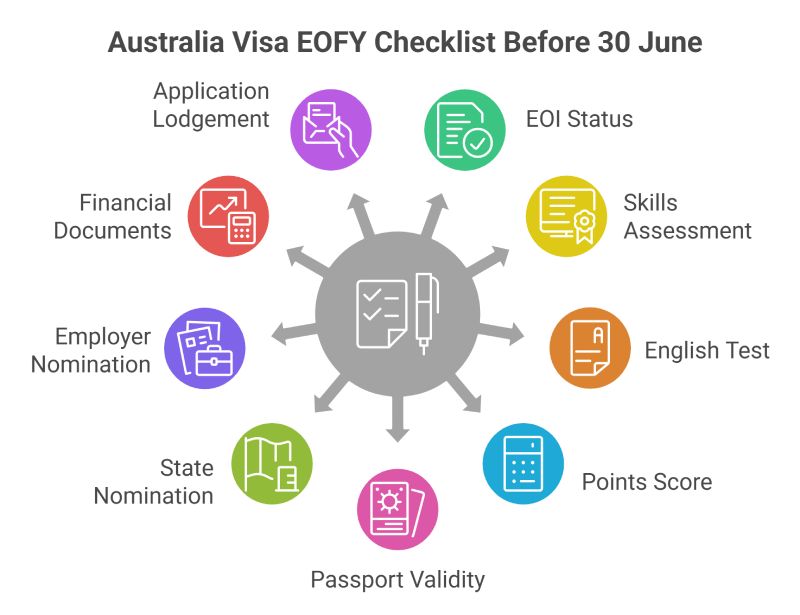
- Update your Expression of Interest (EOI) in SkillSelect with your latest work experience, qualifications, and English test scores.
- Confirm your skills assessment is valid and current.
- Check that your English test results are still within the validity period.
- Review your points score and ensure all claims are accurate.
- Check state nomination closing dates, if applicable.
- Confirm your passport has sufficient validity.
- Lodge your application or nomination before 30 June.
Tips to Improve Your Australian Visa Application Before 30 June
- Apply early: Processing queues build in the final weeks of June. Lodging early gives your application the best chance under current settings.
- Check your occupation list: Confirm your occupation remains on the Australia skilled occupation list before lodging.
- Maximise your points: A higher English score or partner skills claim before 30 June can improve your invitation ranking.
- Keep documents current: Confirm skills assessments, English results, and employment references are all valid before lodging.
- Use a registered migration agent: A registered migration agent ensures your application is complete, accurate, and lodged before the deadline.
FAQs
What is the end of financial year deadline for Australian visa applicants?
30 June is the official end of Australia's Program Year and Financial Year. The Department of Home Affairs resets visa quotas, increases application fees, and raises salary thresholds from 1 July every year. Skilled visa applicants, temporary visa holders, and employer-sponsored workers who lodge before 30 June secure current fees, salary thresholds, and a place in this year's migration program before the reset.
Why do Australian visa fees increase on 1 July?
Australia indexes visa application charges annually in line with the new financial year. The Department of Home Affairs implements fee increases from 1 July every year across most visa subclasses. Lodging your application before 30 June locks in current application charges and saves you hundreds of dollars on the same visa. Fee increases apply to all applications lodged on or after 1 July regardless of when you began preparing.
What happens to my visa application if I lodge after 30 June?
Applications lodged on or after 1 July are assessed under the new program year settings. This means higher visa application fees, increased salary thresholds for employer-sponsored visas, and reduced quota allocations in some streams. If your application is time-sensitive, lodging before 30 June ensures it is assessed under current, more favourable settings before the annual reset takes effect.
What is the Core Skills Income Threshold and how does it change on 1 July?
The Core Skills Income Threshold is the minimum salary an employer must pay a sponsored skilled worker under the Subclass 482 and 186 visas. It increases from AUD 76,515 to AUD 79,499 on 1 July. Employer nominations lodged before 30 June are assessed under the current lower threshold. Nominations lodged on or after 1 July must meet the new higher salary requirement.
Will the Subclass 189 invitation rounds open before 30 June?
No Subclass 189 invitation rounds have been issued since November 2025. The visa now operates under a four-tier occupation priority model with Tier 1 critical shortage occupations receiving most invitations. While no rounds are guaranteed before 30 June, applicants should ensure their SkillSelect EOI is active, updated, and accurate to remain in consideration for any rounds issued before the financial year closes.
What should I do with my SkillSelect EOI before 30 June?
Log in to your SkillSelect account and update your Expression of Interest with your latest work experience, qualifications, English test scores, and any changes to your personal circumstances. Ensure every points claim is accurate and supported by documentation. An updated EOI improves your invitation ranking and keeps you in consideration for the final invitation rounds of the current program year before 30 June.
How do state nomination quotas work at the end of the financial year?
Each state and territory receives a fixed nomination allocation for the program year. Most states exhaust their Subclass 190 and 491 nomination quotas before 30 June and close applications until the new program year begins on 1 July. Applicants who meet state occupation and points requirements should lodge their nomination interest as early as possible to be considered before the current year's allocation closes.
Is the Subclass 491 a good option if my points score is below 85?
Yes. The Subclass 491 adds 15 points to your score — the single largest points boost available in Australia's migration system. For applicants scoring between 60 and 80 points, the 491 is currently the most realistic and reliable pathway to Australian PR. After three years of regional living and work, 491 holders can apply for permanent residency through the Subclass 191 visa.
What is the Subclass 191 visa and who can apply before 30 June?
The Subclass 191 is the permanent residency pathway for Subclass 491 and 494 visa holders. To be eligible, you must have held a regional provisional visa for at least three years, lived and worked in a regional area, and met the minimum income threshold for all three years. Lodging your Subclass 191 application before 30 June gives you the best chance of securing PR within this year's program allocation.
Can I apply for PR from within Australia on a temporary visa?
Yes. Australia directs 70% of visa places to onshore applicants. Temporary visa holders already in Australia are better positioned for PR than offshore candidates. Onshore applicants are eligible for a wider range of PR pathways including the Subclass 190, 491, 186, and 191, and benefit from faster processing times and seamless visa transition arrangements while their PR application is assessed.
What should Subclass 485 holders do before 30 June?
Subclass 485 holders should update their SkillSelect EOI, confirm their skills assessment is current, and verify their English test results are still valid before 30 June. This ensures you remain in consideration for the final invitation rounds of the current program year. Use EOFY as an opportunity to review your points score and identify the strongest PR pathway — whether through the Subclass 189, 190, or 491 — before the new program year begins.
Do salary threshold changes affect existing visa holders?
No. Salary threshold increases that take effect on 1 July do not affect current visa holders or nominations lodged before that date. The new Core Skills Income Threshold of AUD 79,499 applies only to employer nominations lodged on or after 1 July. Existing sponsored workers whose nominations were lodged before 30 June continue to be assessed under the current threshold of AUD 76,515.
What documents should I prepare before lodging a visa application before 30 June?
Key documents include a valid passport, positive skills assessment, English test results, academic transcripts, employment references, and evidence of work experience. For employer-sponsored visas, your employer will need to provide a signed employment contract meeting current salary thresholds. Ensuring all documents are current and valid before lodging reduces the risk of delays or requests for additional information after submission.
Is it too late to apply for a student visa before 30 June?
No. The Subclass 500 student visa can be lodged before 30 June to lock in current application fees before the 1 July increase. You will need a valid Confirmation of Enrolment from your Australian institution and evidence of financial capacity. Lodging before the financial year closes ensures your application is assessed under existing genuine student requirements before any policy updates take effect from 1 July.
What is Labour Market Testing and does it affect my EOFY visa lodgement?
Labour Market Testing is the process employers must complete before nominating an overseas worker for an employer-sponsored visa. It requires advertising the position locally for a minimum period before lodging the nomination. Employers who want to lodge before 30 June to lock in current salary thresholds must begin Labour Market Testing immediately, as the advertising period must be completed before the nomination can be submitted.
What happens to unclaimed visa places at the end of the financial year?
Any visa places that remain unclaimed from the current program year's allocation lapse on 30 June and do not carry over to the new program year. This is why lodging before 30 June is important for capped visa streams — once the quota is reached or the year closes, no further places are available until the new allocation opens on 1 July.
How do I check if my occupation is on the skilled occupation list?
The Department of Home Affairs publishes the Core Skills Occupation List and the Specialist Skills Occupation List on the official immigration website. You can search your occupation by ANZSCO code to confirm eligibility for the Subclass 482, 186, 189, 190, or 491. Occupation lists are reviewed at the start of each program year, so confirming your occupation's status before 30 June ensures you are applying under current settings.
Can I switch from a Subclass 189 EOI to a Subclass 190 or 491 before 30 June?
Yes. You can submit a new EOI for the Subclass 190 or 491 at any time through SkillSelect without withdrawing your existing Subclass 189 EOI. Many applicants maintain multiple EOIs across different visa subclasses simultaneously to maximise their chances of receiving an invitation. If your points score is below 85, submitting a Subclass 190 or 491 EOI before 30 June gives you additional pathways into the current program year.
What is the migration program allocation for the new program year?
Australia's migration program allocation is set at 185,000 places, with approximately 70% of places directed to onshore applicants. The skilled stream accounts for the majority of places, covering independent, state-nominated, regional, and employer-sponsored pathways. The new allocation opens on 1 July, with fresh quota available across all skilled migration streams for the new program year.
Should I use a registered migration agent to lodge before 30 June?
Yes. Australia's visa system is complex and changes frequently at the end of each financial year. A registered migration agent can assess your profile, identify the strongest visa pathway, ensure your application is complete and accurate, and lodge before the 30 June deadline on your behalf. Using a registered migration agent reduces the risk of errors, delays, and missed deadlines that could affect your place in this year's program.
Tags:
EOFY Visa Planning
Australia Visa Deadline
Subclass 189
Subclass 190
Subclass 491
Subclass 191
Subclass 485
Subclass 482
Subclass 186
Subclass 500
Australia Skilled Migration
SkillSelect EOI
State Nomination
Australia PR
Employer Sponsored Visa Australia
Australia Visa Fees
Share
Latest Article
Popular Post
Trending Article
Posted On September 29 2026
Top 10 Countries for Prompt Engineers to Work Abroad: Salary, Demand & PR Opportunities Compared