


Don't know what to do ?.
Get Free Counseling
Last Update: 26 October 2026
Digital Nomad Visa: Requirements, Fees and Countries
A Digital Nomad Visa allows eligible people to live in another country while working remotely for an employer or clients based outside that country. It is a popular option for remote employees, freelancers and self-employed professionals who want to explore new places while continuing their careers. These visas may also be called remote work visas or freelance visas, depending on the country.
Each country has its own eligibility rules, including minimum income, proof of remote work, health insurance, visa fees and rules for bringing family members. Some countries offer stays of one year or longer, with renewal options, while others provide different residence pathways. Australia does not offer a specific Digital Nomad Visa, but several other countries have dedicated options for remote workers. In 2026, Spain requires a monthly income of approximately €2,849, while Portugal requires around €3,680, subject to current rules. A Digital Nomad Visa does not automatically allow you to work for local employers or qualify for permanent residency. Explore the requirements, fees and visa options for each country before applying.
Why Apply for a Digital Nomad Visa?
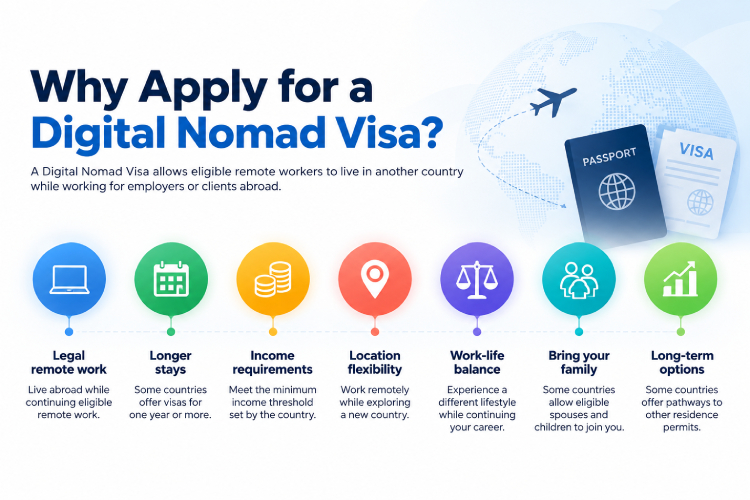
A Digital Nomad Visa allows eligible remote workers to live in another country while working for employers or clients abroad. Benefits and conditions vary by country.
- Legal remote work: Live abroad while continuing eligible remote work.
- Longer stays: Some countries offer visas for one year or more, with renewal options.
- Income requirements: Applicants must meet the minimum income threshold set by their chosen country.
- Location flexibility: Work remotely while exploring a new country, subject to visa conditions.
- Work-life balance: Experience a different lifestyle while continuing your career.
- Bring your family: Some countries allow eligible spouses and children to join you.
- Long-term options: Some countries offer pathways to other residence permits, but permanent residency is not guaranteed.
Eligibility Criteria for a Digital Nomad Visa
The requirements depend on the country you choose. Common eligibility criteria include:
- Age: You may need to be at least 18 years old.
- Minimum income: You must meet the country's required income level.
- Remote work: You must work remotely for an eligible foreign employer or clients.
- Proof of employment: You may need an employment contract, client contracts or proof of self-employment.
- Health insurance: You may need valid health insurance for your stay.
- Clean criminal record: Some countries require police certificates.
- Valid passport: Your passport must meet the country's validity rules.
For example, Spain generally requires a minimum monthly income of €2,442 for a single applicant in 2026, while Portugal's digital nomad residence visa generally requires an average monthly professional income of €3,680. Requirements can change and depend on your circumstances.
Requirements for a Digital Nomad Visa
You may need to provide the following documents when applying:
- A completed and signed visa application form.
- A valid passport that meets the country’s requirements.
- Proof of remote work, such as an employment letter or client contracts.
- Proof of income, such as bank statements, payslips or tax records.
- Valid health insurance for your stay.
- Police clearance certificates, if required.
- Marriage or birth certificates if family members are applying with you.
- Proof of accommodation, if required.
- Proof of payment of the visa application fee.
Different Types of Digital Nomad Visas
Several countries allow people to live there while working remotely for employers or clients abroad. However, not every country offers a dedicated Digital Nomad Visa. Each country has its own income, work and visa requirements.
Canada does not offer a specific Digital Nomad Visa. However, eligible remote workers can enter as visitors and continue working for employers or businesses based outside Canada, subject to visitor rules.
Key requirements:
- Work remotely for a company or business based outside Canada.
- Have a valid visitor visa or electronic travel authorisation (eTA), if required.
- Show that you can support yourself during your stay.
- Follow the conditions of your visitor status.
Eligible visitors can generally stay for up to six months, depending on the permission granted. This option does not allow you to take a job in the Canadian labour market without the required authorisation.
Spain offers a Digital Nomad Visa for eligible remote employees, freelancers and self-employed professionals who work mainly for companies or clients outside Spain.
Eligibility and requirements:
- Have a job or business that can be done remotely.
- Meet the required education or work experience criteria.
- Provide proof of employment or client contracts.
- Have suitable health insurance.
- Meet the minimum income requirement.
Income requirement: In 2026, a single applicant generally needs to earn around €2,849 per month. Additional income is required if family members join the application. Confirm the current amount before applying.
3. Portugal Digital Nomad Visa (D8)
Portugal's D8 Visa allows eligible remote workers to live in Portugal while working for a foreign employer or clients abroad. It is different from the D7 Visa, which is mainly for people with passive income.
Eligibility and requirements:
- Work remotely for a foreign company or clients.
- Provide an employment contract, employer letter or client contracts.
- Show proof of income and accommodation.
- Have suitable health insurance.
- Submit a valid passport and other required documents.
Income requirement: The estimated 2026 requirement is around €3,680 per month. Check the latest amount before applying, as the threshold may change.
Italy introduced its Digital Nomad Visa in 2024 for eligible highly skilled remote workers and professionals.
Eligibility and requirements:
- Meet Italy's requirements for highly skilled work.
- Provide proof of remote employment or self-employed work.
- Show at least six months of relevant work experience.
- Have health insurance and suitable accommodation.
- Provide proof of sufficient income.
Income requirement: An annual income of approximately €28,000 has been used as a reference figure. The exact requirement depends on the applicable rules, so confirm it with the Italian consulate before applying.
5. Croatia Digital Nomad Residence Permit
Croatia allows eligible non-EU/EEA/Swiss citizens to live in the country while working remotely for a company or business based outside Croatia.
Eligibility and requirements:
- Work remotely for a foreign employer or your own foreign-registered business.
- Provide proof of remote work.
- Have a valid passport and health insurance.
- Provide a police certificate if required.
- Show that you have enough money to support yourself.
Income requirement: The stated 2026 estimate is around €3,622.50 per month, or savings of €43,470 for a 12-month stay. Additional funds may be needed for family members. Eligible applicants may receive temporary residence for up to 18 months.
Steps to Apply for a Digital Nomad Visa
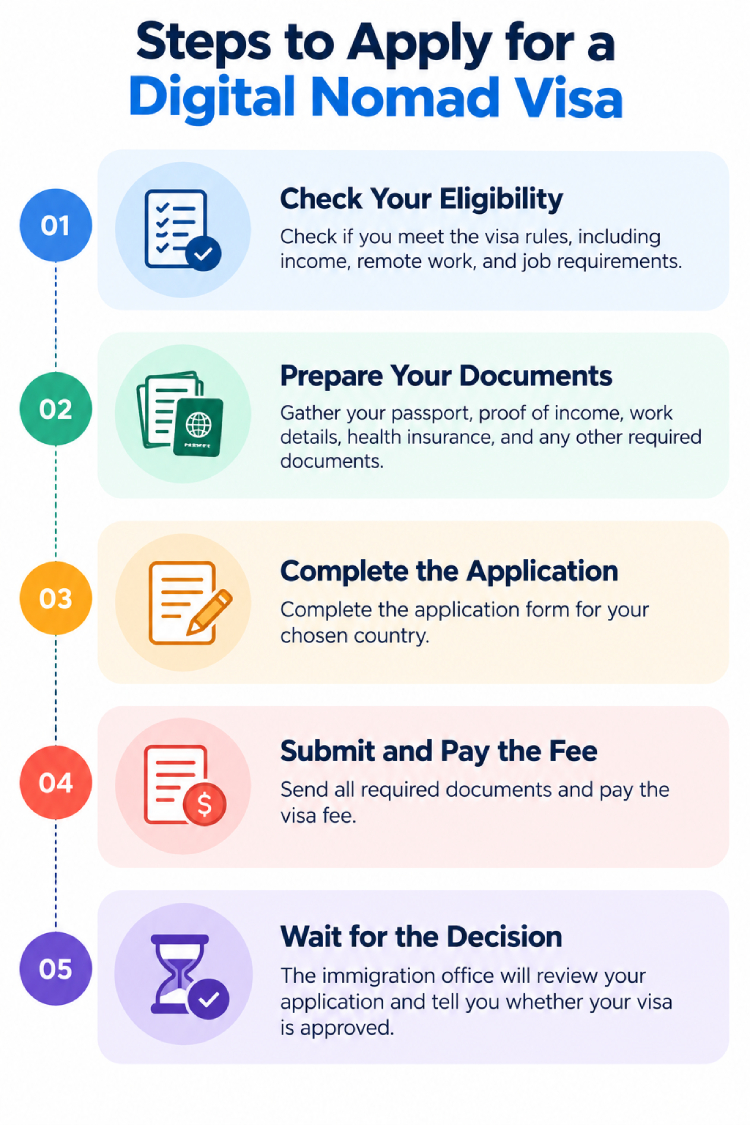
Step 1: Check if you meet the visa rules, including income, remote work, and job requirements.
Step 2: Gather your passport, proof of income, work details, health insurance, and any other required documents.
Step 3: Complete the application form for your chosen country.
Step 4: Send all required documents and pay the visa fee.
Step 5: The immigration office will review your application and tell you whether your visa is approved.
Digital Nomad Visa Fees
Visa fees and income rules vary by country. The amounts below are estimates and may change.
| Country | Minimum Income Requirement | Approximate Fee |
|---|---|---|
| Italy | About €24,789 per year | €116 |
| Norway | No dedicated Digital Nomad Visa | Not applicable |
| Portugal | About €3,680 per month | About €90 |
| Spain | About €2,442 per month | Varies by application location |
| Canada | No dedicated Digital Nomad Visa | CAD 100 for a visitor visa, if required |
Digital Nomad Visa Processing Time
Processing time depends on the country and your application.
| Country | Approximate Processing Time |
|---|---|
| Italy | Depends on the consulate |
| Norway | No dedicated Digital Nomad Visa |
| Portugal | Around 60 days |
| Spain | Some applications may take around 10 days, but delays are possible |
| Canada | Visitor visa processing times vary by country |
Note: Canada and Norway do not have a dedicated Digital Nomad Visa. Their details are included for comparison only. Visa fees, income rules, and processing times may change, so check the latest rules before applying.
Does Australia Offer a Digital Nomad Visa?
Australia does not currently offer a specific Digital Nomad Visa. Australians who want to work remotely while living overseas can apply for remote-work visas offered by countries such as Spain, Portugal, Italy, Greece, Croatia and the UAE. Foreign nationals who want to visit Australia while working remotely must follow Australian visa rules. A visitor visa or Electronic Travel Authority (ETA) does not give general permission to work in Australia. Your work rights depend on your visa conditions and personal circumstances.
Digital Nomad Visa Comparison for 2026
The table below compares popular digital nomad visa options. Income amounts are approximate and may change based on government rules and exchange rates.
| Country | Approx. Annual Income (EUR) | Typical Stay | Renewal | Can Family Join? | Tax Information |
|---|---|---|---|---|---|
| UAE | €39,000 | 1 year | Renewable | Generally yes, subject to conditions | Personal tax depends on your situation and income type. |
| Spain | €29,304 | Varies by visa type; residence permission may last up to 3 years | Possible | Yes, eligible family members may join | Staying over 183 days may make you a tax resident. Some workers may qualify for a special tax scheme. |
| Portugal | About €44,160 | Depends on the visa or residence permit | Possible | Generally yes | Staying over 183 days may make you a tax resident. Other rules can also apply. |
| Italy | Check the current requirement | Usually up to 1 year initially | Possible | Family options may be available | Tax depends on how long you stay and your personal circumstances. |
| Greece | About €42,000 | Up to 1 year on the visa; longer stays may be possible through a residence permit | Possible | Yes, subject to requirements | Staying over 183 days may make you a tax resident. |
| Croatia | €43,470 for a 12-month stay | Up to 18 months | Restrictions apply | Yes, subject to requirements | Tax depends on your residence status and income. |
Note: Income figures are estimates, not guaranteed current thresholds. Check the latest requirements before applying.
Digital Nomad Visa: Tax and Health Insurance
Tax rules
- 183-day rule: Spain, Italy and Greece may treat you as a tax resident if you spend more than 183 days there in a year. Other rules can also apply.
- Spain: Some eligible workers may qualify for a special tax scheme known as the Beckham Law. Approval is not automatic.
- Portugal: Spending more than 183 days in Portugal may make you a tax resident. Other conditions can also affect your status.
- UAE: The UAE generally does not charge personal income tax on employment income, but tax rules in your home country may still apply.
- Croatia: Your tax obligations depend on how long you stay, your income and the applicable tax rules.
- Australia: Australians moving overseas may still have Australian tax obligations, depending on their tax residency and circumstances.
Health insurance
Most digital nomad visa programmes require suitable health insurance. Before applying, check that your policy covers your entire stay and includes emergency medical treatment. Some countries may also require you to register with their local healthcare system.
Important: Visa, tax and insurance rules differ by country and can change. Check the current requirements before making travel plans.
How can Y-Axis help you?
Y-Axis, The world’s number 1 overseas immigration consultation with 25+ years of experience assists you through your journey to become a Digital Nomad in Portugal. We help you take the right step at every stage of the journey.
We assist you in the following ways:
- Job Search Services to find relatable
- Complete guidance to convert a Digital Nomad Visa to a Citizenship
- Expert guidance in arranging a checklist of documents
Don't know what to do ?.
Get Free Counseling
Frequently Asked Questions

