


Don't know what to do ?.
Get Free Counseling
Last Updated: 22 October 2026
Australia Partner Visa (Subclass 820 & 801): Requirements, Fees & Application
Australia offers a Partner Visa pathway for couples who want to build their life together in the country. It provides an opportunity for eligible partners to live together in Australia, with a pathway from temporary residency to permanent residency.
The onshore Partner Visa allows the married or de facto partner of an Australian citizen, permanent resident, or eligible New Zealand citizen to stay in Australia and work towards permanent residency. You submit one combined application for both visa stages, with a fee of AUD 11,710 (from 1 July 2026). The temporary Subclass 820 visa usually takes 22 to 30 months to process, while the permanent Subclass 801 visa is generally assessed around two years after you apply. While waiting, you can live, work, and study in Australia, subject to the visa conditions.
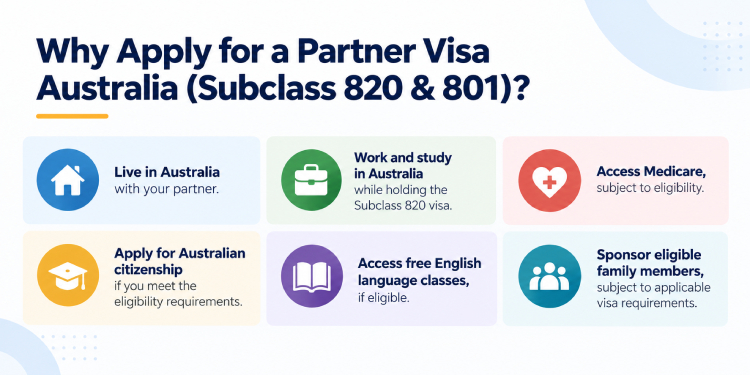
Why Apply for a Partner Visa Australia (Subclass 820 & 801)?
- Live in Australia with your partner.
- Work and study in Australia while holding the Subclass 820 visa.
- Access Medicare, subject to eligibility.
- Apply for Australian citizenship if you meet the eligibility requirements.
- Access free English language classes, if eligible.
- Sponsor eligible family members, subject to applicable visa requirements.
Partner Visa Subclass 820 & 801
The Partner Visa Subclass 820 and 801 allows the spouse or de facto partner of an Australian citizen, permanent resident, or eligible New Zealand citizen to live in Australia. Subclass 820 is the temporary visa, while Subclass 801 is the permanent visa. To apply for Subclass 801, you generally need to hold a Subclass 820 visa and meet the relevant eligibility requirements. The permanent visa allows you to live, work, and study in Australia indefinitely.
As a Partner Visa holder, you may also be eligible to:
- Attend free English classes through the Adult Migrant English Program.
- Access Medicare, subject to eligibility.
- Sponsor eligible family members under the applicable visa rules.
- Apply for Australian citizenship if you meet the citizenship requirements.
Benefits of Partner Visa Subclass 820 & 801
- Live in Australia: Subclass 801 allows you to live in Australia permanently.
- Work and study: You can work and study in Australia, subject to the conditions of your visa.
- Travel internationally: Subclass 801 generally allows travel to and from Australia for five years from the date the visa is granted. After that, you may need a Resident Return Visa (RRV) to return as a permanent resident.
- Travel while on Subclass 820: You can travel to and from Australia while your temporary visa remains valid and its travel conditions permit.
- Access healthcare: You may be eligible to enrol in Medicare.
- Apply for Australian citizenship: Once you hold the permanent Subclass 801 visa and meet the residence and other eligibility requirements, you can apply for Australian citizenship.
*Want to apply for citizenship in Australia? Contact Y-Axis for complete guidance and support
Eligibility Criteria for Partner Visa Subclass 820 & 801
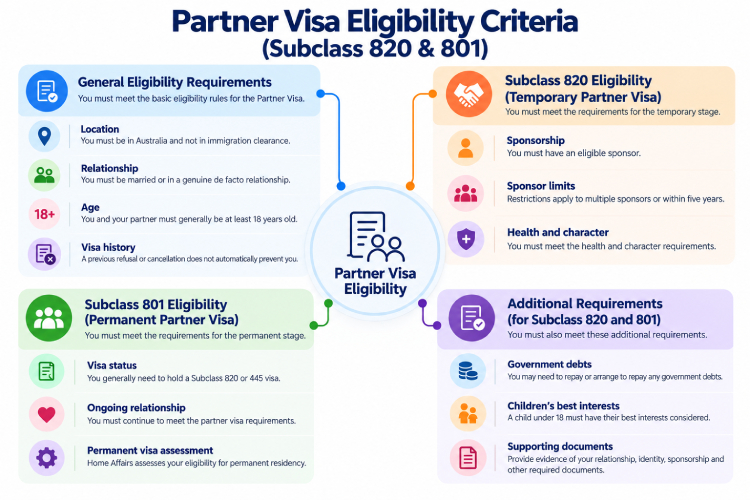
To apply for the Australian Partner Visa Subclass 820 and 801, you must meet the relationship, sponsorship, health, character and other visa requirements. Subclass 820 is the temporary stage, while Subclass 801 is the permanent stage.
General Eligibility Requirements
- Location: You must generally be in Australia and not in immigration clearance when applying for Subclass 820. Any family members included in the application must meet the relevant location requirements.
- Relationship: You must be married to or in a genuine de facto relationship with an Australian citizen, Australian permanent resident, or eligible New Zealand citizen.
- Age: You and your partner must generally be at least 18 years old, subject to applicable exceptions.
- Visa history: A previous visa refusal or cancellation does not automatically prevent you from applying, but special rules may apply. Seek advice from a registered migration agent if this affects you.
Subclass 820 Eligibility (Temporary Partner Visa)
- Sponsorship: You must have an eligible sponsor who meets the Australian Government's sponsorship requirements.
- Sponsor limits: Restrictions generally apply to sponsoring multiple partners or sponsoring another partner within five years. Exceptions may be available in certain circumstances.
- Health and character: You must meet the relevant health and character requirements. Family members may also need to complete checks if requested.
Subclass 801 Eligibility (Permanent Partner Visa)
- Visa status: You generally need to hold a Subclass 820 visa or a Subclass 445 Dependent Child visa, depending on your circumstances.
- Ongoing relationship: You must continue to meet the relevant partner visa relationship requirements, subject to applicable exceptions.
- Permanent visa assessment: Home Affairs assesses your eligibility for permanent residency under the applicable rules.
Additional Requirements for Subclass 820 and 801
- Government debts: You may need to repay any outstanding debts to the Australian Government or make acceptable arrangements to repay them.
- Children’s best interests: If a child under 18 is affected by the application, their best interests must be considered.
- Supporting documents: Provide evidence of your relationship, identity, sponsorship and any other documents required for your application.
Requirements for Partner Visa 820 and 801
You must meet the relevant eligibility requirements for the Australian Partner Visa Subclass 820 and 801.
For Subclass 801
- You generally need to hold a Partner Visa Subclass 820 or a Dependent Child Visa Subclass 445, depending on your circumstances.
For Subclass 820
- Age: You must generally be at least 18 years old.
- Visa history: A previous visa refusal or cancellation does not automatically prevent you from applying, but special rules may apply.
- Health and character: You must meet the applicable health and character requirements.
- Sponsorship: You must have an eligible sponsor and provide the required sponsorship details.
For Both Subclass 820 and 801
- Government debts: You may need to repay outstanding debts to the Australian Government or make acceptable arrangements to repay them.
- Relationship: You must meet the relevant relationship requirements.
- Children’s best interests: The grant must be in the best interests of any child under 18.
Partner Visa Subclass 820 and 801 Checklist
Follow this checklist to prepare for your Australian Partner Visa Subclass 820 and 801 application.
For Subclass 820
- Meet the eligibility requirements: Prepare documents covering your relationship, sponsorship, age, health and character requirements.
- Apply from Australia: You must generally be in Australia and not in immigration clearance when applying for Subclass 820.
For Subclass 801
- Provide updated relationship evidence: Home Affairs generally assesses your permanent Subclass 801 visa about two years after you lodged the combined application. You will be asked to provide updated evidence that your relationship meets the requirements.
- Respond to requests on time: Follow the instructions and deadlines provided by Home Affairs when submitting additional documents.
For Both Subclass 820 and 801
- If your visa is granted: You will receive confirmation with details such as your visa grant number and the date your visa takes effect.
- If your application is refused: Home Affairs will notify you of the decision and provide relevant information about the refusal.
- Application fees: The application charge is generally non-refundable, except in limited circumstances.
Relationship Evidence Checklist for Partner Visa
The Australian Department of Home Affairs checks four main areas of your relationship. You can use this checklist to prepare your documents.
| Category | Documents Required |
|---|---|
| Financial | Joint bank statements, shared property documents, joint loans or bills, and proof of shared expenses. |
| Household | Joint rental agreements, utility bills, proof of living at the same address, and evidence of shared household duties. |
| Social | Travel bookings together, photos with family and friends, event invitations, and statements from friends or family (Form 888). |
| Commitment | Messages, call records, relationship history, future plans, and shared insurance or financial nominations. |
Steps to Apply for a Partner Visa (Subclass 820)
Step 1: Check whether you meet the visa requirements.
Step 2: Create an ImmiAccount on the Australian Department of Home Affairs website.
Step 3: Collect your identity, relationship, sponsorship and other required documents.
Step 4: Complete the online application, upload your documents and pay the visa fee.
Step 5: Complete health examinations and police checks when required.
Step 6: If eligible, you may receive a Bridging Visa A (BVA), which generally allows you to remain in Australia while your application is processed. It usually becomes active when your current visa expires.
Step 7: Wait for Home Affairs to assess your application and notify you of its decision.
Partner Visa Fees & Charges (Subclass 820 & 801)
You pay the Visa Application Charge (VAC) when submitting your Partner Visa application. The fee depends on your circumstances and whether you include family members.
| Applicant Category | Visa Application Fee |
|---|---|
| Main applicant | AUD 8,850 (approx.) |
| Additional applicant aged 18 or above | AUD 4,430 (approx.) |
| Additional applicant under 18 | AUD 2,215 (approx.) |
| Eligible Subclass 300 visa holder applying for a Partner Visa | Reduced fee of approximately AUD 1,410 |
Processing Times for Partner Visa Subclass 820 and 801
Processing times depend on several factors, including:
- Whether you submit all the required documents.
- Whether your application is complete and accurate.
- How long Home Affairs takes to check your information.
- Whether additional documents or checks are needed.
The table below shows the processing times provided in the original content.
| Visa Type | 25% of Applications | 50% of Applications | 75% of Applications | 90% of Applications |
|---|---|---|---|---|
| Subclass 820 (Temporary) | 6 months | 11 months | 25 months | 34 months |
| Subclass 801 (Permanent) | 81 days | 5 months | 9 months | 16 months |
Partner Visa Application Timeline (Subclass 820 → 801)
When you apply for an Australian Partner Visa from within Australia, you apply for both the temporary Subclass 820 visa and the permanent Subclass 801 visa at the same time. The applications are processed in stages.
Step 1 – Submit Your Application
Apply online through ImmiAccount for both visas. Your Australian partner must also submit a sponsorship application.
Step 2 – Get a Bridging Visa
Most applicants receive a Bridging Visa A (BVA), which allows them to stay in Australia lawfully while waiting for a decision. It usually starts when their current visa expires. If you want to travel overseas, you must get a Bridging Visa B (BVB) before leaving Australia.
Step 3 – Get the Temporary Partner Visa (Subclass 820)
Home Affairs reviews your application, relationship evidence and eligibility. If approved, the Subclass 820 visa lets you live, work and study in Australia while waiting for the permanent visa.
Step 4 – Get the Permanent Partner Visa (Subclass 801)
Home Affairs usually assesses your permanent visa application about two years after you submit the combined application. In some cases, such as long-term relationships, both visas may be granted at the same time. This is called a “double grant.”
Bridging Visa Guide (BVA vs BVB) While Your Partner Visa Is Processing
Most onshore applicants get a Bridging Visa A (BVA) when they lodge their Partner Visa application. Here is how it works while you wait.
When Does Your Bridging Visa Start?
- Your bridging visa generally starts when your current substantive visa expires.
- Until then, you must follow the conditions of your current visa.
- Once active, the bridging visa allows you to stay lawfully in Australia while your application is being processed.
Can You Travel While Waiting?
- A Bridging Visa A (BVA) lets you stay in Australia but does not allow you to leave and return on that visa.
- If you need to travel overseas, apply for a Bridging Visa B (BVB) before leaving Australia.
- A BVB allows you to leave and return within its approved travel period.
Can You Work and Study?
- Your work rights depend on the conditions of your bridging visa.
- Some applicants can work without restrictions, while others may have work limits.
- Check your visa grant letter or Visa Entitlement Verification Online (VEVO) to confirm your conditions.
- If your BVA has work restrictions, you may be able to request a change by providing reasons and supporting documents, such as evidence of financial hardship.
Quick Comparison: BVA vs BVB
| Bridging Visa | When It Starts | Travel Rules | Work Rights | How to Apply or Make Changes |
|---|---|---|---|---|
| BVA (Subclass 010) | Usually when your current substantive visa expires | Does not allow you to leave and return to Australia on the BVA | Depends on your visa conditions | You may request a change to work conditions if eligible |
| BVB (Subclass 020) | When granted for travel while your application is being processed | Allows you to leave and return during the approved travel period | Depends on your visa conditions | Apply before travelling and provide the required details and documents; a fee may apply |
De Facto Relationship Requirements
If you are applying for an Australian Partner Visa as a de facto partner, you generally need to show that you have been in a genuine relationship for at least 12 months immediately before applying.
You may not need to meet the 12-month requirement if:
- Your relationship is registered under the relevant Australian state or territory law.
- Compelling and compassionate circumstances apply, such as certain situations involving dependent children.
When Can Subclass 820 and 801 Be Granted Together?
In some cases, Home Affairs may grant the temporary Subclass 820 visa and permanent Subclass 801 visa at the same time. This is often called a double grant.
You may qualify for consideration if, when you apply:
- You have been in a relationship with your partner for at least 3 years, or
- You have been in the relationship for at least 2 years and you and your partner have a dependent child together.
Meeting these timeframes does not guarantee a double grant. Home Affairs must assess your circumstances and all relevant requirements.
Partner Visa Places for 2026–27
The planning figure provided for the 2026–27 Migration Program is 41,500 Partner visa places, up from 40,500. Partner visas are demand-driven, so this planning figure is not a strict limit on the number of eligible applicants who can receive a visa.
Total Partner Visa Cost: What Else Should You Budget For?
The visa application charge is not the only cost. You may also need to pay for medical checks, police certificates, document translations and travel permissions.
| Expense | What to budget for |
|---|---|
| Partner visa application | From AUD 11,710 for most applicants. |
| Medical examination | Depends on the clinic and tests required. |
| Police certificates | Varies by country and certificate type. |
| Document translation | Depends on the number of documents and language. |
| Bridging Visa B | An additional fee may apply if you need to travel overseas while waiting. |
Onshore vs Offshore Partner Visa vs Prospective Marriage Visa
| Feature | Onshore Partner Visa (820/801) | Offshore Partner Visa (309/100) | Prospective Marriage Visa (300) |
|---|---|---|---|
| Who it is for | Married or de facto partners applying in Australia | Married or de facto partners applying from outside Australia | Fiancés who plan to marry in Australia |
| Where you must be when applying | In Australia | Outside Australia | Outside Australia |
| Visa application fee | From AUD 11,710 for most applicants | From AUD 11,710 | From AUD 11,710 |
| Permanent pathway | Temporary 820, then permanent 801 | Provisional 309, then permanent 100 | Usually marry and then apply for Partner Visa 820/801 |
| Processing time | Check the official processing guide | Check the official processing guide | Check the official processing guide |
| Travel while waiting | A Bridging Visa A does not allow re-entry; an eligible applicant may apply for a Bridging Visa B | You generally remain outside Australia while the application is processed, subject to any other visa you hold | Travel rights depend on your current visa and circumstances |
What Happens if Your Relationship Ends?
If your relationship ends while your Partner Visa application is being processed, you may still qualify for a permanent visa in certain circumstances. These can include:
- Family violence: You or a family member included in the application experienced family violence by the sponsoring partner.
- Death of your partner: Your sponsor has died and the relevant requirements are met.
- A child together: You and your former partner have a child and share parental responsibility or access, where the relevant visa rules apply.
Family violence provisions can apply to eligible Partner Visa applicants even after the relationship ends. Evidence requirements depend on your situation and may include court orders, police records, medical reports, or statements and other evidence permitted by Home Affairs.
Sponsor Checks and Requirements
The Australian partner sponsoring an applicant must meet the sponsorship requirements. Home Affairs may consider their previous sponsorship history and relevant criminal history.
- Previous sponsorships: Limits apply to how many partners a person can sponsor and how soon they can sponsor another partner. Exceptions may apply.
- Police checks: Sponsors may need to provide police certificates and details of relevant convictions. Additional checks and requirements may apply when children under 18 are included in the application.
- Accurate information: Sponsors must disclose relevant previous sponsorships and provide truthful information.
Common Reasons a Partner Visa May Be Refused
A Partner Visa application may be refused if the applicant does not provide enough evidence or does not meet the visa requirements. Common problems include:
- Weak relationship evidence: Documents do not clearly show shared finances, household arrangements, social recognition or long-term commitment.
- Inconsistent information: Addresses, relationship dates or details in forms and supporting documents do not match.
- Insufficient de facto relationship history: The applicant cannot show the required relationship period and does not qualify for an exception.
- Missing information: Required documents, health checks or police certificates are not provided when requested.
- Undisclosed sponsorship history: The sponsor does not disclose previous sponsorships or relevant information.
- Failure to meet other visa criteria: The applicant or sponsor does not meet a relevant legal requirement.
How to reduce the risk: Check every answer for accuracy, provide clear and consistent evidence, disclose relevant information and respond to Home Affairs requests by the deadline. Meeting these steps does not guarantee approval, but it can help avoid common application problems.
How Can Y-Axis Help You?
With our vast experience in Australian immigration, Y-Axis can help you understand and navigate the process with complete confidence. Our services include:
- Eligibility Evaluation
- Immigration Checklist
- Complete Application processing
- Assisting in arranging the requirements
- Updates & follow up
Our Accreditations |
|||
 |
 |
 |
 |
Proud Sponsor of |
|||
 |
 |
||
Don't know what to do ?.
Get Free Counseling
Looking for Inspiration
Explore what Global Citizens have to say about Y-Axis in shaping their future
Frequently Asked Questions

