


Don't know what to do ?.
Get Free Counseling
Last Updated: 11-May-2026
Australia Visitor Visa (Subclass 600)
Australia is a dream destination for travelers worldwide, known for its stunning beaches, iconic landmarks, vibrant cities, and welcoming culture. From the golden sands of Bondi Beach to the dramatic landscapes of Uluru and the cosmopolitan charm of Sydney and Melbourne, Australia offers experiences that suit every type of traveler.
If you're planning a trip, applying for an Australia visitor visa is the first and most important step. This visa—often referred to as an Australian tourist visa or visitor visa Australia allows you to enter the country legally for tourism, family visits, or short-term business purposes.
The process is straightforward and fully online. Once approved, your Australian visitor visa gives you the flexibility to travel confidently, knowing your stay complies with immigration regulations. Whether it’s your first visit or you’re returning to explore more, securing the right visa ensures a smooth travel experience.
Australia Tourist Visa– Key Highlights
- 91% Approval Rate: 2.5M+ visitor visas granted in early 2024–25
- Ready: High demand expected for Australian Visitor Visa– apply early for smooth travel
- Flexible Stays: Visit up to 12 months for tourism, family, or short business trips
- Simple Online Process: Apply easily via official ImmiAccount portal
- Multiple Visa Options: Visa 600, ETA 601, or eVisitor 651 available based on your nationality
If you are an Australian citizen, you do not require a visa to enter or live in the country. However, dual citizens must travel using an Australian passport to avoid unnecessary complications.
Permanent residents should ensure they hold a valid Resident Return Visa (subclass 155 or 157) before traveling overseas. Without it, re-entry into Australia may not be permitted.
From Visiting to Settling: Migration Pathways and Career Prospects
While many people begin with an Australia visitor visa, some later explore skilled migration pathways such as the 190 visa, which allows nominated skilled workers to live and work permanently in Australia.
Australia’s strong economy is another reason travelers consider long-term opportunities. The country maintains a competitive Australian median wage, and the overall average income Australia figures reflect a stable job market and high standard of living. Reviewing the median income Australia data can help skilled professionals assess whether migration aligns with their career goals. In addition, several Australian working visas are available for qualified professionals seeking employment opportunities.
If you’re planning multi-country travel from Australia, visa requirements vary by destination. For example, you may need a visa for Vietnam from Australia, an Indonesia visa or Indonesia travel visa, or even a visa for USA from Australia, depending on your nationality and travel plans.
*Want to migrate to Australia? Talk to Y-Axis for complete guidance.
Types of Australian Visit Visa
Australia offers several visitor visa categories under Visitor Visa 600 to suit different travel purposes. Each stream within the subclass is tailored to the traveler’s intent—whether for tourism, business, or family visits. These visas help ensure lawful entry, clearly define your permitted activities, and determine the length of your stay.
Tourist Visitor (Visa 600 – Tourist Stream)
The Tourist Visitor stream is designed for people who wish to visit Australia for:
- Holidays and sightseeing
- Visiting friends or relatives
- Other recreational activities, such as attending cultural or social events
This visa allows stays of up to 3, 6, or 12 months, based on your travel history, application strength, and the discretion of the case officer. You can apply either from outside Australia or, in some cases, from within the country if you are already on a temporary visa.
Key Features:
- Cannot engage in paid work
- May study or train for up to 3 months
- Multiple-entry options available for frequent travelers
Business Visitor (Visitor Visa 600 – Business Visitor Stream)
The Business Visitor stream is intended for individuals coming to Australia for short-term, non-work-related business activities. This includes:
- Attending business meetings or conferences
- Participating in trade negotiations
- Exploring investment or business opportunities
It is important to note that this visa does not allow the sale of goods or services, nor does it permit full employment in Australia.
Key Features:
- Typically valid for up to 3 months
- Cannot be used for formal employment or work contracts
- Must demonstrate genuine business purpose and financial backing
This visa is ideal for business professionals looking to explore Australia’s commercial landscape without engaging in hands-on work.
Family Visitor Visa (Subclass 600 – Sponsored Stream)
The Sponsored Family stream is for travelers who plan to visit close family members in Australia and require a formal sponsorship from their Australian relative. This visa may be requested by the Department of Home Affairs when there is a need to strengthen ties and ensure the visitor leaves Australia on time. Who can Sponsor:
- Australian citizens
- Australian permanent residents
- Eligible New Zealand citizens
Key Features:
- The sponsor may be asked to provide a security bond (AUD 5,000–15,000), refundable upon the visitor’s timely departure
Note: Each of these visa streams plays a specific role in ensuring travel to Australia is well-regulated, convenient, and aligned with the traveler’s purpose. Whether you’re a tourist, business professional, or visiting family, there’s a pathway to suit your needs.
Australia Visitor Visa: ETA 601, eVisitor 651 & Visitor 600
Australia offers several visitor visa options depending on your nationality, purpose of travel, and how long you wish to stay. Below is a comparison of the three main visa types to help you choose the right one for your travel plans.
| Visa Type | Eligibility | Cost | Validity | Typical Processing Time* |
|---|---|---|---|---|
| ETA (Electronic Travel Authority, subclass 601) | Available to passport holders from selected countries (mainly non-EU, including the US, Canada, Singapore, Japan, among others). Application must be made via the Australian ETA app outside Australia. | AUD 20 service fee (no separate application charge) | Valid for 12 months with multiple entries; stay up to 3 months each visit | Often very fast, sometimes within minutes, but may take longer if further checks are required |
| eVisitor (subclass 651) | Available to citizens of eligible European Union and European Economic Area countries applying from outside Australia. | Free (no visa application charge) | Valid for 12 months with multiple entries; stay up to 3 months each visit | Generally fast; most are processed quickly, but times can vary depending on application volumes |
| Visitor Visa (subclass 600) | Open to applicants from any country, including those not eligible for ETA or eVisitor. Streams include Tourist, Business Visitor, and Sponsored Family. | From AUD 145 if applying outside Australia; from AUD 365 if applying inside Australia | Usually granted for 3, 6, or 12 months, depending on the stream and individual circumstances | Varies; many are processed within a few weeks, though times differ based on case complexity and peak periods |
Benefits of an Australian Tourist Visa
- Extended Stay Options: Depending on the visa type, visitors can stay in Australia for up to 12 months.
- Multiple Entries: Some visas allow multiple entries, enabling travelers to leave and re-enter Australia during the visa's validity.
- Flexibility: Visas cater to various purposes, including tourism, visiting family, or short-term business activities.
- Online Application: Most tourist visas can be applied for online, streamlining the process.
- Support Services: Applicants have access to resources and assistance throughout the visa application process
Eligibility for an Australian Visit Visa
To be eligible for an Australian Tourist Visa, applicants must:
- Have a Valid Passport: Ensure your passport is valid for the duration of your stay.
- Be a Genuine Visitor: Intend to stay temporarily in Australia for tourism, visiting family, or business purposes.
- Have Sufficient Funds: Demonstrate the financial means to support yourself during your stay and for your return journey.
- Meet Health and Character Requirements: Undergo necessary health examinations and provide police certificates if required.
- Have No Outstanding Debts to the Australian Government: Settle any debts before applying for a visa.
Tourist Visa Australia Documents Required
Here’s a comprehensive Australia Visit Visa checklist to help you gather the necessary documents and complete the application process smoothly:
- Completed Visa Application Form: Filled accurately with all required information.
- Valid Passport: A copy of the biographical page of your passport.
- Photographs: Recent passport-sized photographs as per specifications.
- Financial Documents: Bank statements, payslips, or other evidence of sufficient funds.
- Travel Itinerary: Details of your planned activities in Australia.
Health and Character Documents: Medical examinations and police certificates, if requested.
What are the current Australia Visit Visa Charges?
There are different types of visit visas available for individuals looking to visit Australia for tourism, family visits, or business. The current Australia visit visa charges depend on the type of visa that you are applying for and the duration of your stay.
Below are the current Australia visit visa charges:
| Visa Type | Fee for Applicants Outside Australia | Fee for Applicants Inside Australia | Duration |
|---|---|---|---|
| Tourist Visa (Subclass 600) | AUD 150 | AUD 375 | Up to 12 months (depending on the visa grant) |
| Business Visitor Visa (Subclass 600) | AUD 150 | AUD 375 | 3, 6, or 12 months (depending on the purpose) |
| Electronic Travel Authority (ETA) (Subclass 601) | AUD 20 | N/A | Up to 3 months |
| eVisitor (Subclass 651) | Free | N/A | Up to 3 months |
| Transit Visa (Subclass 771) | AUD 20 | N/A | Typically 72 hours |
| Family Sponsored Visitor Visa (Subclass 600) | AUD 150 | N/A | Up to 12 months |
How to Apply for an Australian Visitor Visa?
The application process for an Australian visitor visa is straightforward and managed online through the Department of Home Affairs. Below are the key steps you will follow when lodging your application.
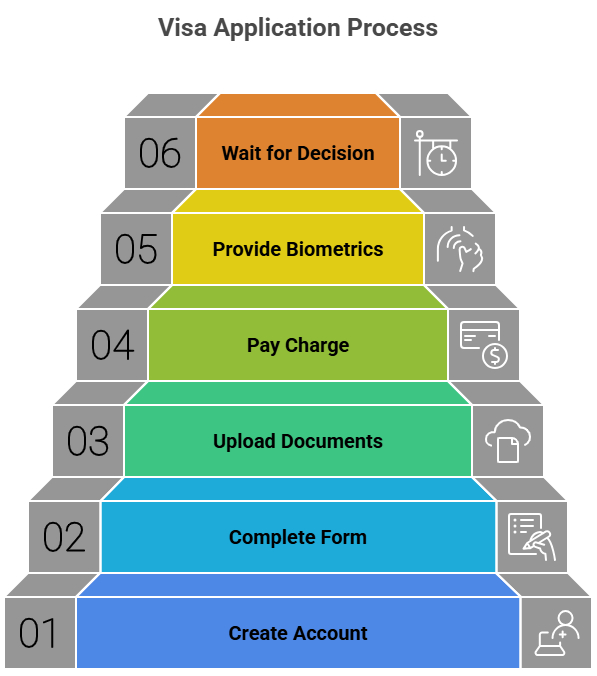
Step 1: Create an ImmiAccount
Start by creating or logging in to your ImmiAccount on the Department of Home Affairs website. This is the official portal for lodging and managing your visa application.
Step 2: Complete the Online Application Form
Select the appropriate visitor visa type (subclass 600, 601, or 651) and fill in all required details, including your travel plans, personal information, and supporting circumstances.
Step 3: Upload Supporting Documents
Attach required documents such as your passport bio page, evidence of funds, travel itinerary, and proof of ties to your home country. Ensure all documents are clear and legible to avoid delays.
Step 4: Pay the Visa Application Charge
Pay the relevant visa fee online using a valid payment method. Some visas, like the eVisitor (651), do not carry a charge, while others, such as the Visitor visa (600), have set fees.
Step 5: Provide Biometrics (if requested)
If you are applying from a country where biometrics are required, you will receive instructions after lodgement. You must book an appointment at a designated Australian Biometric Collection Centre (ABCC).
Step 6: Wait for Visa Processing and Decision
The Department of Home Affairs will assess your application. You may be asked for further information or health checks if required. Once a decision is made, you will be notified through your ImmiAccount, and your visa details can be checked using the VEVO system.
How to Check the Status of Your Australia Visit Visa?
Checking the status of your Australia visit visa is an essential part of the application process. Here’s how you can track your visa status:
Step 1: Log into ImmiAccount
Visit the Australian Government Department of Home Affairs website and log into your ImmiAccount.
Step 2: Access "My Applications”
Go to the "My Applications" section to view the status of your visa application.
Step 3: Receive Visa Outcome Notification
Check your email or ImmiAccount for the visa grant notification if approved.
Step 4: Use VEVO
For granted visas, check visa details and conditions through Visa Entitlement Verification Online (VEVO) using your passport or visa grant number.
Step 5: Contact the Visa Office
If you can’t access the status, contact the Australian visa office with your application details.
How to Apply for an Australian Visit Visa for Parents?
Step 1: Check Eligibility
Ensure your parents meet the criteria for a Visitor Visa (subclass 600) and that they are able to visit Australia for tourism or family visit purposes.
Step 2: Prepare Required Documents
Gather essential documents such as their valid passports, financial proof (to show they can support themselves), health insurance, invitation letter from the sponsoring child, and proof of family relationship.
Step 3: Complete the Application
Fill out the Visitor Visa (subclass 600) application form online through the official ImmiAccount platform.
Step 4: Pay the Visa Fee
- Make the visa application payment, which depends on the visa type and processing speed.
Step 5: Submit the Application
- Submit the completed application and documents via the ImmiAccount online portal.
Step 6: Provide Biometrics and Attend Interview (If Required)
- Some applicants may need to provide biometrics or attend an interview depending on individual circumstances.
Step 7: Wait for a Decision
Monitor the visa application status online or via email until the final decision is made.
Australia Visit Visa Processing Time
Processing times vary depending on the visa type and individual circumstances:
- Visitor Visa (subclass 600) – Tourist stream: 50% of applications processed in 13 days; 90% in 27 days.
- Visitor Visa (subclass 600) – Business Visitor stream: 50% in 39 days; 90% in 87 days.
- Visitor Visa (subclass 600) – Sponsored Family stream: 50% in 24 days; 90% in 36 days.
Note: Processing times are subject to change and can be influenced by factors such as application volume and completeness.
Fees for Australia visit visa
Below are the Australia visit visa processing costs, including the tourist visa fee Australia applicants need to pay when submitting their application.
| Visa Type | Visa Fee (AUD) |
|---|---|
| Visitor Visa (subclass 600) | AUD 145 |
| Tourist Stream (subclass 600) | AUD 145 |
| Sponsored Family Stream (subclass 600) | AUD 145 |
| Transit Visa (subclass 771) | AUD 70 |
| eVisitor (subclass 651) | Free |
| Electronic Travel Authority (ETA) | AUD 20 |
How to Avoid Delays in Your Australia Visitor Visa Application?
Submitting a complete, “decision-ready” application is the best way to avoid processing delays. Here are the key points to keep in mind:
- Submit a complete application
Ensure all details are accurate and consistent with your passport. Attach required documents such as your travel itinerary, proof of identity, and any supporting evidence.
- Provide evidence of ties to your home country
Include payslips, employer leave letters, enrollment certificates, or family documents that show you intend to return home after your visit.
- Show proof of sufficient funds
Attach recent bank statements or financial records demonstrating you can cover your expenses during your stay in Australia.
- Include your travel history
Document previous international trips to strengthen your application and establish credibility.
- Translate documents properly
Any non-English documents must be accompanied by certified translations that clearly identify the translator and their qualifications.
- Apply through ImmiAccount and stay responsive
Lodge your application online, agree to electronic communication, and check your account regularly. Respond quickly to any requests for additional information.
How Can Y-Axis Help You?
Navigating the visa application process can be complex. Y-Axis offers comprehensive support to ensure a smooth experience:
- Expert Guidance: Receive personalized advice on selecting the appropriate visa type.
- Document Preparation: Assistance in compiling and reviewing necessary documentation.
- Application Support: Step-by-step help in completing and submitting your application.
- Updates and Follow-Up: Regular updates on your application status and liaison with immigration authorities if needed.
- Sign up with Y-Axis for complete guidance about visit visa
With Y-Axis, you can confidently plan your Australian journey, knowing that experienced professionals are guiding you every step of the way.


.webp)

.webp)


Don't know what to do ?.
Get Free Counseling
Looking for Inspiration
Explore what Global Citizens have to say about Y-Axis in shaping their future
Frequently Asked Questions