

Study in Canada

Don't know what to do?
Get Free Counseling
Last Updated: 05-May-2026
Study in Canada: Complete Student Visa Guide
Canada's strong academic standing, safe environment, and inclusive multicultural atmosphere continue to draw students from around the world. For Australian students, applying for a Canada student visa is the first step toward studying in this welcoming country. Here's a quick look at some key points:
- In 2025, the Canadian government has capped new study permits in Canada at 437,000 to better manage housing, services, and academic resources for international students.
- Over 396,000 Post-Graduation Work Permit (PGWP) holders were working in Canada at the end of 2023, demonstrating strong career opportunities after graduation.
- Ontario continues to be the most popular destination, hosting over half of all new study permit recipients, with access to top-ranked Canadian universities and programs.
- Roughly 70% of international students aim to obtain a PGWP, and over half plan to pursue permanent residency, making early planning of a Canada student visa crucial.
- Despite recent caps on study permits, Canada remains a top destination due to its world-class education, multicultural environment, and clear pathways to work and residency.
*Want guidance to apply for study in Canada? Sign up with Y-Axis for comprehensive support.
Canada is welcoming 408,000 students in 2026
The Canadian government has released the 2026 study program distribution, setting a target of welcoming 408,000 international students.
| Category | Allocated Study Permits |
| PAL/ TAL required applicants | 1,80,000 |
| Master’s and doctoral students (PAL/TAL exempt) | 49,000 |
| Primary and secondary school (kindergarten to grade 12, also PAL/TAL exempt) | 1,15,000 |
| Other PAL/TAL-exempt study permit applicants | 64,000 |
| Total | 4,08,000 |
What is Canada Study Permit (Student Visa)?
In Canada, international students usually need a study permit from Immigration, Refugees and Citizenship Canada (IRCC) to attend specific schools (DLIs). If your program is longer than six months, you have to get this permit before you arrive. Depending on where you're from, you might also need a Temporary Resident Visa (TRV) or an Electronic Travel Authorization (eTA) to enter Canada.
The study permit states the conditions of your stay, like which school you can go to, what level of study you can do, and if there are any work restrictions. It's usually good for your program's length, plus an extra 90 days, which allows time to get ready to leave, apply for a work permit after graduation, or extend your stay for more study.
Types of Canada Study Visas & Permits
Detailed information about the student visas and permits for Canada is given below.
| Type of Visa/Permit | Purpose | Who Needs It | Validity |
|---|---|---|---|
| Study Permit | Authorises full-time study at a Designated Learning Institution (DLI). | International students enrolled in programs longer than 6 months. | Duration of the study program + 90 days. |
| Co-op/Internship Work Permit | Allows students to complete mandatory work placements as part of their course. | Students whose program includes a compulsory co-op or internship component. | Matches the length of the study permit. |
| Temporary Resident Visa (TRV) | Entry document required for visa-required countries to enter Canada. | Students from countries that are not visa-exempt. | Varies, usually matches study permit. |
| Electronic Travel Authorization (eTA) | Electronic entry requirement for visa-exempt travellers flying to Canada. | Students from visa-exempt countries (including Australia) travelling by air. | Up to 5 years or until passport expiry. |
Benefits of Studying in Canada for Australian Students
Canada is a top choice for students worldwide, including those from Australia, because it offers quality education, diverse cultures, and strong career prospects. Several Canadian universities rank among the world’s top 100, providing excellent academic programs with modern research and career-focused learning. A Canadian degree is recognized globally, improving job opportunities both in Canada and Australia.
Canada’s multicultural environment, with people from over 200 countries, helps international students adapt and feel comfortable. The country is safe, welcoming, and usually ranks high among the world’s safest nations, with cities focusing on student safety and quality of life. Canada also provides excellent options for work during and after graduation, along with clear pathways to permanent residency, making it a preferred choice for long-term study and career planning.
Top benefits of studying in Canada with a Canada Student Visa:
- Canadian degrees and diplomas hold global recognition, improving career opportunities both in Canada and internationally.
- You can attend top-ranked universities and colleges that offer updated facilities and research programs.
- The multicultural setting aids adaptation and the growth of international networks.
- Work in Canada is permitted part-time for international students while studying and full-time during breaks, in addition to co-op and internship programs.
- The Post-Graduation Work Permit (PGWP) offers a chance to gain Canadian work experience and provides pathways to Canada PR or permanent residency.
- Tuition and living costs are lower than in the US and the UK, while still keeping a high quality of life.
- Canada is a safe country for international students.
*Looking for guidance to study abroad? Y-Axis is here to support you with the process.
Eligibility Criteria for Canadian Student Visa for Australians
To study in Canada, Australian students must obtain a study permit if their full-time program at a recognized educational institution lasts longer than six months. Applicants are required to demonstrate that they can cover their tuition fees, living expenses, and return travel costs. They must also meet Canada’s health and personal ethics standards, which may include medical examinations or police clearance certificates.
A study permit is not required for programs shorter than six months. However, longer programs or those that include work placements (such as co-op or internship programs) will require a permit.
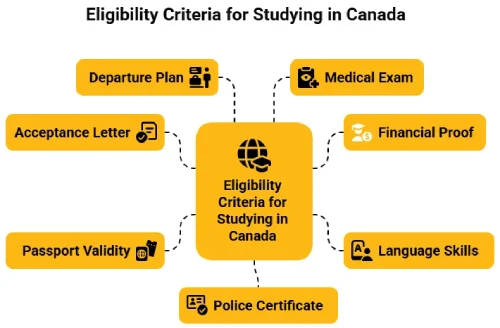
Eligibility Criteria include:
- A formal acceptance letter from a Canadian learning institution that is approved by the government.
- Proof that you have enough funds to pay for your tuition, living costs, and return trip. This includes money for any family members coming with you.
- Evidence of your English or French skills. You can show this through tests like IELTS, TOEFL, PTE, or TEF, if needed.
- A passport that will remain valid for your entire stay in Canada.
- Proof that you plan to leave Canada when your study permit ends, unless you are eligible to stay longer.
- You might need to pass a medical exam as required by Canadian immigration.
- You might need to provide a police certificate to prove you do not have a criminal record.
Documents Required to Study in Canada
To apply for a study permit, you must provide the following documents:
- A valid passport.
- An acceptance letter from a Designated Learning Institution (DLI).
- Proof you have enough money to support yourself (like bank statements or sponsor letters).
- Recent passport-sized photos that meet Canadian visa requirements.
- Completed application forms for the study permit.
- Proof of your English or French skills, if needed (like IELTS or TOEFL scores).
- Biometrics (fingerprints and photo), if asked for.
- Medical exam results, if IRCC requests them.
- A police clearance certificate, if asked for.
- Receipts that show you have paid your tuition fees or made a deposit.
How to apply for Canada student visa?
The process to apply for Canada Study Permit is given below:
Step 1: Get a letter of acceptance from a Designated Learning Institution, as well as any needed provincial attestation letter.
Step 2: Apply online by creating an IRCC account, filling out the application, uploading the needed documents, and paying the fees.
Step 3: Attend your biometrics appointment. Complete a medical exam if asked to do so.
Step 4: Track your application status and quickly respond to any requests from IRCC.
Step 5: Once your application is approved, you will get a port-of-entry letter. Get an eTA/TRV, if needed, and present your documents at the border to get your study permit.
Canada Student Visa Fees & Cost of Study
Detailed information about the cost of studying in Canada is given below:
| Expense Category | Average Cost (per year) |
|---|---|
| Study Permit Application | CAD 150 |
| Tuition Fees | CAD 20,000 – CAD 40,000 |
| Living Expenses | CAD 15,000 – CAD 20,000 |
| Health Insurance | CAD 600 – CAD 1,000 |
| Miscellaneous Costs | CAD 1,000 – CAD 2,000 |
Canada Study Permit Processing Time
Detailed information about the processing time for Canada Study Permit is given below.
| Application Location | Average Processing Time |
|---|---|
| From Australia | 2 – 6 weeks |
| From within Canada | 4 – 8 weeks |
| Via Student Direct Stream | Around 20 calendar days |
Scholarships for International Students in Canada
In Australia, students have access to scholarships from the government, universities, and private entities to help with expenses. These scholarships, often awarded based on merit, can cover tuition or living costs.
| Scholarship Name | Amount | What It Covers | Eligibility Criteria |
|---|---|---|---|
| Vanier Canada Graduate Scholarships | CAD 50,000/year for up to 3 years | Tuition, living expenses | Outstanding academic achievement in graduate studies; leadership skills; nominated by a Canadian institution. |
| Lester B. Pearson International Scholarship (University of Toronto) | Full tuition + books + incidental fees + residence for 4 years | Tuition, books, incidental fees, and residence | Exceptional academic achievement, creativity, and leadership; must be nominated by school. |
| University of British Columbia International Scholars Program | Up to full tuition + living expenses | Tuition and living costs | High academic performance and financial need; demonstrated leadership. |
| York University International Student Scholarship | CAD 20,000/year (renewable for up to 4 years) | Tuition | Strong academic record (minimum “A” average) and leadership qualities. |
| University of Manitoba Graduate Fellowships | CAD 14,000/year (Master’s), CAD 18,000/year (PhD) | Tuition and living expenses | Academic excellence; open to all nationalities; full-time graduate students. |
| Carleton University Entrance Scholarships | CAD 4,000 – CAD 16,000 | Tuition | Strong academic achievement; automatic consideration with admission. |
| University of Calgary International Entrance Scholarship | CAD 20,000/year (renewable) | Tuition | Exceptional academic performance and extracurricular involvement. |
| Humber College International Entrance Scholarships | CAD 2,000 – CAD 4,000 | Tuition | Academic merit; awarded at the time of admission. |
| McGill University Entrance Scholarships | CAD 3,000 – CAD 12,000 | Tuition | Academic excellence; automatic consideration with admission. |
| Banting Postdoctoral Fellowships | CAD 70,000/year for 2 years | Living expenses and research costs | Postdoctoral researchers demonstrating excellence and leadership in research. |
Can You Work While Studying in Canada?
Yes, international students in Canada can work while they study, provided they meet requirements. Most full-time students who have a valid study permit can work up to 20 hours a week during school terms and full-time during breaks like summer or winter holidays. Students can work either on campus or off campus without needing another work permit.
If a student's program has a mandatory work placement or internship, they will need to apply for a Co-op/Internship Work Permit as well as their study permit. Working while studying can help with living costs and provide relevant Canadian work experience. This experience can benefit students when they apply for post-graduation work permits and later, for permanent residency.
Post-Study Work and Permanent Residency Opportunities in Canada
| Opportunity | Description | Duration | Eligibility Criteria |
|---|---|---|---|
| Post-Graduation Work Permit (PGWP) | Allows graduates to work in Canada after completing an eligible program. | Up to 3 years (based on program length) | Completed a full-time program of at least 8 months at a Designated Learning Institution (DLI). |
| Canadian Experience Class (CEC) | PR pathway under Express Entry for those with Canadian work experience. | Permanent | At least 1 year of skilled Canadian work experience; meet language requirements. |
| Provincial Nominee Program (PNP) | PR pathway for graduates nominated by a province or territory. | Permanent | Graduate from an eligible Canadian institution; meet specific provincial criteria. |
| Atlantic Immigration Program | PR program for graduates in Atlantic provinces with a job offer. | Permanent | Graduate from a recognised institution in Atlantic Canada; have a job offer from a designated employer. |
| Rural and Northern Immigration Pilot (RNIP) | PR pathway for graduates in participating smaller communities. | Permanent | Graduate from a local post-secondary institution; have a qualifying job offer in the community. |
Bringing Family While Studying in Canada
In Canada, international students can bring immediate family—spouses/partners and dependent children. Spouses/partners could get open work permits for full-time jobs. Children can usually attend primary or secondary school without needing their own study permits. To include family, students have to show they can cover living costs. Family applications can be submitted with the student's permit application or later. While having family present can improve the study experience, it's important to budget for extra expenses and meet all immigration rules to ensure things go smoothly.
Top Courses to Study in Canada for International Students
|
Field of Study |
Top 10 Universities/Colleges |
Popular Programs |
|
Engineering & Technology |
• University of Toronto |
Mechanical Engineering, Civil Engineering, Electrical Engineering, Software Engineering, Computer Engineering |
|
Computer Science & IT |
• University of Toronto |
Computer Science, Data Science, Cybersecurity, Artificial Intelligence, Cloud Computing |
|
Business & Management |
• University of Toronto (Rotman) |
MBA, International Business, Finance, Marketing, Entrepreneurship |
|
Health & Life Sciences |
• University of Toronto |
Medicine, Nursing, Public Health, Biomedical Sciences, Pharmacy |
|
Creative Arts & Design |
• OCAD University |
Graphic Design, Animation, Film Production, Industrial Design, Fine Arts |
Top Universities in Canada for International Students
| University | QS Global Rank (2025) | Location | Popular Courses Offered |
|---|---|---|---|
| University of Toronto | 25 | Toronto, Ontario | Engineering, Medicine, Business, Computer Science, Law |
| McGill University | 29 | Montreal, Quebec | Medicine, Life Sciences, Business, Law, Arts & Humanities |
| University of British Columbia | 38 | Vancouver, British Columbia | Forestry, Engineering, Computer Science, Environmental Sciences |
| University of Alberta | 96 | Edmonton, Alberta | Energy Engineering, Earth Sciences, Medicine, Business |
| University of Waterloo | 115 | Waterloo, Ontario | Computer Science, Engineering, Mathematics, Business |
| Western University | 120 | London, Ontario | Health Sciences, Business, Engineering, Social Sciences |
| Université de Montréal | 159 | Montreal, Quebec | Medicine, Law, Engineering, Arts, Natural Sciences |
| University of Calgary | 198 | Calgary, Alberta | Engineering, Geosciences, Business, Medicine |
| McMaster University | 176 | Hamilton, Ontario | Health Sciences, Engineering, Business, Social Sciences |
| University of Ottawa | 203 | Ottawa, Ontario | Law, Public Policy, Engineering, Social Sciences |
Living in Canada as an International Student
Studying in Canada provides students with quality education, cultural variety, and a secure setting. Housing choices include on-campus dorms, shared apartments, and homestays; costs differ by city and province. Public transportation works well in urban areas, and many cities offer student discounts for it. Healthcare coverage is required; some provinces include international students in their public health plans, but others need private insurance. Canada’s cities, natural scenery, and diverse communities offer chances for recreation, networking, and personal growth. The academic focus, support services, and living standards make studying in Canada worthwhile.
How Y-Axis Helps with Canadian Student Visas?
Y-Axis is a top immigration and visa consultancy that helps students, professionals, and families reach their goals abroad. Y-Axis gives specialized help and complete services to make studying, working, or living abroad easier.
Our services include:
- Get a free eligibility check for Australia immigration via Y-Axis Australia Immigration Points Calculator
- Avail expert guidance and counseling for Australia immigration.
- Take advantage of our coaching services for PTE and IELTS
- Book your slot today for free career counseling
- Get complete guidance for Australia PR visa
Looking for inspiration
Explore what Global Citizens have to say about Y-Axis in shaping their future
Frequently Asked Questions