


Don't know what to do ?.
Get Free Counseling
Last Updated: 19 October 2026
Australia National Innovation Visa (Subclass 858)
The National Innovation visa (subclass 858) is a permanent visa for people who have achieved great success in their field and are recognised around the world. It replaced the Global Talent visa on 6 December 2024. You can apply only after receiving an invitation.
First, you must submit an Expression of Interest (EOI). The Australian Government reviews applicants based on their achievements and the priority rules in Ministerial Direction 120. Priority is given to people with major international awards, candidates nominated by government agencies, and talented people in important industries. If you receive an invitation, you have 60 days to submit your visa application. Getting an invitation does not guarantee visa approval.
*Planning to settle in Australia permanently? Book a Free Consultation with Y-Axis today.
What is the National Innovation Visa?
The National Innovation visa is designed to attract established and emerging leaders who can contribute to Australia's economy, research, innovation, and cultural or sporting achievements.
It may suit exceptional people such as:
- Global researchers and academics.
- Entrepreneurs developing innovative businesses.
- Innovative investors with a strong record of supporting successful ventures.
- Athletes and creative professionals with internationally recognised achievements.
- Other highly accomplished people whose work can benefit Australia.
The visa is not a general skilled migration pathway. Applicants need evidence of exceptional achievement and must meet the visa requirements, including nomination and invitation requirements.
Benefits of the National Innovation Visa
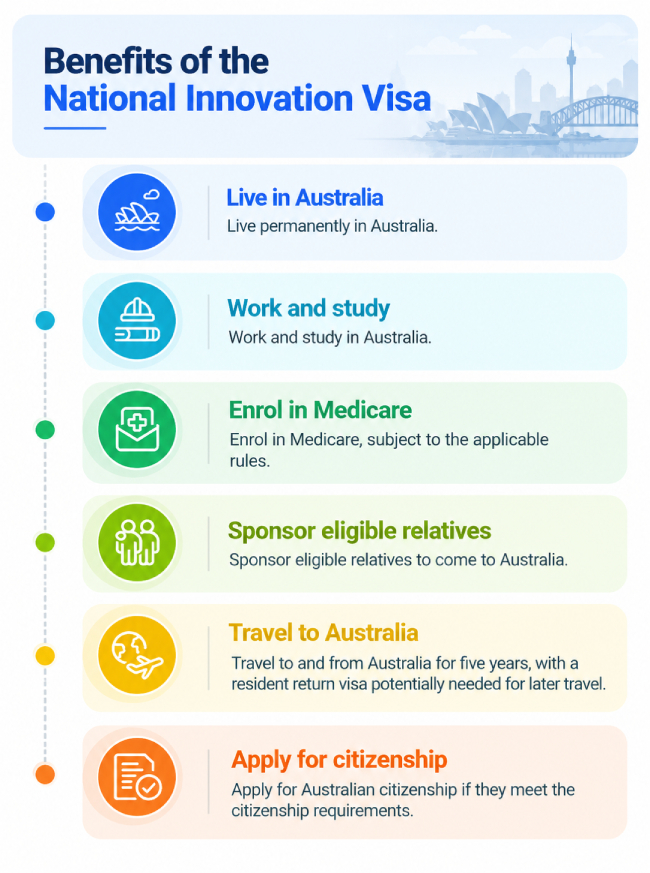
The National Innovation visa is a permanent visa. If granted, it can allow eligible holders to:
- Live permanently in Australia.
- Work and study in Australia.
- Enrol in Medicare, subject to the applicable rules.
- Sponsor eligible relatives to come to Australia.
- Travel to and from Australia for five years, with a resident return visa potentially needed for later travel.
- Apply for Australian citizenship if they meet the citizenship requirements.
Applicants can include eligible family members in their application. Visa grant, family eligibility, and access to particular benefits remain subject to the applicable rules.
National Innovation Visa Priority Sectors
Ministerial Direction 120 sets out the current priority order and sectors. Examples of relevant fields include artificial intelligence, robotics, cybersecurity, clean energy, biotechnology, medical innovation, agricultural technology, space systems, financial technology, transport infrastructure, and critical minerals. Being employed in one of these sectors does not automatically qualify someone for the visa. Applicants need evidence that meets the exceptional-achievement indicators. The table below shows the priority sectors for the National Innovation Visa under Ministerial Direction 120, divided into Tier 1 and Tier 2 categories. Applicants should have strong evidence of their achievements in these sectors to support their visa application.
| Sector tier | Priority sectors |
|---|---|
| Tier 1 | Critical technologies, Renewables and low-emission technologies, Health industries |
| Tier 2 | Agri-food and AgTech, Defence capabilities and space, Education, Financial services and FinTech, Infrastructure and transport, Resources |
*Want to check your eligibility for Australian PR? Use the free Y-Axis Australia PR Points Calculator to find out in minutes.
National Innovation Visa Eligibility Requirements
Applicants should demonstrate an internationally recognised record of exceptional and outstanding achievement in their field. They must also meet the applicable nomination and invitation requirements.
Key requirements include:
- Exceptional achievement: Evidence of significant achievements in a profession, sport, the arts, academia, or research.
- International recognition: Awards, publications, patents, leadership, commercial success, or other credible evidence appropriate to the applicant's field.
- Current standing: Evidence that the applicant remains prominent in their area of expertise.
- Benefit to Australia: Evidence of how the applicant's skills and achievements can contribute to Australia.
- Eligible nominator: A person or organisation with a national reputation in the same field who meets the visa rules.
- Invitation: Applicants must receive an invitation before lodging the visa application.
- Health and character: Applicants and relevant family members must meet applicable requirements.
Evidence Checklist for the National Innovation Visa
Applicants should provide strong evidence of their achievements in their field. Depending on their background, useful evidence may include:
- Research grants: Funding from organisations such as ARC, UKRI, the EU, or NSF.
- Research publications: Papers published in leading academic journals.
- International speaking engagements: Invitations to speak at major events such as Web Summit, ICM, or AACR.
- Patents: International patents or other evidence of important innovation.
- High salary: Earnings at or above AUD 190,100, where relevant, as one possible indicator of exceptional achievement—not a mandatory visa requirement.
- Investment achievements: A record of successful initial public offerings (IPOs), angel investments, or other significant investment activity.
The evidence required depends on the applicant's field and achievements. These examples do not guarantee an invitation or visa approval. Applicants should check Ministerial Direction 120 and provide documents that support their individual claims.
National Innovation Visa Priority Order
Home Affairs considers EOIs according to the following order under Ministerial Direction 120.
| Priority | Candidate group |
|---|---|
| Priority 1 | Global experts from any sector who have received international, top-of-field awards |
| Priority 2 | Candidates nominated on Form 1000 by an eligible Australian Government or state/territory government agency |
| Priority 3 | Candidates with exceptional achievements in a Tier 1 priority sector |
| Priority 4 | Candidates with exceptional achievements in a Tier 2 priority sector |
| Priority 5 | Other eligible candidates considered under the applicable priority framework |
Important: Priority is not the same as visa eligibility. Even candidates in a high-priority group must meet the visa criteria and provide supporting evidence.
Read about…
1 Million Jobs in Australia over the Next Decade
National Innovation Visa Latest Invitation Numbers
Home Affairs publishes invitation statistics for the National Innovation visa. The latest published round available for this update covers April–June 2026.
| Published measure | April–June 2026 |
|---|---|
| EOIs received | 2,166 |
| Invitations issued | 248 |
| Priority 1 invitations | Fewer than 5 |
| Priority 2 invitations | Fewer than 20 |
| Priority 3 invitations | 192 |
| Priority 4 invitations | 38 |
Steps to apply for the National Innovation Visa
Step 1: Describe your achievements and provide evidence that aligns with the visa's achievement indicators and priority framework.
Step 2: Home Affairs considers EOIs according to its priorities. An EOI is not a visa application, and submitting one does not guarantee an invitation.
Step 3: Identify an eligible person or organisation with a national reputation in your field. If invited, obtain the completed Form 1000 nomination.
Step 4: If invited, submit the application through ImmiAccount within 60 days of the invitation. Include Form 1000 and the required supporting evidence.
Step 5: Provide any further information requested and meet health and character requirements. Home Affairs assesses the application on its merits. An EOI remains active for two years, but applicants cannot update it after submission. Home Affairs may invite applicants during that period.
*Want to work in Australia? Get expert guidance from Y-Axis professionals.
National Innovation Visa fees
The Australian Government lists the main applicant visa application charge as AUD 6,235, according to the current visa page checked for this update. Additional charges may apply for family members and other services.
| Cost item | Estimated or published amount |
|---|---|
| Main applicant visa application charge | AUD 6,235 |
| Additional applicant charges | Depend on age and application circumstances |
| Second instalment for an adult applicant without functional English, if requested | AUD 4,890 |
| Health checks, police certificates and biometrics | Additional costs may apply |
Use the official Visa Pricing Estimator before applying, because fees and concessions can change. The second instalment is payable only if Home Affairs requests it.
State and Territory Nomination
State or territory government nomination can provide Priority 2 consideration under the National Innovation visa framework when the nomination meets the applicable rules. Each jurisdiction may have its own process and selection criteria.
| Jurisdiction | Information to check |
|---|---|
| New South Wales (NSW) | Pathways for researchers and academics, entrepreneurs, innovative investors, sports professionals, and creative professionals |
| Victoria | Current National Innovation visa nomination arrangements and eligibility criteria |
| South Australia | Current nomination pathways, registration process, and applicant requirements |
| Other states and territories | Whether a nomination pathway is open and what criteria apply |
NIV vs Other Australian Visas
| Feature | National Innovation visa (858) | Skills in Demand visa (482), Specialist Skills stream | Skilled Independent visa (189) |
|---|---|---|---|
| Best suited to | People with internationally recognised exceptional achievements | Eligible skilled workers with an Australian employer sponsor | Eligible skilled workers invited through the points-tested system |
| Invitation or sponsorship | NIV invitation and eligible nominator required | Employer sponsorship and nomination requirements apply | Points-tested invitation required |
| Visa type | Permanent | Temporary | Permanent |
| Salary rule | No mandatory minimum salary for NIV; salary can be an achievement indicator | Salary and stream-specific requirements apply | No single universal salary threshold for the points-tested visa |
| Main selection basis | Exceptional achievement and priority framework | Eligible employment, occupation and stream requirements | Points, occupation and invitation requirements |
| Processing time | Varies; check the official processing guide | Varies | Varies |
Who may not be suited to the NIV?
The National Innovation visa is designed for applicants with exceptional, internationally recognised achievements. A strong professional career alone may not be enough if the applicant cannot demonstrate the required level of achievement and potential contribution to Australia. Skilled professionals whose main strengths are their qualifications, work experience, occupation, or employer sponsorship may wish to explore other pathways, such as the Skilled Independent visa (189), Skilled Nominated visa (190), or Employer Nomination Scheme visa (186). The most appropriate visa depends on the person's circumstances and the current eligibility rules.
How Y-Axis can help with the National Innovation Visa
Y-Axis can help applicants organise their information and understand the stages involved in the National Innovation visa process. Support may include:
- Evidence mapping: Organising achievements against the relevant indicators in Ministerial Direction 120.
- EOI preparation: Helping structure the information and evidence for an Expression of Interest.
- Nominator guidance: Explaining Form 1000 requirements and helping applicants understand how to identify a suitable nominator.
- State nomination guidance: Helping applicants review published state or territory pathways and their requirements.
- Application preparation: Helping applicants understand the document checklist and steps to follow after an invitation.
Don't know what to do ?.
Get Free Counseling
Looking for Inspiration
Explore what Global Citizens have to say about Y-Axis in shaping their future
Frequently Asked Questions

