

Posted on November 02 2026
What Are the Different Types of Australia Visas to Immigrate?

By , Editor & Director
Updated November 06 2026
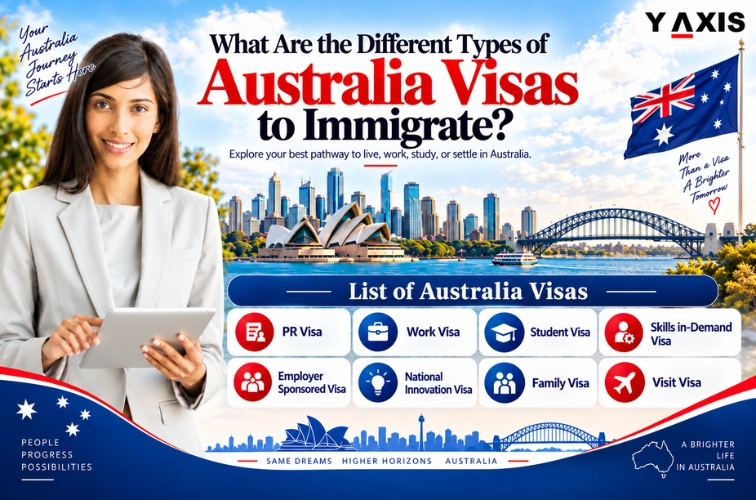
Australia offers different types of visas for people planning to immigrate for work, study, family reunification or permanent residency. Skilled workers can apply for the Skilled Independent visa (Subclass 189), Skilled Nominated visa (Subclass 190) or Skilled Work Regional visa (Subclass 491), while employer-sponsored options include the Skills in Demand visa (Subclass 482), Employer Nomination Scheme visa (Subclass 186) and Skilled Employer Sponsored Regional visa (Subclass 494).
Australia also offers partner and family visas, the Student visa (Subclass 500) for international students and the National Innovation visa (Subclass 858) for exceptional talent. With several visas offering pathways to permanent residency, Australia is an ideal destination for skilled workers, students and families seeking career opportunities, quality education and long-term settlement.
*Want to migrate to Australia? Get expert guidance from Y-Axis professionals.
Types of Australia Visas for Immigration
Australia offers different types of visas for people planning to immigrate for work, study, family reunification or permanent residency. The main categories are skilled migration, employer-sponsored, partner and family, student and talent-based visas. Some visas grant permanent residency directly, while others are temporary and can lead to PR.
| Visa Type | Who Is It For? | Main Purpose |
|---|---|---|
| Skilled Independent visa (Subclass 189) | Skilled workers who meet the points test, without sponsorship or nomination | To live and work permanently anywhere in Australia |
| Skilled Nominated visa (Subclass 190) | Skilled workers nominated by an Australian state or territory | To live and work permanently in Australia |
| Skilled Work Regional visa (Subclass 491) | Skilled workers nominated by a state or territory or sponsored by an eligible relative | To live and work in regional Australia, with a pathway to PR |
| Skills in Demand visa (Subclass 482) | Skilled workers sponsored by an approved Australian employer | To work for a sponsoring employer for up to four years, with a possible pathway to PR |
| Employer Nomination Scheme visa (Subclass 186) | Skilled workers nominated by an Australian employer | To live and work permanently in Australia |
| Skilled Employer Sponsored Regional visa (Subclass 494) | Skilled workers sponsored by an approved employer in regional Australia | To work in regional Australia for up to five years, with a pathway to PR |
| National Innovation visa (Subclass 858) | People with an internationally recognised record of exceptional achievement who receive an invitation | To live permanently in Australia and contribute to important sectors |
| Partner visa (Subclasses 309/100 or 820/801) | Partners of Australian citizens, permanent residents or eligible New Zealand citizens | To join a partner in Australia, first temporarily and then permanently |
| Student visa (Subclass 500) | International students enrolled in a course at an approved institution | To study full time in Australia |
| Temporary Graduate visa (Subclass 485) | International graduates who have completed qualifying studies in Australia | To live and work temporarily in Australia after studying |
| Working Holiday visa (Subclass 417) | Young travellers from countries covered by Australia’s Working Holiday program | To holiday and work in Australia, with options to extend your stay |
*Want to apply for Australian PR? Book a free consultation with Y-Axis today.
Australia Visa Eligibility Requirements
To qualify for an Australian visa, applicants must meet the requirements of their chosen visa category. Skilled migration visas generally require a positive skills assessment, English proficiency and at least 65 points, while employer-sponsored visas require an Australian employer nomination. Student and partner visa applicants must meet study or relationship requirements. All applicants must also satisfy health and character requirements.
- Age: Generally under 45 for points-tested skilled visas.
- Points: Score at least 65 points for Subclasses 189, 190 and 491.
- Skills assessment: Obtain a positive skills assessment for your nominated occupation, where required.
- English language: Meet the English language requirements for your visa.
- Work experience: Have relevant work experience, where required.
- Employer sponsorship: Have an Australian employer sponsor for employer-sponsored visas.
- Study enrolment: Secure admission and obtain a Confirmation of Enrolment (CoE) for a Student visa.
- Financial capacity: Show sufficient funds for study and living expenses, where required.
- Family relationship: Provide proof of your relationship for partner and family visas.
- Health and character: Meet Australia’s medical and police clearance requirements.
*Not sure which Australia visa suits you? Get free eligibility assessment from Y-Axis today.
How to Apply for an Australian Visa?
To apply for an Australian visa, choose the right visa subclass, check the requirements, prepare your documents and submit your application online through ImmiAccount.
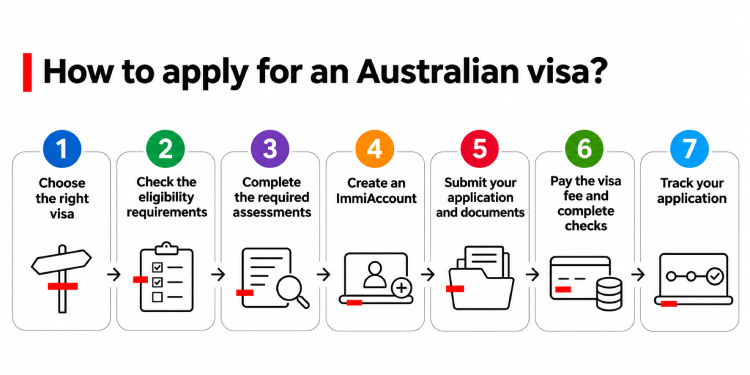
Step 1: Choose the right visa
Select a visa based on your purpose, such as skilled migration, employer sponsorship, study, family or a Working Holiday.
Step 2: Check the eligibility requirements
Review the visa criteria, including age, qualifications, work experience, English language skills and sponsorship requirements.
Step 3: Complete the required assessments
Get a skills assessment, take an English test and submit an Expression of Interest (EOI) through SkillSelect if required.
Step 4: Create an ImmiAccount
Register on the Department of Home Affairs website to start your online visa application.
Step 5: Submit your application and documents
Complete the application form and upload your passport, educational certificates, employment records and other required documents.
Step 6: Pay the visa fee and complete checks
Pay the application charge and complete medical examinations, police checks or biometrics if required.
Step 7: Track your application
Check ImmiAccount for application updates, requests for additional documents and your final visa decision.
*Want to apply for Australia Visa? Book a free consultation with Y-Axis today.
Australian Visa Fees
Australian visa fees vary by subclass. The Subclass 189 visa costs around AUD 6,135, while the Partner visa costs approximately AUD 11,710 for the main applicant. Additional charges apply for family members, skills assessments, English tests and medical examinations.
| Australian visa type | Application fee (AUD) |
|---|---|
| Skilled Independent visa (Subclass 189) | AUD 6,135 |
| Skilled Nominated visa (Subclass 190) | AUD 6,140 |
| Skilled Work Regional visa (Subclass 491) | AUD 6,140 |
| Skills in Demand visa (Subclass 482) | AUD 4,015 |
| Working Holiday visa (Subclass 417) | AUD 840 |
| Student visa (Subclass 500) | AUD 2,500 |
| Partner visa (Subclasses 309/100 or 820/801) | AUD 11,710 |
Australian Visa Processing Time
Australian visa processing times depend on the visa subclass and application requirements. The Subclass 189 visa generally takes 2 to 8 months, while Subclasses 190 and 491 may take longer due to state nomination and application assessment. Processing times also vary based on application completeness and individual circumstances.
| Australian Visa Type | Processing Time |
|---|---|
| Skilled Independent visa (Subclass 189) | 2 to 8 months |
| Skilled Nominated visa (Subclass 190) | 4 to 16 months |
| Skilled Work Regional visa (Subclass 491) | 5 to 18 months |
| Skills in Demand visa (Subclass 482) | 37 days to 9 months, depending on stream |
| Working Holiday visa (Subclass 417) | Up to about 2 months |
| Student visa (Subclass 500) | 16 days to 7 months, depending on course sector |
| Partner visa (Subclass 309 or 820, first stage) | About 21 to 32 months |
*Planning to migrate to Australia? Get expert guidance from Y-Axis professionals.
FAQs
What are the different types of Australian visas for immigration?
Australia offers skilled migration visas (Subclasses 189, 190 and 491), employer-sponsored visas (Subclasses 482, 186 and 494), partner and family visas, the Student visa (Subclass 500) and the invitation-only National Innovation visa (Subclass 858). Some visas grant permanent residency directly, while others are temporary and can lead to PR.
Which Australian visas give direct permanent residency?
The Skilled Independent (Subclass 189) and Skilled Nominated (Subclass 190) visas grant full permanent residency from the moment of grant. The Employer Nomination Scheme visa (Subclass 186) and the National Innovation visa (Subclass 858) are also permanent visas.
What is the difference between the 189, 190 and 491 visas?
The 189 needs no state or employer nomination. The 190 requires state or territory nomination, which adds 5 points. The 491 is a regional visa that adds 15 points through nomination or eligible family sponsorship. The 189 and 190 are permanent, while the 491 is a provisional visa with a pathway to PR.
How many points do I need for Australian skilled migration?
You need at least 65 points for the 189, 190 and 491. That is only the minimum, and most invitations go to applicants with 80 to 95+ points, depending on occupation demand.
What is the age limit for Australian skilled visas?
You must be under 45 at the time of invitation for the 189, 190 and 491.
Do I need a job offer to immigrate to Australia?
No, not for the points-tested visas. The 189, 190 and 491 are based on your points score, skills assessment and English level, plus state or regional nomination for the 190 and 491. The employer-sponsored visas (482, 186 and 494) do need an approved Australian employer to nominate you.
Which temporary visas can lead to permanent residency?
Skills in Demand (482) holders can move to PR through the Temporary Residence Transition stream of the Employer Nomination Scheme (186). 491 and 494 holders can apply for PR after living and working in regional Australia for the required period and meeting the other requirements.
What replaced the Temporary Skill Shortage (TSS) visa?
The Skills in Demand (SID) visa replaced the TSS visa on 7 December 2024. It kept the 482 subclass number.
Is there still a business or investor visa for Australia?
The Business Innovation and Investment Program (Subclass 188) closed to new applications on 31 July 2024. Business and investor migration is now structured around the National Innovation visa, employer sponsorship and skilled migration. The National Innovation visa (858) is invitation-only and based on exceptional achievement, not on an investment amount.
Can I get PR on a Student visa?
No, the Student visa (Subclass 500) is temporary and doesn’t lead to PR directly. After your studies you can apply for the Temporary Graduate visa (Subclass 485) to work in Australia. You can then apply for a skilled or employer-sponsored visa if you meet the requirements.
Tags:
Types of Australia Visas
Australia Visa Types
Australia Immigration
Australia PR Visa
Australia Skilled Migration Visas
Australia Employer Sponsored Visa
Australia Family Visa
Australia Student Visa
Australia National Innovation Visa
Australia Migration Pathways
Share
Latest Article
Popular Post
Trending Article
Posted On November 06 2026
What is the Average Salary in Canada?