

Posted on November 28 2025
What are the most in-demand jobs in Ireland for the next 10 years?

By , Editor
Updated January 23 2026
Listen to this article
The most in-demand jobs in Ireland for the next 10 years will be in technology, healthcare, engineering, finance, and renewable energy sectors. According to the Cedefop Skills Forecast, Ireland is set to create around 1.98 million job openings by 2035, driven by digital innovation, healthcare expansion, infrastructure development, and sustainability initiatives.
Professionals such as Software Developers, Cybersecurity Experts, Data Analysts, Nurses, Engineers, Accountants, and Renewable Energy Specialists are highly sought after.
With strong job growth and clear visa pathways, skilled professionals can build successful careers in major cities like Dublin and Cork, where opportunities continue to expand across multiple sectors in the coming years.
*Want to work in Ireland? Let Y-Axis guide you every step of the process
Most In-Demand Jobs in Ireland for the next 10 years
The most in-demand jobs in Ireland over the next decade will be shaped by rapid digital transformation, healthcare expansion, infrastructure growth, and sustainability goals. The Irish Government aims to create 300,000 new jobs by 2030 through continued investment in innovation, infrastructure, and workforce development.
Growing opportunities in key sectors such as technology, healthcare, engineering, finance, and renewable energy, offering skilled professionals the chance to build long-term, successful careers in Ireland’s evolving economy.
|
Occupation |
In-demand Job Roles |
|
Technology & IT |
Software Developers, Cybersecurity Analysts, Data Scientists, Cloud Engineers, AI Specialists |
|
Healthcare |
Registered Nurses, General Practitioners, Physiotherapists, Healthcare Assistants, Medical Technologists |
|
Engineering |
Civil Engineers, Electrical Engineers, Mechanical Engineers, Project Managers, CAD Technicians |
|
Finance & Accounting |
Accountants, Financial Analysts, Auditors, Tax Consultants, Compliance Officers |
|
Renewable Energy |
Solar Energy Technicians, Wind Turbine Engineers, Environmental Consultants, Sustainability Managers |
|
Construction & Infrastructure |
Architects, Quantity Surveyors, Site Engineers, Construction Managers, Safety Officers |
|
Education & Training |
Teachers, Vocational Trainers, Education Coordinators, Early Childhood Educators |
|
Pharmaceuticals & Life Sciences |
Laboratory Technicians, Biochemists, Quality Assurance Specialists, Research Scientists |
|
Hospitality & Tourism |
Chefs, Hotel Managers, Event Coordinators, Customer Service Executives |
|
Logistics & Supply Chain |
Supply Chain Managers, Logistics Coordinators, Warehouse Supervisors, Transport Planners |
Average Salaries and Top Industries in Ireland
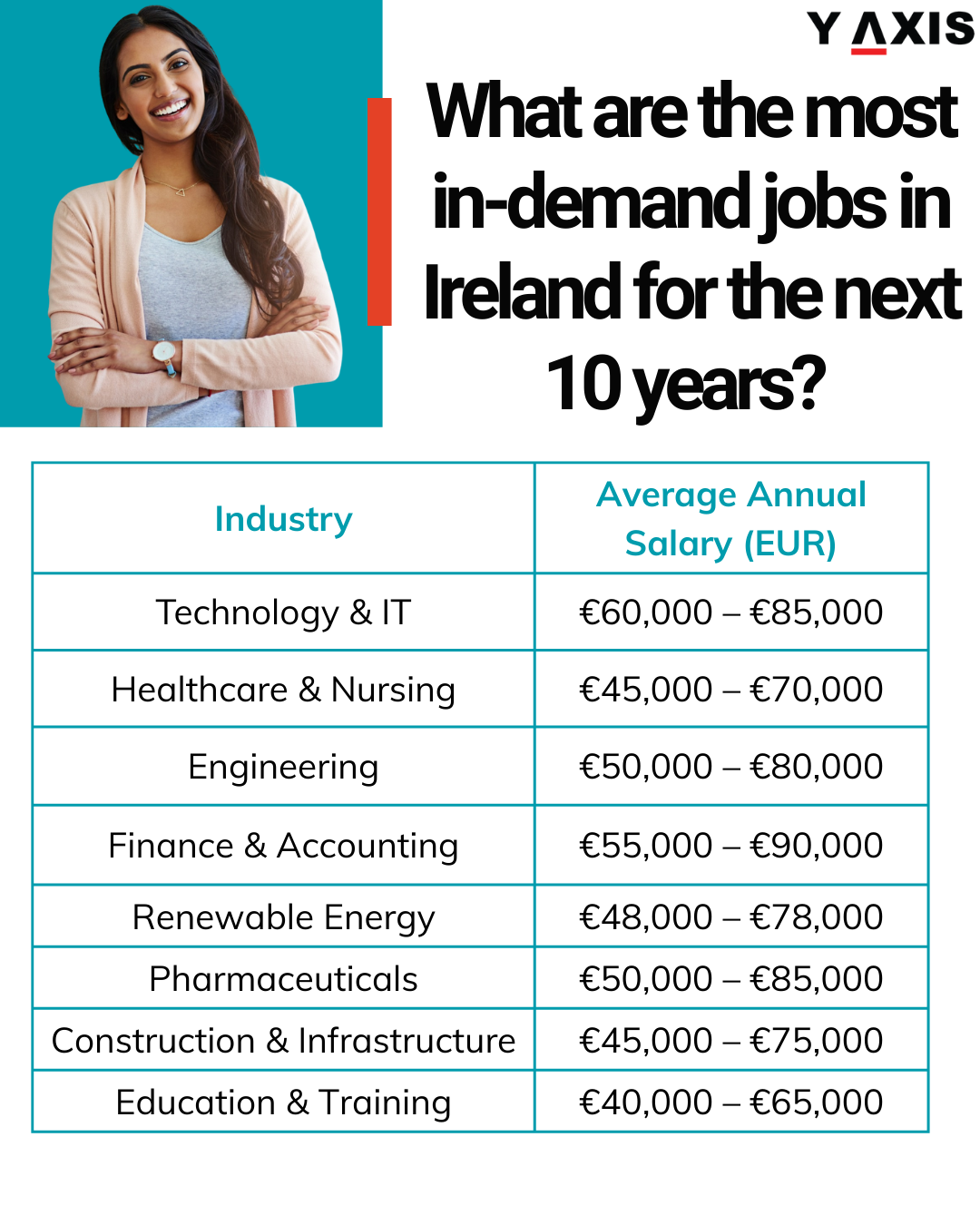
Ireland offers competitive average salaries ranging from €40,000 to €70,000 per year, depending on industry, experience, and skill level. Key sectors such as IT, healthcare, engineering, finance, and pharmaceuticals continue to drive strong demand for skilled professionals.
With attractive pay scales, a strong global business presence, and consistent economic growth, Ireland continues to be one of Europe’s most promising destinations for career opportunities.
|
Industry |
Average Annual Salary (EUR) |
|
Technology & IT |
€60,000 – €85,000 |
|
Healthcare & Nursing |
€45,000 – €70,000 |
|
Engineering |
€50,000 – €80,000 |
|
Finance & Accounting |
€55,000 – €90,000 |
|
Renewable Energy |
€48,000 – €78,000 |
|
Pharmaceuticals |
€50,000 – €85,000 |
|
Construction & Infrastructure |
€45,000 – €75,000 |
|
Education & Training |
€40,000 – €65,000 |
Key Skills Needed to Work in Ireland
Ireland’s evolving economy is creating high demand for professionals with advanced technical and soft skills. Employers are increasingly seeking candidates who can adapt to digital transformation, sustainability, and innovation-driven roles.
|
Category |
Key Skills in Demand |
|
Technology & Digital |
Software development, cloud computing, cybersecurity, data analytics, AI & machine learning |
|
Healthcare |
Patient care, clinical management, digital health systems, medical technology, communication |
|
Engineering & Construction |
Project management, CAD design, renewable energy systems, automation, safety compliance |
|
Finance & Business |
Financial analysis, risk management, auditing, taxation, regulatory compliance |
|
Renewable Energy |
Environmental management, solar/wind system maintenance, sustainability strategy |
|
Soft Skills |
Communication, teamwork, problem-solving, adaptability, leadership |
Best Cities to Work in Ireland
Ireland offers diverse career opportunities across both major cities and fast-growing regional hubs. Each city has its own industry strengths, lifestyle, and expat community.
|
City |
Key Sectors |
Why Consider This City? |
|
Dublin |
Technology, Finance, Business Services |
Ireland’s tech and finance hub with top global employers and strong career growth. |
|
Cork |
Pharmaceuticals, Engineering, IT |
Major industrial centre with global firms and affordable living. |
|
Galway |
MedTech, Renewable Energy, R&D |
Innovation-driven city offering a balanced lifestyle and career options. |
|
Limerick |
Engineering, Manufacturing, Logistics |
Fast-growing job market with affordable housing and strong infrastructure. |
|
Waterford |
Biopharma, Green Energy, Engineering |
Emerging hub for sustainable industries and regional career opportunities. |
Benefits of Working in Ireland for Australians
Ireland has become a top destination for Australian professionals seeking international career growth. With strong job demand, competitive salaries, and an excellent quality of life, the country offers a perfect balance of opportunity and lifestyle.
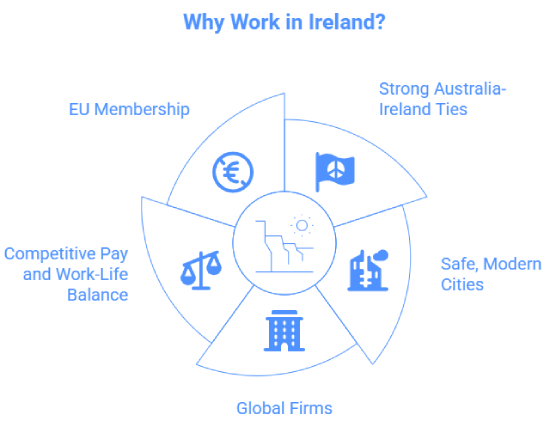
- Strong Australia–Ireland ties make permits like the Critical Skills Employment Permit easier to obtain.
- Safe, modern cities such as Dublin and Cork offer great healthcare, education, and culture.
- Global firms in tech, finance, and pharma provide high-demand, well-paying roles.
- Competitive pay and solid work-life balance support long-term career stability.
- EU membership offers wider job opportunities and career mobility.
How Can I Get a Job in Ireland from Australia?
Australians can get a job in Ireland by applying through trusted job portals, direct employer listings, or international recruitment agencies. To work legally, you’ll need a valid job offer and an Irish work permit such as the Critical Skills or General Employment Permit.
Steps to find a job in Ireland:
Step 1: Identify in-demand roles in key sectors such as IT, healthcare, engineering, finance, and renewable energy.
Step 2: Prepare a concise, Irish-style CV and cover letter highlighting your skills, achievements, and relevant experience.
Step 3: Apply through leading job portals like IrishJobs.ie, Indeed Ireland, LinkedIn, or Seek Ireland.
Step 4: Once you secure a job offer, your employer applies for a Critical Skills or General Employment Permit via the Department of Enterprise, Trade and Employment (DETE).
Step 5: If required, apply for an Irish long-stay (D) visa through the Irish Naturalisation and Immigration Service (INIS).
Step 6: Plan your relocation by arranging housing, health insurance, and other essentials in cities like Dublin, Cork, Galway, or Limerick, based on your job location and lifestyle preferences.
FAQs
1. What are the most in-demand jobs in Ireland for the next 10 years?
Over the next decade, Ireland will see high demand in sectors such as Information Technology, Healthcare, Engineering, Finance, and Green Energy. Roles like software developers, data analysts, nurses, mechanical engineers, and renewable energy specialists are among the most sought-after.
As Ireland continues to attract global investment, multinational companies are expanding operations, creating opportunities for skilled professionals. Australians with experience in digital transformation, healthcare management, and sustainable technology will find promising prospects in Ireland’s growing economy. These in-demand jobs in Ireland offer excellent pay, career stability, and a clear path to work and settle in Europe.
2. Why is Ireland experiencing a rise in in-demand jobs?
Ireland’s booming economy, strong foreign investment, and tech-driven industries are driving job growth. The presence of major companies like Google, Apple, Meta, and Pfizer boosts demand for skilled professionals. The country’s focus on digitalisation, renewable energy, and healthcare innovation fuels demand for engineers, IT specialists, and healthcare workers.
Government initiatives supporting research, sustainability, and workforce training further strengthen the labour market. For Australians seeking global exposure, Ireland’s rising job demand provides opportunities to work in a stable, English-speaking EU country with excellent work-life balance and a thriving professional environment.
3. What are the top IT jobs in demand in Ireland?
Ireland’s IT sector remains one of the fastest-growing in Europe. The most in-demand IT jobs in Ireland include software developers, cybersecurity analysts, data scientists, cloud engineers, and AI specialists. With Dublin being a major tech hub, global firms offer lucrative opportunities for professionals with experience in cloud computing, big data, and programming languages such as Python, Java, and C++.
For Australians, working in Ireland’s tech sector offers access to global career growth, remote work flexibility, and exposure to innovative European technology ecosystems that value digital and analytical skills.
4. Which healthcare jobs are in high demand in Ireland?
Healthcare remains a priority sector in Ireland, creating strong demand for professionals like registered nurses, healthcare assistants, doctors, physiotherapists, and aged-care specialists. The Irish Health Service Executive (HSE) actively recruits internationally to fill talent gaps. Australians with recognised medical qualifications and experience in patient care can find rewarding job opportunities.
With an aging population and growing healthcare infrastructure, Ireland offers excellent salaries, visa sponsorship options, and career development. Healthcare jobs in Ireland are ideal for Australians seeking meaningful international work experience and long-term stability in a respected profession.
5. What engineering jobs will be in demand in Ireland?
Engineering is one of the most in-demand career fields in Ireland for the next 10 years. Civil, mechanical, electrical, and environmental engineers are highly sought after due to Ireland’s on-going infrastructure projects and renewable energy expansion.
Demand is also increasing for biomedical and software engineers supporting Ireland’s pharma and tech sectors. Australians with engineering backgrounds can take advantage of competitive salaries, international projects, and visa sponsorship programs. With the country’s strong focus on sustainability and innovation, engineering jobs in Ireland offer exciting career opportunities and long-term growth potential.
6. Are finance and accounting professionals in demand in Ireland?
Yes. Ireland’s thriving financial services sector continues to create demand for accountants, financial analysts, auditors, and compliance specialists. Dublin’s status as a European financial hub attracts global banks and fintech firms. Australians with qualifications like CPA or CA and experience in financial management, taxation, or risk assessment can access high-paying finance jobs in Ireland.
The demand is especially strong in sustainable finance, investment analysis, and digital banking. Ireland’s robust economy and low corporate tax rate make it a prime destination for finance professionals seeking international exposure.
7. What emerging industries are creating jobs in Ireland?
Emerging industries shaping Ireland’s job market include renewable energy, biotechnology, fintech, and AI. The Irish government’s commitment to achieving net-zero emissions by 2050 has accelerated growth in wind and solar energy sectors. Meanwhile, biotech and pharmaceuticals continue to drive hiring in research and manufacturing.
Australians skilled in green technology, science, and automation can find strong career opportunities in these fields. These new industries are vital to Ireland’s long-term economic growth, making them attractive for professionals seeking sustainable, future-focused jobs with international career potential.
8. How can Australians apply for in-demand jobs in Ireland?
Australians can apply for in-demand jobs in Ireland by identifying roles in sectors like IT, healthcare, and finance, preparing an EU-format CV, and applying through portals such as LinkedIn, Indeed Ireland, or Irish Jobs.
Focus on employers offering visa sponsorship or roles under the Critical Skills Employment Permit. Once hired, apply for a work visa via Ireland’s Department of Enterprise, Trade, and Employment.
9. What visa options are available for Australians to work in Ireland?
Australians can apply for several visa options to work in Ireland, including the Critical Skills Employment Permit, General Employment Permit, and Working Holiday Visa. The Critical Skills Employment Permit targets roles in high-demand sectors like IT, engineering, and healthcare, offering a pathway to permanent residency.
The General Employment Permit is suitable for non-critical roles, while the Working Holiday Visa allows young Australians (aged 18–35) to work and travel for up to a year. These visa options make Ireland a flexible and accessible destination for skilled Australian workers.
10. What is the average salary for in-demand jobs in Ireland?
Salaries for in-demand jobs in Ireland vary by industry and experience. IT professionals earn between €55,000–€90,000 annually, engineers between €50,000–€85,000, and healthcare workers between €40,000–€70,000. Finance professionals can expect €60,000–€100,000, depending on their role.
Ireland’s competitive pay, combined with strong career progression and a high quality of life, makes it an attractive destination for Australians seeking overseas opportunities. With tax incentives and relocation support available in some sectors, in-demand jobs in Ireland offer both financial and professional growth over the next decade.
Tags:
jobs in Ireland
work in Ireland visa
in-demand jobs Ireland
Dublin jobs
Irish job opportunities
visa to work in Ireland
Seek Ireland
Share
Latest Article
Popular Post
Trending Article
Posted On March 05 2026
Top 10 Countries for Physicians: Salary, Demand & PR Opportunities Compared