


Posted on November 23 2026
What Is the Average Salary in Ireland?

By , Editor & Director
Updated November 23 2026
The average salary in Ireland is around €58,127 per year, or €4,844 gross per month, according to the Central Statistics Office (CSO). The median annual salary is €46,305. Salaries are particularly strong in ICT, finance, pharmaceuticals, engineering and healthcare. Actual take-home pay depends on income tax, the Universal Social Charge (USC) and Pay Related Social Insurance (PRSI).
Ireland has strong job opportunities in ICT, life sciences, finance, healthcare and construction. Dublin has the highest average salaries, while Cork, Galway and Limerick offer jobs across key sectors. The country also offers the Critical Skills Employment Permit for priority occupations, making it easier for skilled workers to live and work in Ireland.
*Want to work in Ireland? Let Y-Axis help you through the application process.
Top 10 Highest-Paying Jobs in Ireland
The highest-paying jobs in Ireland include Chief Executive, Chief Risk Officer, Chief Information Officer, General Manager and International General Counsel roles. These positions offer gross annual salaries ranging from €155,000 to €400,000, depending on experience and industry. Dublin leads with the most high-paying opportunities, particularly in finance and technology.
| Job | Average Gross Salary per Month | Average Gross Salary per Year |
|---|---|---|
| Chief Executives | €33,333 | €400,000 |
| Chief Risk Officers | €23,750 | €285,000 |
| Chief Information Officers | €22,917 | €275,000 |
| General Managers | €20,000 | €240,000 |
| International General Counsel | €19,583 | €235,000 |
| Chiefs of Architecture | €17,917 | €215,000 |
| Heads of Investor Relations | €17,708 | €212,500 |
| Transfer Pricing Partners | €16,667 | €200,000 |
| Heads of International Tax | €16,042 | €192,500 |
| Country Managers (Sales) | €12,917 | €155,000 |
*Looking for jobs in Ireland? Let Y-Axis guide you through application process.
Average Salaries for In-Demand Jobs in Ireland
The average salary for in-demand jobs in Ireland ranges from €47,000 to €105,000 per year. Technology, finance and healthcare roles generally pay the most, while consulting, pharma, biotech and engineering jobs average €66,000 to €69,000 annually. Dublin, Cork, Galway and Limerick are major job centres, with demand for registered nurses, renewable energy engineers and construction professionals.
| Occupation | Average Annual Salary | Chances of Visa Sponsorship |
|---|---|---|
| IT and Software | €104,900 | Very High |
| Engineering and Manufacturing | €65,800 | Very High |
| Healthcare | €52,200 | Very High |
| Nursing | €47,400 | Very High |
| Consulting and Professional Services | €68,900 | High |
| Pharma and Biotech | €68,600 | High |
| Energy and Renewables | €57,500 | High |
| Accounting and Finance | €81,200 | Moderate to High |
| Construction | €53,100 | Moderate to High |
| Logistics and Supply Chain | €53,300 | Moderate |
Read More…
Most in-demand jobs in Ireland for the next 10 years
Best Cities in Ireland with the Most Job Opportunities
Dublin has the most job opportunities in Ireland, particularly in technology, finance, pharmaceuticals and tourism. Cork is a major centre for pharmaceuticals, engineering and healthcare, while Galway offers strong employment in medical devices and technology. Limerick provides jobs in manufacturing and engineering, and Waterford is emerging as a hub for IT, logistics and agri-food.
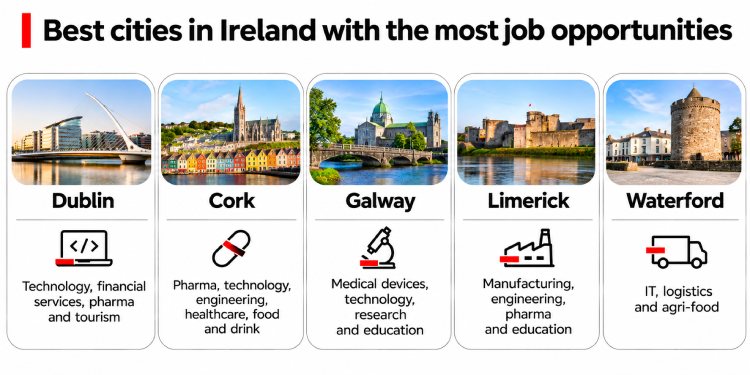
| City | Key Industries | Average Annual Salary |
|---|---|---|
| Dublin | Technology, financial services, pharmaceuticals, tourism | €67,241 |
| Cork | Pharmaceuticals, technology, engineering, healthcare, food and drink | €59,577 |
| Galway | Medical devices, technology, research, education | €55,666 |
| Limerick | Manufacturing, engineering, pharmaceuticals, education | €56,239 |
| Waterford | IT, logistics, agri-food | €52,783 |
Ireland vs Australia: Salary, Tax and Savings
Ireland’s median annual earnings are €46,305, compared with AUD 90,532 for full-time employees in Australia. Both countries offer strong job markets in technology, healthcare, engineering and finance, with high demand for skilled workers. Tax credits in Ireland and the tax-free threshold in Australia help reduce employees’ tax burden and increase their take-home pay.
| Factor | Ireland | Australia |
|---|---|---|
| Median gross monthly salary | €3,859 | AUD 7,544 |
| Median gross annual salary | €46,305 | AUD 90,532 |
| Estimated monthly income tax and contributions | €722 | AUD 1,624 |
| Estimated monthly take-home pay | €3,137 | AUD 5,920 |
| Average monthly rent | €1,513 | AUD 3,090 |
| Estimated monthly take-home after rent | €1,624 | AUD 2,830 |
| Estimated annual take-home after rent | €19,488 | AUD 33,960 |
Cost of Living in Ireland
The average monthly cost of living in Ireland for a single person, including rent, ranges from €2,600 to €3,500. Dublin is the most expensive city, while Cork, Galway, Limerick and Waterford are generally more affordable. Actual expenses depend on accommodation, location and lifestyle.
| Factor | Estimated Monthly Cost |
|---|---|
| Rent | €1,839–€2,232 |
| Groceries | €300–€400 |
| Electricity and gas | €151–€282 |
| Transportation | €50–€140 |
| Internet and mobile | €55–€90 |
| Eating out and leisure | €200–€350 |
| Total monthly cost | €2,595–€3,494 |
Job Outlook in Ireland
Ireland has strong demand for skilled workers in healthcare, technology, engineering, construction and finance. Employment has reached approximately 2.84 million, with doctors, nurses, software developers, IT analysts, civil engineers and quantity surveyors among the most in-demand occupations. The government’s plan to build 300,000 new homes by 2030, rising healthcare needs, major infrastructure projects and continued investment by multinational companies is expected to create more jobs. Skilled workers with relevant qualifications and experience can find opportunities across these sectors and develop their careers in Ireland.
*Want to migrate to Ireland? Book a free consultation with Y-Axis today.
FAQs
What is the median salary in Ireland?
The median annual salary in Ireland is €46,305, a more accurate picture of typical pay than the average, since high earners skew the mean upward. The median gross monthly figure is around €3,859. This gives a clearer sense of what most workers actually earn.
What is the average salary in Ireland compared to Australia?
Ireland’s median annual earnings are €46,305, compared with AUD 90,532 for full-time employees in Australia. Both countries offer strong job markets in technology, healthcare, engineering and finance, with high demand for skilled workers. Tax credits in Ireland and the tax-free threshold in Australia help reduce employees’ tax burden and increase their take-home pay.
What is the average monthly salary in Ireland?
The average gross salary in Ireland is about €4,844 a month, based on a mean annual salary of €58,127. A typical worker’s median is closer to €3,859 a month, so many people earn comfortably in that range. Technology and finance roles pay considerably more, and pay rises steadily with experience.
What is the average salary in Ireland after tax?
A median earner takes home about €3,137 a month after income tax, USC and PRSI, while an average earner takes home closer to €3,656. Ireland’s tax credits and a 20% rate on the first €44,000 keep take-home pay strong, and Budget 2027 improves it further from January 2027.
What are the highest-paying jobs in Ireland?
The highest-paying jobs in Ireland include Chief Executive, Chief Risk Officer, Chief Information Officer, General Manager and International General Counsel roles. These positions offer gross annual salaries ranging from €155,000 to €400,000, depending on experience and industry. Dublin leads with the most high-paying opportunities, particularly in finance and technology.
What is the average salary for in-demand jobs in Ireland?
The average salary for in-demand jobs in Ireland ranges from €47,000 to €105,000 a year. Technology, finance and healthcare roles generally pay the most, while consulting, pharma and engineering jobs average €66,000 to €69,000 annually. Demand is strong for registered nurses, renewable energy engineers and construction professionals.
Which city in Ireland pays the highest salary?
Dublin pays the highest average salary in Ireland, particularly in technology, finance, pharmaceuticals and tourism. Cork is a major centre for pharmaceuticals, engineering and healthcare, while Galway offers strong employment in medical devices and technology. Limerick and Waterford provide growing opportunities in manufacturing, IT and agri-food.
What is the minimum wage in Ireland?
The national minimum wage is €14.15 an hour for workers aged 20 and over, rising to €14.94 from 1 January 2027. Younger workers receive a set percentage of the adult rate, for example 90% at age 19. The minimum wage applies across all sectors and is reviewed annually by the government.
What is the cost of living in Ireland?
The average monthly cost of living in Ireland for a single person, including rent, ranges from €2,600 to €3,500. Dublin is the most expensive city, while Cork, Galway, Limerick and Waterford are generally more affordable. Actual expenses depend on accommodation, location and lifestyle.
What is the job outlook in Ireland?
Ireland has strong demand for skilled workers in healthcare, technology, engineering, construction and finance. Employment has reached approximately 2.84 million, with doctors, nurses, software developers, IT analysts, civil engineers and quantity surveyors among the most in-demand occupations. Government housing and infrastructure plans are expected to create further opportunities.
Tags:
Average Salary in Ireland
Ireland Salary in AUD
Average Monthly Salary in Ireland
Take-Home Pay in Ireland
Ireland vs Australia Salaries
Average Salary in Dublin
Highest-Paying Jobs in Ireland
Minimum Wage in Ireland
Cost of Living in Ireland
Move to Ireland from Australia
Share
Latest Article
Popular Post
Trending Article

Posted On November 24 2026
What Is the Average Salary in Luxembourg?