
.webp?VersionId=PRNaEm6D01cV_3UcO5U9Vs2WDdPQU1lv "How you can retire in Europe with Portugal’s passive income D7 visa?")
Posted on October 01 2024
How you can retire in Europe with Portugal’s passive income D7 visa?
By , Editor
Updated October 01 2024
Highlights: How to retire in Europe with Portugal’s passive income D7 visa?
- Portugal’s D7 visa opens a pathway to permanent residency and Schengen travel access in Europe.
- Portugal’s D7 visa offers an option for retires to gain residency if they meet certain passive income.
- An applicant must maintain a passive income of €1,000 per month to gain residency.
- Applicants can include a dependent minor or an adult dependent in the D7 application.\
*Want to migrate to Portugal? Talk to Y-Axis for complete guidance.
What is Portugal D7 visa?
The Portugal D7 visa program retires, and an option to gain residency if they meet specific passive income requirements. Portugal’s D7 visa offers a pathway to permanent residency and Schengen travel access in Europe.
Requirements to apply for Portugal D7 visa
Applicants need to fulfill some requirements to apply for the Portugal D7 visa:
Financial eligibility
As mentioned earlier, the D7 visa requires applicants to meet a certain minimum passive income threshold. These incomes can be from any source, such as:
- Rentals
- Dividend
- Interest income
- Pension
The minimum income requirement is linked to the minimum wage in Portugal. While the minimum wage in Portugal now is €820 per month, the applicant must maintain an income of €1,000 per month as the minimum income keeps changing. On an annual basis, the amount is €12,000 (₹11.16 lakh).
If the spouses are added to the application, the passive income requirement increases to 50%. Thus, the total passive income requirement is €1,500 (₹1.39 lakh) per month to €18,000 (₹16.74 lakh) per year.
The minor and adult dependents can also be added to the D7 visa application, and then the passive income will also be required.
To stay in the country
After two years, the visa can be renewed for three years. During these three years, D7 visa holders must be in Portugal for 28 months. They cannot leave the country for six or eight consecutive months.
To work in the country
D7 visa holders must work in the country if they are financially independent and can support themselves without working in Portugal. However, the applicant cannot work for a local Portuguese company on a D7 visa. The D7 visa gives residency permits and visa-free access to the Schengen area, which includes 29 European countries. An applicant can work for a Portuguese company after getting permanent residency.
An applicant can apply for PR or citizenship in the country after five years on a D7 visa. Other than that, condition-free residency in Portugal -free travel in the Schengen Area, and residency allow one to work in Portugal. As a Portugal passport holder, an applicant can freely live and work across the Schengen Area. The Portugal passport also gives visa-free/visa-on-arrival access to 188 countries.
Tax implications
India and Portugal have a Double Taxation Avoidance Agreement (DTAA). Speak to a Portugal-qualified chartered accountant to understand the taxation applicable to different types of passive income.
*Want to know more about Portugal D7 visa? Sign up with Y-Axis for complete guidance.
Application procedure for Portugal D7 visa
Applicants can apply for the D7 visa through the Portugal embassy. The application fees for a single adult are €90 (₹8,370). However, even before you start the application process, an applicant must do certain things such as:
Step 1: Find a Portuguese lawyer who can remotely help to obtain an NIF, the taxpayer identification number in Portugal.
Step 2: Open an account with a Portuguese bank and deposit €12,000 as your first stay deposit
Step 3: Secure proof of accommodation in Portugal
Step 4: Get the application approved
Step 5: Avail a four-year double-entry into Portugal
Step 6: Once you enter Portugal, apply for the final D7 residence visa
Step 7: Register your biometrics and provide other documents
Within four months of arriving in Portugal, schedule an appointment with AIMA (The Agency for Integration, Migration, and Asylum) for an interview and biometrics. Applicants must carry documents such as proof of passive income, accommodation, a criminal record certificate, health insurance, and a valid passport.
*Are you looking for step-by-step assistance for Overseas Immigration? Talk to Y-Axis, the leading overseas immigration consultancy in Australia.
For recent immigration updates, check out Y-Axis Immigration News!
Tags:
Portugal’s passive income D7 visa
Migrate to Portugal
Portugal D7 visa
Migrate to Portugal
Europe immigration
Portugal Immigration News
Portugal PR
Immigration updates
Portugal immigration
Europe visa
Europe immigration news
Share
Latest Article
Popular Post
Trending Article
Posted On September 29 2026
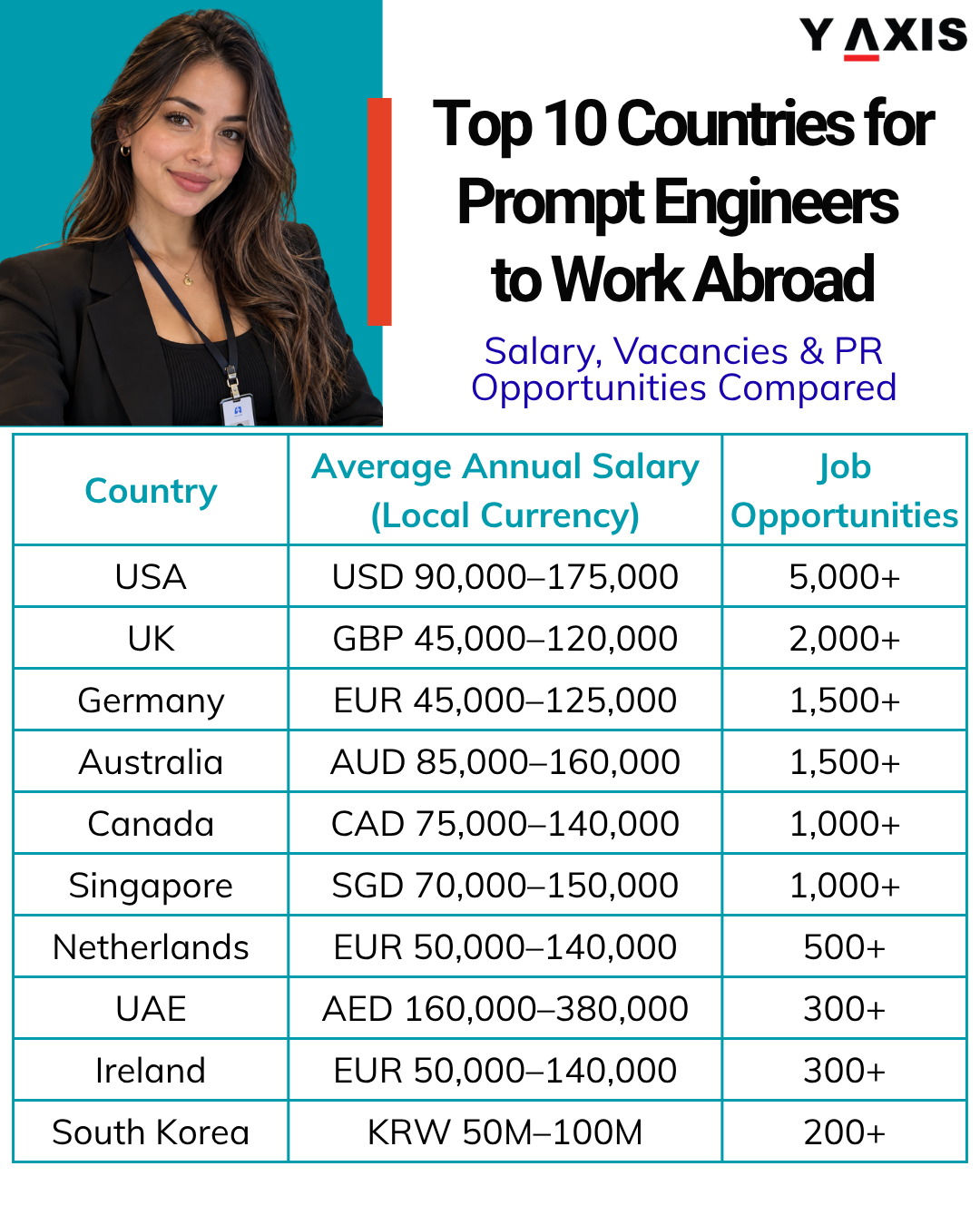
Top 10 Countries for Prompt Engineers to Work Abroad: Salary, Demand & PR Opportunities Compared