
Posted on April 11 2026
Can I Study in Europe for Free as an International Student?

By , Editor & Director
Updated April 16 2026
Yes, international students can study in Europe for free at many public universities in countries such as Germany, Norway, and Austria, which offer tuition-free education. Countries like France and Finland also provide affordable education, along with scholarships that help reduce overall costs. Top scholarships such as Erasmus Mundus, DAAD, and Eiffel Excellence can cover tuition fees, living expenses, and travel.
Many universities, including Ludwig Maximilian University of Munich, Technical University of Munich, and Humboldt University of Berlin, offer a wide range of programs taught in English, making it easier for international students to apply. Students can also work part-time during their studies and benefit from post-study work opportunities in several European countries, helping them gain experience and manage living costs while studying in Europe for free with the right country, university, and scholarships.
*Want to study in Europe for free? Let Y-Axis help you through application process.
Why Europe is a Top Destination for Free Education for International Students?
Europe is a top choice for international students seeking free or affordable education, with strong academic reputation and wide access to tuition-free universities. Countries like Germany and Norway offer free education at public universities, while France and Finland provide low-cost options and scholarships. With quality education, global exposure, and strong career opportunities, Europe remains a preferred study destination.
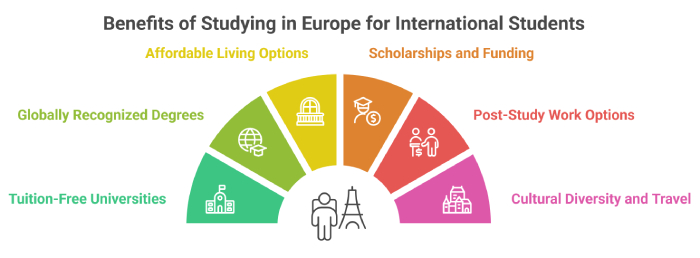
Key Benefits of Free Education in Europe for International Students:
- Tuition-free universities: Many public universities offer free education, helping reduce overall study costs
- Globally recognised degrees: European qualifications are widely accepted and valued by employers worldwide
- Affordable living options: Several countries offer lower living costs compared to other popular destinations like USA
- Scholarships and funding: Various scholarships help cover tuition fees, living expenses, and travel
- Post-study work options: Graduates can stay and explore job opportunities after completing their degree
- Cultural diversity and travel: Experience different cultures and travel easily across European countries
Top 10 Countries in Europe Offering Free Education for International Students
Several European countries offer free or affordable education for international students through public universities. Countries like Germany and Norway are known for tuition-free education, while France and Austria provide low-cost study options. Many of these countries also offer English-taught programs and scholarships, making it easier to study in Europe without high expenses.
Top 10 Countries in Europe offering Free Education for International Students:
- Germany: Public universities offer tuition-free education, with only small semester fees covering administrative and student services
- Norway: Public universities charge no tuition fees, making it a top destination for free education despite higher living costs
- Austria: Universities offer low tuition fees along with affordable living, making it a budget-friendly option for students
- France: Government-funded universities provide low-cost education with access to scholarships and quality academic programs
- Finland: Offers scholarships and affordable study options, especially for international students in English-taught programs
- Sweden: Universities offer scholarships that help cover tuition fees and living expenses for eligible students
- Denmark: Free education for EU students and scholarships available for international students to reduce overall costs
- Italy: Affordable universities with low tuition fees and a wide range of scholarships for international students
- Spain: Low-cost universities offering diverse programs with relatively affordable tuition and living expenses
- Poland: Budget-friendly education system with many English-taught programs and low overall study costs
Best Tuition-Free Universities in Europe for International Students
Many public universities in Europe, such as Ludwig Maximilian University of Munich and Technical University of Munich, offer tuition-free education, making them a top choice for international students seeking affordable study options. These universities are known for high academic standards, strong global rankings, and a wide range of programs taught in English, and while most charge a small semester or administrative fee, the overall cost remains significantly lower compared to other study destinations.
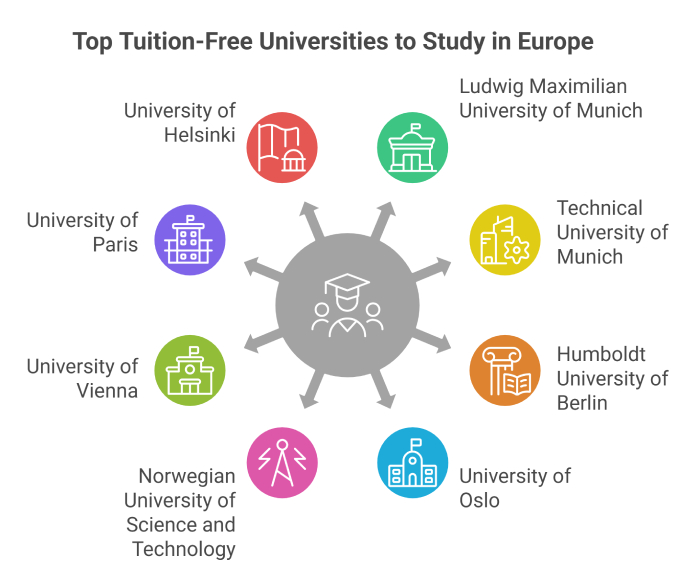
Top Tuition-Free Universities in Europe for International Students:
- Ludwig Maximilian University of Munich: One of Germany’s top universities offering tuition-free education with strong programs in science, business, and humanities
- Technical University of Munich: A leading technical university with free tuition and globally recognised engineering and technology programs
- Humboldt University of Berlin: Offers tuition-free education with a strong focus on research and academic excellence
- University of Oslo: A top public university with no tuition fees and high-quality programs across various fields
- Norwegian University of Science and Technology: Known for engineering and technology programs with tuition-free education
- University of Vienna: Offers low-cost to free education with a wide range of programs for international students
- University of Paris: Provides affordable education with access to scholarships and diverse study options
- University of Helsinki: Offers scholarships and affordable programs with strong academic reputation
Read more…
Top Universities Offering 100% Scholarships to International Students
Top 10 Fully Funded Scholarships in Europe for International Students
There are several fully funded scholarships in Europe available for international students, covering tuition fees, living expenses, travel, and insurance. Scholarships such as Erasmus Mundus, DAAD in Germany, and Eiffel Excellence in France are widely recognised and offered across various universities and study programs. These scholarships are mainly available for master’s and PhD programs and are provided by governments, universities, and international organisations, making it possible to study in Europe without financial burden.
List of top 10 fully funded scholarships in Europe for International Students:
- Erasmus Mundus Joint Master Degrees: Covers tuition fees, monthly stipend, travel costs, and insurance for selected master’s programs across multiple European countries
- DAAD Scholarships (Germany): Fully funded scholarships covering tuition, monthly stipend, travel, and health insurance for international students
- Eiffel Excellence Scholarship (France): Offers monthly allowance, travel costs, and other benefits for master’s and PhD students
- Swedish Institute Scholarships: Covers tuition fees, living expenses, travel grant, and insurance for international students
- Norwegian Government Scholarships: Provides financial support for international students studying in Norway
- Italian Government Scholarships: Covers tuition fees and provides monthly allowances for international students
- University of Helsinki Scholarships (Finland): Offers full tuition fee coverage and additional financial support
- Amsterdam Merit Scholarships (Netherlands): Covers tuition fees and provides financial assistance for talented international students
- ETH Zurich Excellence Scholarship (Switzerland): Fully funded scholarship covering tuition fees and living expenses
- Gates Cambridge Scholarship (UK): Covers full tuition, living costs, and travel for postgraduate study
Eligibility Requirements to Study in Europe for International Students
To study in Europe as an international student, you need to meet specific academic and admission requirements set by universities and countries. While requirements may vary, most universities follow a similar process for admission.
Key Eligibility Requirements to study in Europe for International Students:
- Academic qualifications: Completion of secondary education for bachelor’s or a recognised degree for master’s programs
- English language proficiency: IELTS, TOEFL, or equivalent scores for English-taught programs
- Valid passport: Required for university application and visa processing
- Statement of Purpose (SOP): Explains your academic background, goals, and study plans
- Letters of Recommendation (LORs): Academic or professional references supporting your application
- Proof of funds: Evidence to show you can cover living expenses during your studies
- Student visa: Required after receiving an admission offer
- CV/Resume: Needed for most postgraduate and some undergraduate programs
*Planning to study in Europe? Let Y-Axis help you through application process.
Documents Required to Study in Europe for International Students
To apply to universities in Europe, international students must prepare and submit a set of essential documents as part of the admission and visa process. While requirements may vary by country and university, most institutions require similar documents.
Key Documents Required for International Students:
- Academic transcripts and certificates: Previous education records for admission evaluation
- English language test scores: IELTS, TOEFL, or equivalent for English-taught programs
- Valid passport: Required for identification and visa application
- Statement of Purpose (SOP): Explains your academic goals and reasons for choosing the program
- Letters of Recommendation (LORs): Academic or professional references supporting your application
- CV/Resume: Required for many postgraduate programs
- Proof of funds: Financial documents showing ability to cover living expenses
- Passport-size photographs: Required for application and visa processing
- Offer letter from university: Needed to apply for a student visa
How to Study in Europe for Free for International Students?
To study in Europe for free, you need to choose a country with tuition-free education, apply to public universities, and use scholarships to cover living costs. Countries like Germany and Norway offer free or low-cost education, but you must meet eligibility requirements, submit applications on time, and complete the visa process to secure admission.
Step-by-Step Process to Study in Europe for Free:
Step 1: Choose a country like Germany or Norway that offers free or low-cost education
Step 2: Find public universities that offer tuition-free or low-fee programs
Step 3: Select a course and check eligibility and language requirements
Step 4: Prepare required documents such as transcripts, SOP, LORs, and test scores
Step 5: Apply to universities and scholarships before deadlines
Step 6: Receive admission offer and confirm your acceptance
Step 7: Apply for a student visa and plan accommodation, finances, and travel
*Want to study in Europe for free? Get expert guidance from Y-Axis.
Cost of Living in Europe for International Students
The cost of living in Europe for international students varies by country, but overall it is more affordable compared to many other study destinations. On average, students can expect to spend between €700 and €1,500 per month, depending on the country, city, and lifestyle.
Average Monthly Cost of Living in Europe for International Students:
|
Category |
Average Monthly Cost (€) |
|
Accommodation |
€300 – €800 |
|
Food and Groceries |
€150 – €300 |
|
Transportation |
€30 – €100 |
|
Health Insurance |
€50 – €120 |
|
Miscellaneous Expenses |
€100 – €250 |
Best Courses to Study in Europe for International Students
Europe offers a wide range of programs that are available at tuition-free or low-cost universities, especially in high-demand fields. Choosing the right course can improve your chances of admission, scholarships, and job opportunities after graduation.
Top Courses to Study in Europe for International Students:
- Engineering: Popular fields include mechanical, civil, and electrical engineering with strong job demand across Europe
- Computer Science & IT: High demand for software development, data science, and AI-related programs
- Business & Management: Courses in finance, marketing, and international business offered by top universities
- Medicine & Healthcare: Medical, nursing, and public health programs with global recognition
- Natural Sciences: Physics, chemistry, and biology programs with strong research opportunities
- Social Sciences: Psychology, sociology, and political science with diverse career options
Study Intakes in Europe and Application Deadlines for International Students
There are three main intakes in Europe—Fall, Spring, and Summer. The Fall intake (September/October) is the most popular, offering a wide range of programs and scholarship opportunities. The Spring intake (January/February) provides additional options for students, while the Summer intake (May/June) is available for selected programs. Application deadlines usually fall between December and March for Fall intake and September to November for Spring intake.
List of Study Intakes and Application Deadlines in Europe:
|
Intake |
Duration |
Application Period |
|
Fall Intake (September/October) |
Main intake |
December – March |
|
Spring Intake (January/February) |
Secondary intake |
September – November |
|
Summer Intake (May/June) |
Limited intake |
January – March |
Post-Study Work Opportunities in Europe for International Students
After completing their studies, many European countries offer international students the opportunity to stay and work, helping them gain professional experience and build long-term careers. Post-study work options vary by country, but most allow graduates to remain for a specific period to search for jobs or start working.
Some of the Main Post-Study Work Visa Options in Europe:
- Germany: Stay up to 18 months to find a job related to your field of study
- France: Stay up to 2 years (for master’s graduates) to work or search for jobs
- Netherlands: One-year orientation visa to find employment after graduation
- Sweden: Stay up to 12 months to search for jobs or start a business
- Denmark: Stay up to 3 years under the job search scheme after graduation
- Spain: Stay up to 12 months to find employment after completing studies
- Italy: Stay up to 12 months to look for job opportunities
Also Read…
Most In-demand Jobs in Europe for the next 10 years
Tips to Increase Your Chances of Studying in Europe for Free
Studying in Europe for free is achievable with the right planning and approach. By choosing suitable countries, applying early, and preparing strong applications, international students can improve their chances of securing admission and scholarships.
- Apply early: Submit applications before deadlines to increase admission and scholarship chances
- Target tuition-free countries: Focus on countries like Germany and Norway that offer free education
- Apply to multiple universities: Increase your chances by applying to several programs
- Focus on scholarships: Apply for options like Erasmus Mundus and DAAD to cover living costs
- Maintain strong academic scores: Good grades improve admission and scholarship eligibility
- Prepare a strong SOP and LORs: Clear goals and strong recommendations strengthen your application
FAQs
Can I study in Europe for free as an international student?
Yes, you can study in Europe for free as an international student at many public universities in countries like Germany and Norway. These universities offer tuition-free or very low-cost education. However, you still need to cover living expenses such as accommodation, food, and insurance. Scholarships like Erasmus Mundus and DAAD can help reduce these costs, making free education in Europe more accessible and affordable.
Which countries in Europe offer free education for international students?
Several European countries offer free or affordable education for international students. Germany and Norway are the most popular for tuition-free universities. Countries like Austria, France, and Finland provide low-cost education and scholarships. The availability depends on the university and program. Many countries also offer English-taught courses, making it easier for international students to study in Europe for free without additional language requirements.
Is university free in Europe for non-EU students?
Yes, universities are free or affordable for non-EU students in some European countries. Germany and Norway offer tuition-free education at public universities regardless of nationality. In other countries, non-EU students may pay moderate tuition fees. Even when tuition is free, students must cover living costs. Scholarships and financial aid programs help reduce expenses, making Europe an affordable study destination for international students.
How can I study in Europe for free?
To study in Europe for free, choose countries with tuition-free universities and apply to public institutions. Check eligibility requirements, prepare documents, and apply before deadlines. Scholarships like Erasmus Mundus and DAAD can cover living costs. After receiving admission, apply for a student visa. Proper planning, early application, and selecting the right university improve your chances of studying in Europe for free.
Can I study a master’s degree in Europe for free?
Yes, many European countries offer free or low-cost master’s programs for international students, especially at public universities. Germany is a top choice for tuition-free master’s degrees. Some countries charge low fees but offer scholarships to reduce costs. Many programs are available in English, making them accessible. Scholarships can fully fund your studies, covering tuition, living expenses, and travel costs.
Are there tuition-free universities in Europe?
Yes, there are many tuition-free universities in Europe, especially in countries like Germany and Norway. Public universities in these countries do not charge tuition fees for most programs. Students usually pay small semester or administrative fees. These universities provide high-quality education and globally recognised degrees, making them a popular choice for international students who want to study in Europe for free.
Can I study in Europe for free in English?
Yes, many European universities offer English-taught programs, especially at the master’s level. Countries like Germany, Netherlands, Sweden, and Finland provide a wide range of courses in English. This allows international students to study in Europe for free or at low cost without learning a new language. You may need to submit IELTS or TOEFL scores as proof of English proficiency.
What are the requirements to study in Europe?
To study in Europe, international students must meet academic and language requirements. This includes having relevant qualifications, English language test scores, and documents such as transcripts, SOP, and LORs. You also need proof of funds and a valid passport. After admission, you must apply for a student visa. Requirements vary by country and university, so checking details is important.
What is the cost of living in Europe for students?
The cost of living in Europe for students ranges from €700 to €1,500 per month depending on the country, city, and lifestyle. Expenses include accommodation, food, transportation, health insurance, and personal costs. Countries like Germany and Poland are more affordable, while Norway is more expensive. Scholarships and part-time work options can help students manage living costs effectively while studying in Europe.
Which country is best to study in Europe for free?
Germany is one of the best countries to study in Europe for free due to tuition-free public universities and a wide range of programs. Norway is another top option offering free education. Austria and France also provide affordable education with scholarships. The best country depends on your course, budget, and career goals, so choosing the right destination is important for success.
Do I need IELTS to study in Europe for free?
In most cases, international students need an English language test like IELTS or TOEFL to study in Europe for free, especially for English-taught programs. Some universities may waive this requirement if you have previously studied in English. Requirements vary by country and university, so it is important to check admission guidelines carefully. A strong IELTS score can improve your chances of admission and scholarships.
Can I work while studying in Europe?
Yes, international students can work part-time while studying in Europe. Most countries allow students to work up to 10–20 hours per week during the academic term. This helps cover living expenses while studying in Europe for free. Work regulations vary by country, so it is important to check local rules before starting a job. Part-time work also provides useful international experience.
Are scholarships available in Europe for international students?
Yes, many scholarships are available for international students in Europe, including fully funded options. Scholarships like Erasmus Mundus, DAAD, and Eiffel Excellence cover tuition fees, living expenses, and travel costs. These are offered by governments, universities, and organisations. Applying for scholarships helps reduce financial burden and increases your chances of studying in Europe for free with minimal expenses.
When should I apply to study in Europe?
You should apply to study in Europe at least 6–9 months before your chosen intake. For the Fall intake, applications usually open between December and March. For the Spring intake, deadlines are typically between September and November. Applying early improves your chances of admission and scholarships. Each university has its own deadlines, so checking timelines in advance is important.
What documents are required to study in Europe?
To study in Europe, international students need documents such as academic transcripts, English language test scores, SOP, LORs, CV, and a valid passport. You also need proof of funds to show you can cover living expenses. Some programs may require additional documents. Preparing all documents early helps ensure a smooth application process and avoids delays during admission.
Can I stay in Europe after graduation?
Yes, many European countries allow international students to stay after graduation to find jobs or start working. Post-study work options vary by country, but most provide a period to search for employment. Countries like Germany and France offer extended stay options. This helps students gain work experience and build long-term careers after studying in Europe.
Is studying in Europe worth it for international students?
Yes, studying in Europe is worth it due to high-quality education, globally recognised degrees, and affordable costs. Many countries offer tuition-free or low-cost education, making Europe attractive for international students. Students also benefit from cultural diversity, travel opportunities, and strong career prospects. With scholarships and work options, Europe provides excellent academic and professional value.
Which courses are best to study in Europe for free?
Popular courses to study in Europe for free include engineering, computer science, business, medicine, and social sciences. These programs are widely available at tuition-free or low-cost universities and offer strong career opportunities. Many courses are also taught in English, making them accessible for international students. Choosing in-demand fields improves your chances of admission and employment after graduation.
Can I get PR after studying in Europe?
Some European countries offer pathways to permanent residency after completing studies and gaining work experience. Requirements vary by country but usually include securing a job and meeting residency criteria. Countries like Germany provide options for long-term residence. Studying in Europe can be a good pathway toward settling abroad if you plan your career carefully.
Is Europe affordable for international students?
Yes, Europe is relatively affordable compared to other study destinations. With tuition-free education in some countries and low-cost universities in others, students can manage expenses effectively. Living costs vary by country, but scholarships, budgeting, and part-time work help reduce financial pressure. Overall, Europe offers a good balance of quality education and affordability for international students.
Tags:
Study in Europe
Free Education
Study Abroad from Australia
Tuition-Free Universities
International Students
Study in Germany
Study in Norway
Study in Finland
Scholarships in Europe
Affordable Study Abroad
Share
Latest Article
Popular Post
Trending Article
Posted On September 29 2026
Top 10 Countries for Prompt Engineers to Work Abroad: Salary, Demand & PR Opportunities Compared