

Posted on October 23 2026
How Can I Get Permanent Residency in the UK?

By , Editor & Director
Updated October 23 2026
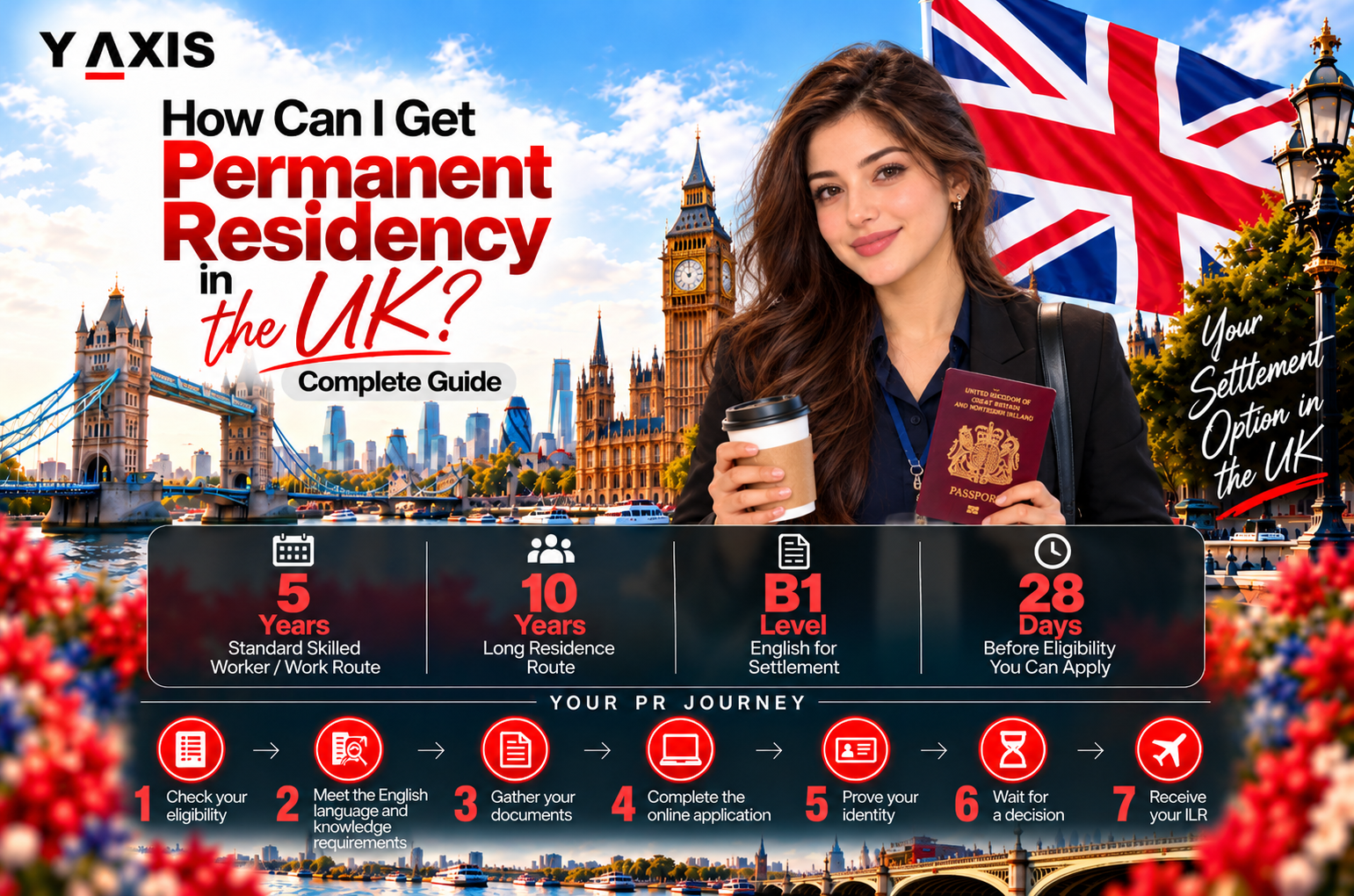
You can get permanent residency in the UK by applying for Indefinite Leave to Remain (ILR) after completing the qualifying residence period for your visa route. Most Skilled Worker, Health and Care Worker and five-year family visa applicants can apply after five years, while Global Talent visa holders may qualify after three or five years and Innovator Founder visa holders after three years. You must meet the residence requirements, satisfy the English language requirement and pass the Life in the UK Test unless exempt. Once granted, ILR allows you to live, work and study in the UK without time restrictions and provides a pathway to British citizenship.
*Want to apply for UK PR? Let Y-Axis guide you through the application process.
Pathways to Permanent Residency in the UK
The main routes include Skilled Worker, Health and Care Worker, family, Global Talent, Innovator Founder and long residence. Most work and five-year family visa routes require five years of qualifying residence, while some Global Talent and Innovator Founder applicants can qualify after three years. Each route has specific settlement requirements that must be met before applying.
| Visa route | Qualifying period | Main requirements |
|---|---|---|
| Skilled Worker visa | 5 years | Eligible job, required salary and employer confirmation. |
| Health and Care Worker visa | 5 years | Eligible healthcare or care role and employer confirmation. |
| Global Talent visa | 3 or 5 years | Qualifying endorsement or eligible prestigious award. |
| Innovator Founder visa | 3 years | Endorsed business meeting innovation, viability and growth requirements. |
| Family visa (spouse or partner) | 5 or 10 years | Genuine relationship and applicable financial and residence requirements. |
| Scale-up Worker visa | 5 years | Qualifying residence and required earnings. |
| UK Ancestry visa | 5 years | Commonwealth citizenship, a qualifying UK-born grandparent and residence requirements. |
| British National (Overseas) visa | 5 years | Qualifying BN(O) status or dependant status and residence requirements. |
| International Sportsperson visa | 5 years | Eligible sporting role, required endorsement and qualifying residence. |
| Long-residence route | 10 years | 10 years of qualifying lawful residence and compliance with residence rules. |
UK Permanent Residency Requirements
To qualify for permanent residency in the UK, you must meet the Indefinite Leave to Remain (ILR) requirements for your visa route, including completing the qualifying residence period, meeting continuous residence rules, satisfying the English language requirement and passing the Life in the UK Test unless exempt. Depending on your visa category, you may also need to meet specific salary, employment or financial requirements.
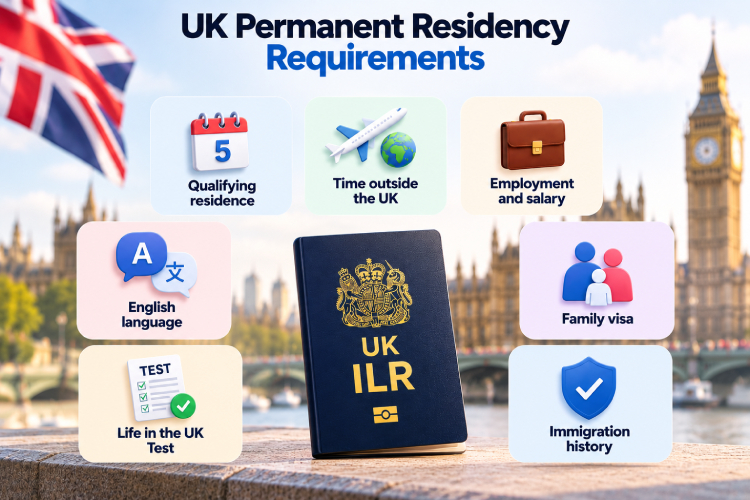
- Qualifying residence: Complete 5 years on most routes, 3 years on some routes, or 10 years under the long-residence route.
- Time outside the UK: Stay within the permitted absence limit, which is 180 days in any 12-month period on most routes.
- Employment and salary: Meet the job and salary requirements for your visa route.
- English language: Meet the B1 level requirement in speaking and listening.
- Life in the UK Test: Pass the test by answering at least 18 of 24 questions correctly.
- Family visa: Meet the relationship requirements for your visa route.
- Immigration history: Follow UK immigration rules and provide accurate information in your application.
*Need help with UK ILR requirements? Book a free consultation with Y-Axis today.
Documents Required for UK Permanent Residency
To apply for Indefinite Leave to Remain (ILR), you must provide documents proving your identity, immigration status and eligibility for settlement. The exact documents depend on your visa route and personal circumstances.
- Valid passport: Your current passport or another accepted identity document.
- Visa details: Evidence of your current UK visa or immigration status.
- Residence evidence: Bank statements or tenancy agreements confirming your qualifying residence.
- English language proof: An approved B1 test certificate or accepted qualification.
- Life in the UK Test: Your pass reference number.
- Employment evidence: Your employer letter and payslips for your work visa route.
- Relationship evidence: Your marriage or civil partnership certificate for spouse or partner applications.
- Absence record: A list of your trips outside the UK with exact dates.
How to Apply for Permanent Residency in the UK?
To get permanent residency in the UK, you must apply for Indefinite Leave to Remain (ILR) after completing the qualifying residence period and meeting your visa route’s requirements. The process involves submitting an online application, providing the required documents, paying the fee and completing identity checks before receiving a decision.
Step 1: Check your eligibility
Confirm you have completed the qualifying residence period and meet the settlement requirements for your visa route.
Step 2: Pass the Life in the UK Test
Take the test and keep your pass reference number.
Step 3: Meet the English language requirement
Prove B1-level English in speaking and listening through an approved test or accepted qualification.
Step 4: Apply online
Complete your ILR application on GOV.UK. You can apply up to 28 days before your qualifying period ends.
Step 5: Pay the fee and verify your identity
Pay the application fee, upload your documents and complete your biometric checks.
Step 6: Receive your decision
The Home Office notifies you of the outcome. Once approved, your ILR status appears on your eVisa.
*Want to apply for UK PR? Book a free consultation with Y-Axis today.
UK Permanent Residency Fees
The standard fee for applying for UK permanent residency through Indefinite Leave to Remain (ILR) is £3,226 per applicant. Additional costs may include the Life in the UK Test, an English language test if required, and optional priority processing services.
| Fee category | Cost | Details |
|---|---|---|
| ILR application | £3,226 per person | Main applicant and each dependant applying |
| Standard processing | Included | Usually a decision within 6 months |
| Priority service | £500 extra | Decision usually within 5 working days, where available |
| Super priority service | £1,000 extra | Decision by the next working day after weekday biometrics, or within 2 working days after weekend biometrics |
| Life in the UK Test | £50 | Required unless exempt |
| English language test | Varies | Additional cost if a test is required |
UK Permanent Residency Processing Time
The standard processing time for UK permanent residency is usually within 6 months. Applicants who need a faster decision may be able to use the priority service, which usually takes 5 working days, or the super priority service, which provides a decision by the next working day after weekday biometrics or within 2 working days after weekend biometrics. Both services require an additional fee and depend on availability.
*Want to migrate to UK permanently? Book a free consultation with Y-Axis today.
FAQs
How can I apply for UK permanent residency (ILR)?
You can apply for UK permanent residency, officially known as Indefinite Leave to Remain (ILR), after completing the qualifying residence period and meeting your visa route’s settlement requirements. Apply online, submit the required documents and pay the application fee.
What are the eligibility requirements for UK permanent residency?
You must complete the qualifying residence period, meet continuous residence rules, satisfy the English language requirement and pass the Life in the UK Test unless exempt. Some visa routes also require specific salary, employment or financial criteria.
Can I get UK permanent residency after five years on a work visa?
Yes, eligible Skilled Worker visa holders can generally apply for ILR after five years of qualifying residence, provided they meet the applicable salary, sponsorship and settlement requirements.
Can I apply for ILR after three years on a Global Talent visa?
Yes, some Global Talent visa holders qualify after three years, while others need five years. Eligibility depends on the basis of their endorsement or award and the applicable settlement rules.
How much is the UK ILR application fee?
The application fee stated for this guide is £3,226 per applicant. Additional costs may include the Life in the UK Test, an English language test and optional priority processing. Check GOV.UK for the latest fees.
How long does a UK ILR application take to process?
A standard ILR application usually takes up to six months. Priority services may offer faster decisions for an additional fee, subject to availability.
How many days can I stay outside the UK while qualifying for ILR?
Many five-year settlement routes generally allow up to 180 days outside the UK in any 12-month period. Absence rules vary by visa route, so check the requirements that apply to your application.
Do I need B1-level English to apply for UK ILR?
Many applicants must demonstrate English proficiency at B1 level or above unless exempt. Check the current requirements and accepted evidence before applying.
Do I need to pass the Life in the UK Test to get ILR?
Yes, most applicants must pass the Life in the UK Test unless exempt. The test contains 24 questions, and you need at least 18 correct answers to pass.
How long after getting ILR can I apply for British citizenship?
Most eligible applicants can apply after holding ILR for 12 months. Those married to British citizens may qualify sooner, provided they meet the separate citizenship requirements.
Tags:
UK Permanent Residency
Indefinite Leave to Remain
ILR
UK Settlement
UK Immigration
UK Visa
ILR Eligibility
UK Settlement Requirements
Life in the UK Test
UK Citizenship
Share
Latest Article
Popular Post
Trending Article

Posted On October 26 2026
What is the Average Salary in the UAE?