

Posted on May 28 2026
Fall Intake: Top Universities Opening Application Rounds in April–May

By , Editor & Director
Updated May 28 2026
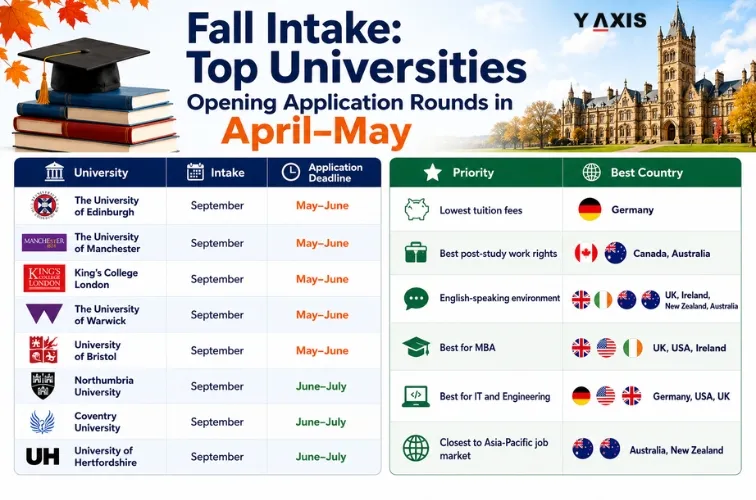
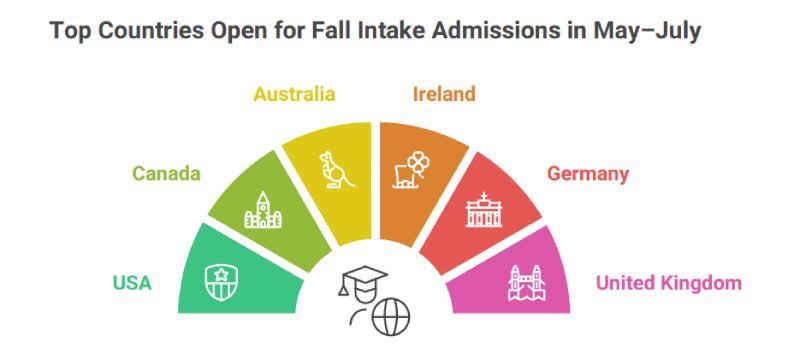
The top universities opening application rounds in April–May for the Fall intake include institutions across the UK, USA, Canada, Germany, Ireland, the New Zealand, and Australia. The Fall intake covers over 90% of university-specific scholarships globally, the widest course selection and the strongest post-study work opportunities across all major study destinations.
For students targeting September or July entry, April–May is the most critical application window of the year. Most top universities follow rolling admissions during this period. Applying early gives you the best chance of securing your preferred program, scholarship, and accommodation before places are filled.
*Want to apply for the Fall intake? Let Y-Axis guide you through application process.
Why Apply for the Fall Intake in April–May?
The Fall intake is the primary academic semester across all major study destinations, offering the widest range of programs, the highest scholarships, and the best post-study work opportunities of any intake period.
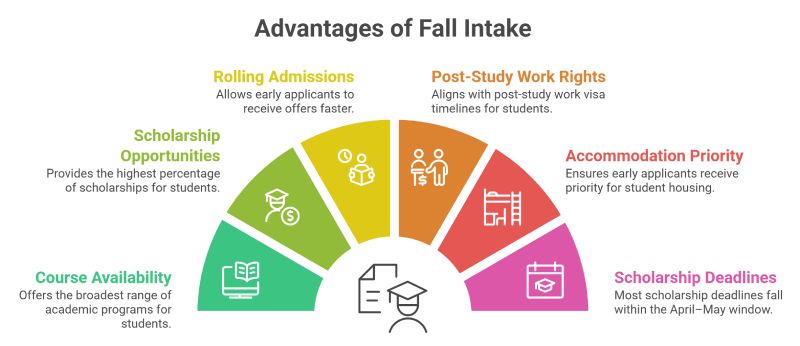
- Widest course availability: Almost all undergraduate and postgraduate programs are open for Fall entry
- Maximum scholarships: Over 90% of university-specific and government funding globally goes to Fall intake students
- Rolling admissions: Early applicants receive offers faster with more time for visa processing
- Post-study work rights: Fall entry aligns with post-study work visa timelines across all seven destinations
- Accommodation priority: Student housing is allocated on a first-come, first-served basis
- Scholarship deadlines: Most university and government scholarship deadlines fall within the April–May window
How to Choose the Right Country for the Fall Intake?
Choosing the right study destination depends on your budget, career goals, post-study work rights, and language preferences. Here is a quick guide to help narrow down the right country.
|
Priority |
Best Country |
|
Lowest tuition fees |
Germany |
|
Best post-study work rights |
Canada, Australia |
|
English-speaking environment |
UK, Ireland, New Zealand, Australia |
|
Best for MBA |
UK, USA, Ireland |
|
Best for IT and Engineering |
Germany, USA, UK |
|
Closest to Asia-Pacific job market |
Australia, New Zealand |
Top Universities Opening Fall Intake Application Rounds in April–May
Top universities across the UK, USA, Canada, Germany, Ireland, New Zealand, and Australia are actively accepting applications in April–May for the Fall intake. Institutions such as the University of Edinburgh, TU Munich, Trinity College Dublin, and the University of Melbourne are among the top universities with open application rounds during this period.
United Kingdom
The UK is one of the most popular study destinations globally, offering world-class universities, an English-speaking environment, and a 2-year post-study Graduate Route for eligible graduates. Postgraduate applications are accepted on a rolling basis through June–July each year. Undergraduate applications are submitted through UCAS.
The UK has over 150 universities offering postgraduate programs across Business, IT, Engineering, Health Sciences, and Arts. Top institutions like the University of Edinburgh, University of Manchester, and King's College London accept applications on a rolling basis. Early applicants receive offers faster and have more time to prepare for visa processing.
|
University |
Intake |
Application Deadline |
|
University of Edinburgh |
September |
May–June |
|
University of Manchester |
September |
May–June |
|
King's College London |
September |
May–June |
|
University of Warwick |
September |
May–June |
|
University of Bristol |
September |
May–June |
|
Northumbria University |
September |
June–July |
|
Coventry University |
September |
June–July |
|
University of Hertfordshire |
September |
June–July |
Popular courses: MBA, MSc Data Science, MSc Computer Science, MSc Finance, MA International Relations
*Want to study in the UK? Let Y-Axis help you through application process.
United States
The USA is one of the top destinations for postgraduate and research degrees globally, offering world-ranked universities, strong industry connections, and excellent career outcomes. The Fall semester starts in August or September each year. Unlike most countries, the USA follows a rolling admissions system — universities process applications as they arrive until programs reach capacity.
Regular decision deadlines at most top US universities close by January–February each year. However, several universities including Arizona State University, Northeastern University, and Michigan State University continue accepting applications through April–May via rolling admissions. Early application is strongly recommended as popular programs fill quickly.
|
University |
Intake |
Application Deadline |
|
Arizona State University |
Fall |
May–June |
|
Northeastern University |
Fall |
May–June |
|
University of Texas at Dallas |
Fall |
May–June |
|
Michigan State University |
Fall |
May–June |
|
Penn State University |
Fall |
Rolling through summer |
|
University of Pittsburgh |
Fall |
May–June |
Popular courses: MS Computer Science, MBA, MS Data Analytics, MS Engineering, MS Public Health
*Want to study in USA? Let Y-Axis guide you through application process.
Canada
Canada is a top study destination offering high-quality education, affordable tuition, and one of the best post-study work options globally through the Post-Graduation Work Permit (PGWP), which allows graduates to work in Canada for up to 3 years. The Fall semester starts in September each year.
Most top Canadian universities including the University of Toronto, UBC, and McGill close applications by January–February. However, several universities including the University of Calgary, Brock University, and University of Manitoba continue accepting applications through May–June via rolling admissions. Early application is strongly recommended as popular programs fill quickly.
|
University |
Intake |
Application Deadline |
|
University of Calgary |
Fall |
May–June |
|
University of Manitoba |
Fall |
May–June |
|
Brock University |
Fall |
May–June |
|
University of Regina |
Fall |
May–June |
|
Vancouver Island University |
Fall |
May–June |
|
University of New Brunswick |
Fall |
May–June |
Popular courses: MBA, MS Computer Science, Master of Engineering, Master of Public Health, Master of Education
*Want to study in Canada? Let Y-Axis help you through application process.
Germany
Germany is one of the most affordable study destinations globally, with most public universities charging only a nominal semester fee of €100–€350 rather than full tuition. The Winter Semester starts in October each year. All applications to German public universities are processed through Uni-Assist, the centralised document verification body, before being forwarded to the university.
The Uni-Assist deadline is typically July 15 each year for the Winter Semester. However, top universities like TU Munich and Freie Universität Berlin set earlier internal deadlines around May 31. Students are advised to apply well before the Uni-Assist deadline to allow enough time for document verification and visa processing.
|
University |
Intake |
Application Deadline |
|
TU Munich (TUM) |
Winter Semester |
May–June |
|
LMU Munich |
Winter Semester |
June–July |
|
Heidelberg University |
Winter Semester |
June–July |
|
RWTH Aachen University |
Winter Semester |
June–July |
|
Freie Universität Berlin |
Winter Semester |
May–June |
|
University of Hamburg |
Winter Semester |
June–July |
Popular courses: MS Engineering, MS Computer Science, MBA, MS Natural Sciences, MS Economics
*Want to study in Germany? Let Y-Axis help you through application process.
Ireland
Ireland is a highly attractive study destination offering world-class universities, an English-speaking environment, and a 2-year stay-back option for international postgraduate graduates. The September intake is the primary and most popular entry point, with applications accepted through May–July each year. Around 80% of graduates in Ireland secure employment within nine months of graduation.
Ireland is home to the European headquarters of companies like Google, Meta, Apple, and Pfizer, making it a strong destination for students targeting careers in tech, pharma, and finance. Trinity College Dublin, University College Dublin, and University College Cork are among the top ranked universities accepting applications right now.
|
University |
Intake |
Application Deadline |
|
Trinity College Dublin |
September |
May–June |
|
University College Dublin |
September |
May–June |
|
University College Cork |
September |
May–June |
|
University of Galway |
September |
May–June |
|
Dublin City University |
September |
May–July |
|
Maynooth University |
September |
May–July |
Popular courses: MSc Computer Science, MBA, MSc Data Analytics, MSc Pharmacy, MA International Relations
*Want to study in Ireland? Let Y-Axis help you through application process.
New Zealand
New Zealand is a growing study destination offering high-quality education, an English-speaking environment, and strong post-study work rights of up to 3 years through the Post-Study Work Visa. The September intake is the primary entry point for international students, with applications accepted through May–July each year.
New Zealand is home to eight universities, all ranked in the top 3% of universities worldwide. The University of Auckland, University of Otago, and Victoria University of Wellington are among the most popular choices for international students across Business, IT, Engineering, and Health Sciences programs.
|
University |
Intake |
Application Deadline |
|
University of Auckland |
September |
May–June |
|
University of Otago |
September |
May–June |
|
Victoria University of Wellington |
September |
May–June |
|
University of Canterbury |
September |
May–July |
|
Massey University |
September |
May–July |
|
Auckland University of Technology |
September |
May–July |
Popular courses: MBA, MSc Computer Science, MSc Engineering, MSc Data Science, Master of Public Health
Australia
Australia offers two major intakes each year — February (Semester 1) and July (Semester 2). The July intake is the second major entry point, fully resourced across Business, IT, Engineering, Arts, and Health Sciences at almost all major universities including the prestigious Group of Eight. Applications for the July intake are accepted through April–June each year.
Students studying in regional Australia are eligible for additional post-study work rights of up to 2 extra years on top of the standard visa. Australia's top universities including the University of Melbourne, University of Sydney, and Monash University are among the most popular choices for international students globally.
|
University |
Intake |
Application Deadline |
|
University of Melbourne |
July |
June–July |
|
University of Sydney |
July |
June–July |
|
Monash University |
July |
June |
|
University of Queensland |
July |
June |
|
Australian National University |
July |
June |
|
University of Western Australia |
July |
June–July |
|
RMIT University |
July |
May–June |
|
University of Technology Sydney |
July |
May–June |
Popular courses: Master of Business Analytics, Master of Data Science, Master of Engineering, Master of Information Technology, Master of Public Health
*Want to study in Australia? Let Y-Axis help you through application process.
Eligibility Requirements for the Fall Intake
The eligibility requirements for the Fall intake vary by country and institution. However, the following requirements apply broadly across top universities in all seven destinations.
Key eligibility requirements for the Fall intake:
- Bachelor's degree: A recognised undergraduate degree from an accredited university
- English proficiency: IELTS 6.5–7.0 overall, PTE Academic, or TOEFL — exact scores vary by university and country
- Academic transcripts: Official transcripts from all previous institutions
- Statement of Purpose (SOP): Required by most universities across all seven destinations
- CV / Resume: Outlining academic background, work experience, and achievements
- Letters of Recommendation (LORs): Typically two to three from academic or professional referees
- Valid passport: Required for both the application and visa process
- GRE / GMAT: Required for select postgraduate programs in the USA and some business schools globally
How to Apply for the Fall Intake?
Applying for the Fall intake involves a straightforward process across all seven destinations. Most universities accept direct online applications through their official websites.
Step-by-step application process for the Fall intake:
Step 1: Shortlist countries, universities, and programs based on rankings, course content, tuition fees, and career goals
Step 2: Check eligibility requirements for each program including English test scores, GPA, and any additional prerequisites
Step 3: Prepare your documents — transcripts, SOP, CV, LORs, English test scores, and passport copy
Step 4: Submit applications directly through each university's online portal. Use UCAS for UK undergraduate programs and direct portals for all other destinations
Step 5: Receive and compare offer letters — conditional or unconditional depending on the institution
Step 6: Accept your preferred offer and pay any enrollment deposit required to confirm your place
Step 7: Apply for your student visa for your chosen destination as soon as you receive your offer letter
Step 8: Arrange health insurance, accommodation, and flights before the semester begins
*Planning to apply for the Fall intake? Get expert guidance from Y-Axis professionals today.
Top 10 Scholarships for the Fall Intake to Study Abroad
The top 10 scholarships available for the Fall intake include the Chevening Scholarship, Fulbright Program, DAAD Scholarship, and Manaaki New Zealand Scholarship, among others. Most scholarship deadlines fall within or just before the April–May application window, making early application the most critical factor in securing funding.
|
Scholarship |
Country |
Value |
|
Chevening Scholarship |
UK |
Full tuition + living stipend |
|
Commonwealth Scholarship |
UK |
Full tuition + living costs |
|
Fulbright Program |
USA |
Full funding including living allowance |
|
DAAD Scholarship |
Germany |
Full tuition + monthly stipend |
|
Vanier Canada Graduate Scholarship |
Canada |
CAD 50,000 per year (doctoral students) |
|
Government of Ireland Scholarship |
Ireland |
Full tuition + €10,000 stipend |
|
Manaaki New Zealand Scholarship |
New Zealand |
Full tuition + living allowance + travel |
|
University of Auckland International Scholarship |
New Zealand |
Up to NZD 10,000 per year |
|
Destination Australia Scholarship |
Australia |
AUD 15,000 per year |
|
Australia Awards Scholarship |
Australia |
Full tuition + living allowance |
Cost of Studying Abroad for the Fall Intake
The cost of studying abroad for the Fall intake varies significantly by country, university, and program. Germany is the most affordable option, with public universities charging as little as €100–€350 per semester. Below is an estimated breakdown of tuition fees and living costs across all seven destinations.
|
Country |
Tuition Fees Per Year |
Living Costs Per Year |
|
UK |
AUD 35,000 – 65,000 |
AUD 20,000 – 30,000 |
|
USA |
AUD 35,000 – 70,000 |
AUD 20,000 – 35,000 |
|
Canada |
AUD 25,000 – 45,000 |
AUD 15,000 – 25,000 |
|
Germany |
AUD 500 – 5,000 |
AUD 12,000 – 18,000 |
|
Ireland |
AUD 18,000 – 40,000 |
AUD 15,000 – 25,000 |
|
New Zealand |
AUD 20,000 – 40,000 |
AUD 15,000 – 25,000 |
|
Australia |
AUD 25,000 – 55,000 |
AUD 21,000 – 30,000 |
Note: Tuition fees and living costs are estimates and vary by university, program, and city. Always confirm directly with your chosen institution.
Tips to Improve Your Chances of Getting Admission for the Fall Intake
Getting admission to a top university for the Fall intake is competitive. Here are six tips to improve your chances of securing admission and scholarships.
- Apply early: Most universities follow rolling admissions — early applicants receive offers faster and have first access to scholarships and accommodation
- Tailor your SOP: Write a specific Statement of Purpose for each university — generic SOPs are rarely successful
- Choose referees carefully: Select recommenders who know your work well and can write detailed, specific letters
- Meet the English requirement: Aim for IELTS 7.0 or above for competitive programs — a higher score strengthens your application significantly
- Apply to multiple universities: Shortlist at least 3–5 universities across your preferred destinations to maximise your chances
- Prepare documents early: Transcript verification, reference letters, and English tests take time — start at least 3–4 months before your target deadline
*Planning to apply for the Fall intake? Get expert guidance from Y-Axis professionals.
FAQs
Which countries have Fall intake applications open in April–May?
Seven major study destinations have open Fall intake applications in April–May — the UK (until June–July), USA (rolling admissions at select universities), Canada (rolling at several institutions), Germany (Uni-Assist deadline July 15), Ireland (until May–July), New Zealand (until May–July), and Australia (July intake open until June–July). Students should apply as soon as possible, especially for destinations where deadlines close earliest.
What is the Fall intake and when does it start?
The Fall intake is the primary academic semester starting in September or October across the UK, USA, Canada, Germany, Ireland, and New Zealand. In Australia, the equivalent is the July intake (Semester 2), beginning in late July or early August. It is the largest intake globally, offering the widest range of courses, scholarships, and post-study work options across all major destinations.
Is it too late to apply for the Fall intake?
Not necessarily, but time is always short for Fall entry. The UK, Ireland, and Germany typically accept applications until June–July. Canada and the USA have rolling admissions open at several universities through May–June. Australia's July intake accepts applications until June–July. New Zealand is open through May–July. Apply immediately across your preferred destinations without delay.
Which country is the most affordable for the Fall intake?
Germany is by far the most affordable. Most German public universities charge only a nominal semester fee of around €100–€350, making tuition essentially free for international students. Canada and New Zealand offer mid-range options. The UK and USA are generally the most expensive. Australia sits in the mid-to-high range depending on the university and course selected.
What English test scores are required for the Fall intake?
Most universities across all seven destinations require an overall IELTS score of 6.5 to 7.0, or equivalent PTE Academic or TOEFL scores. Some top-ranked universities and highly competitive programs may require higher scores. Always confirm the exact English proficiency requirement directly with your chosen university and specific program before submitting your application.
What is the difference between Fall intake and Spring intake?
The Fall intake (September/October in the Northern Hemisphere, July in Australia) is the primary semester with the widest course availability, most scholarships, and strongest career alignment. The Spring intake (January/February) is a secondary entry point with fewer programs and reduced scholarship opportunities. For most students targeting top universities and strong funding, the Fall intake is the strategically stronger choice.
Which is the best country for an MBA in the Fall intake?
The UK, USA, Ireland, and Australia are the strongest MBA destinations for the Fall intake. The UK offers world-ranked programs with strong European career access. The USA has globally top-ranked MBA programs with powerful industry networks. Ireland provides access to EU-based multinationals in tech and pharma. Australia offers strong programs at Melbourne, Sydney, and Monash with excellent post-study work rights across the Asia-Pacific region.
What documents are required to apply for the Fall intake?
You generally need academic transcripts, a bachelor's degree certificate, a valid passport, English proficiency test results, a Statement of Purpose, an updated CV, and letters of recommendation. Some programs additionally require a GMAT or GRE score, a portfolio, or evidence of work experience. Always check requirements for each specific university and program before applying.
What visa is required for each Fall intake destination?
Students need a UK Student Visa for the UK, an F-1 Visa for the USA, a Study Permit for Canada, a German National Visa (Type D) for Germany, an Irish Study Visa for Ireland, a Student Visa for New Zealand, and a Student Visa (Subclass 500) for Australia. Always apply for your visa immediately upon receiving your official university offer letter.
How long does visa processing take for the Fall intake?
UK Student Visas take 3–8 weeks. US F-1 Visas take 2–4 weeks after interview, but slots fill fast in peak season. Canadian Study Permits take 4–8 weeks. German National Visas take 6–12 weeks. Irish Study Visas take 4–8 weeks. New Zealand Student Visas take 4–6 weeks. Australian Student Visas take 3–8 weeks. Submit your visa application immediately upon receiving your offer letter.
Which country offers the best post-study work rights?
Canada offers up to 3 years through the Post-Graduation Work Permit. The UK offers a 2-year Graduate Route for eligible graduates. Ireland offers a 2-year stay-back option for postgraduate graduates. Australia offers 2–6 years depending on study location, with regional study adding extra years. New Zealand offers up to 3 years through the Post-Study Work Visa. Germany offers an 18-month job search visa after graduation.
Which country is best for IT and Computer Science in the Fall intake?
Germany offers world-class technical universities like TU Munich and RWTH Aachen at minimal tuition cost. The UK offers excellent programs at Edinburgh and King's College London. Australia has strong options at RMIT, UTS, and Monash. New Zealand has growing IT programs at the University of Auckland and Victoria University of Wellington. The USA offers the strongest research and industry connections for postgraduate Computer Science study globally.
Can students apply to multiple countries simultaneously for the Fall intake?
Yes, and it is strongly recommended. Applying to universities across two or three countries simultaneously gives more options, stronger negotiating power on scholarships, and a reliable fallback if one application is unsuccessful. It also allows students to compare offers, fees, and post-study work rights before making a final decision. Managing parallel applications ensures no deadlines, documents, or visa timelines are missed.
Are there fully funded scholarships available for the Fall intake?
Yes. The Chevening Scholarship (UK), Fulbright Program (USA), DAAD Scholarship (Germany), and Government of Ireland Scholarship are among the fully funded options available every year. University-specific merit scholarships are also available across all seven destinations. Most scholarship deadlines align with or fall before university application deadlines, so applying early in April–May significantly improves your chances of securing funding.
What is the Uni-Assist process for Germany?
Uni-Assist is Germany's centralised document verification body used by most public universities. Students submit academic documents through Uni-Assist, which verifies credentials before forwarding them to the university. The main deadline is typically July 15 for the Winter Semester. However, top universities like TU Munich and Freie Universität Berlin set earlier internal deadlines around May 31. Always check both the Uni-Assist and university-specific deadlines before applying.
What is the New Zealand International Scholarship and who can apply?
The New Zealand International Scholarship is a government-funded award covering full tuition and a living allowance for international students. It is available for students enrolling in undergraduate and postgraduate programs at New Zealand universities. Applications open alongside university admissions each year. Early application is strongly recommended as the number of scholarships available each year is limited.
Does Germany really have free tuition for international students?
Yes, most German public universities charge only a nominal semester fee of around €100–€350 rather than full tuition. This applies to both undergraduate and postgraduate students. Private universities in Germany do charge full tuition fees. The main cost of studying in Germany is living expenses, which are generally lower than in the UK, USA, Ireland, or Australia, making it outstanding value for international students.
Why is the UK Fall intake especially important each year?
The UK Fall intake (September) is the primary and most competitive entry point, offering the widest range of programs, the most scholarship availability, and access to the full post-study Graduate Route work visa. Most universities across the UK open applications from September the previous year, with rolling admissions continuing until June–July. Applying early gives the strongest chance of securing top programs and funding.
Is Ireland a good study destination for the Fall intake?
Yes. Ireland is English-speaking, part of the EU, and home to European headquarters of companies like Google, Meta, Apple, and Pfizer. Around 80% of graduates secure employment within nine months of graduation. Ireland also offers a 2-year stay-back option for international postgraduate graduates. Combined with competitive fees and strong graduate employment rates, Ireland is a compelling Fall intake destination year after year.
How early should students start preparing for the Fall intake?
Ideally 9–12 months before the intake starts. Research universities and shortlist courses first, then prepare English test scores, SOP, transcripts, and recommendation letters. Apply to universities by November–January for the best chances at top institutions. Start visa preparation as soon as an offer is received. Early preparation improves the chances of securing preferred programs, scholarships, and student accommodation across all seven destinations.
Tags:
Fall Intake
Study Abroad
UK Universities
USA Universities
Canada Universities
Germany Universities
Ireland Universities
New Zealand Universities
Australia Universities
Scholarships
Student Visa
Application Deadlines
Share
Latest Article
Popular Post
Trending Article
Posted On October 09 2026
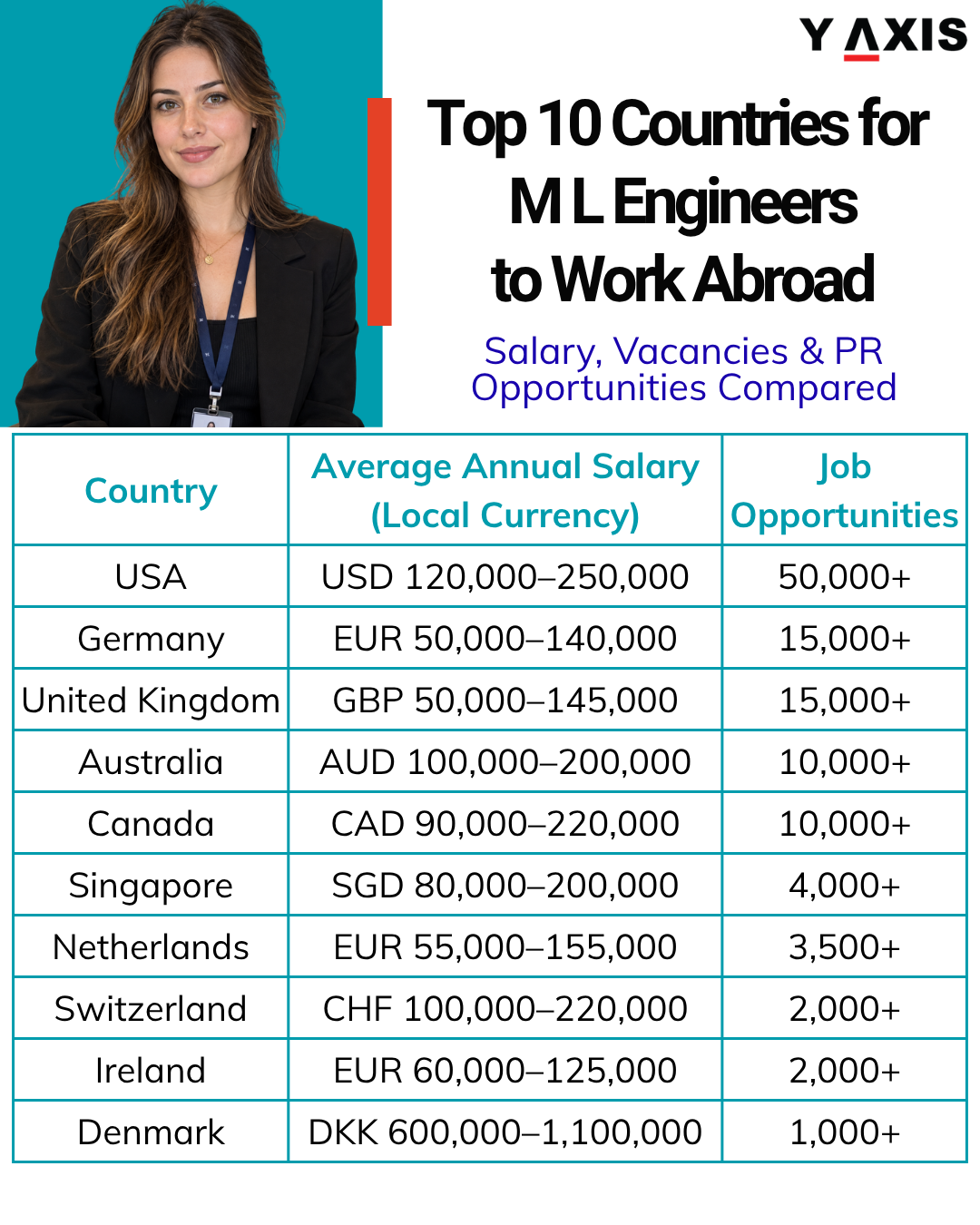
Top 10 Countries for Machine Learning (ML) Engineers to Work Abroad: Salary, Demand & PR Opportunities Compared