

Posted on October 19 2026
Canada vs. Australia for IT Professionals: Which Country Should You Choose?

By , Editor
Updated October 19 2026
Both Canada and Australia offer IT professionals career opportunities in software engineering, cybersecurity, cloud computing and data analytics, with competitive salaries and pathways to permanent residency (PR). Australia offers skilled migration options through Subclass 189 and 190 visas, alongside employer-sponsored pathways through Subclass 482 and 186. Canada provides PR routes through Express Entry and Provincial Nominee Programs (PNPs). Explore how the two countries compare in IT job opportunities, salaries, work visa options, PR pathways, taxes and living costs to find the right destination for your IT career and future settlement.
*Want to work abroad? Let Y-Axis help you through application process.
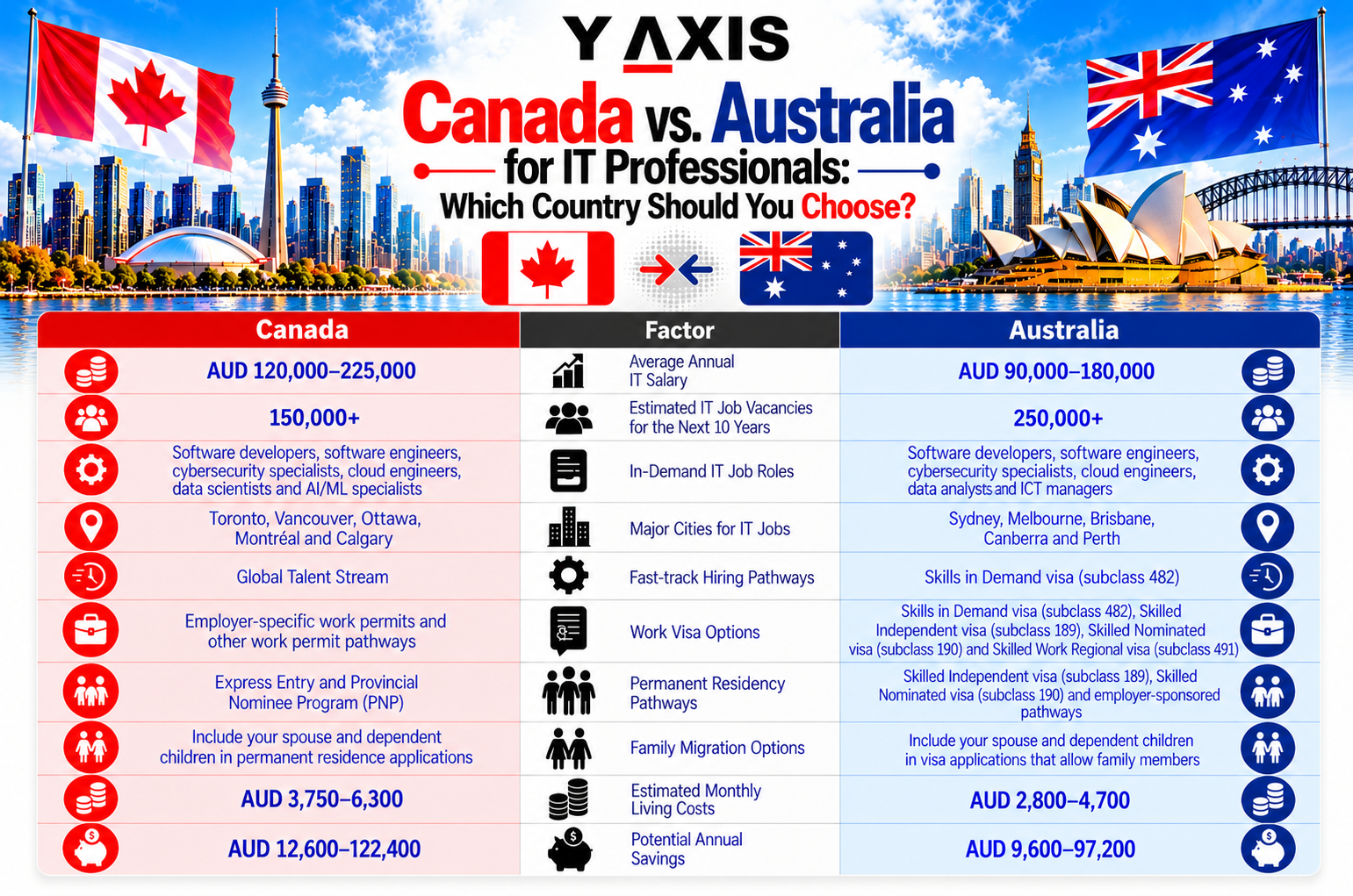
Canada vs. Australia for IT Professionals: Quick Comparison
| Factor | Canada | Australia |
|---|---|---|
| Average Annual IT Salary | CAD 80,000–150,000 | AUD 90,000–180,000 |
| Estimated IT Job Vacancies for the Next 10 Years | 150,000+ | 250,000+ |
| In-Demand IT Job Roles | Software developers, software engineers, cybersecurity specialists, cloud engineers, data scientists and AI/ML specialists | Software developers, software engineers, cybersecurity specialists, cloud engineers, data analysts and ICT managers |
| Major Cities for IT Jobs | Toronto, Vancouver, Ottawa, Montréal and Calgary | Sydney, Melbourne, Brisbane, Canberra and Perth |
| Fast-track Hiring Pathways | Global Talent Stream | Skills in Demand visa (subclass 482) |
| Work Visa Options | Employer-specific work permits and other work permit pathways | Skills in Demand visa (subclass 482), Skilled Independent visa (subclass 189), Skilled Nominated visa (subclass 190) and Skilled Work Regional visa (subclass 491) |
| Permanent Residency Pathways | Express Entry and Provincial Nominee Program (PNP) | Skilled Independent visa (subclass 189), Skilled Nominated visa (subclass 190) and employer-sponsored pathways |
| Estimated Monthly Living Costs | CAD 2,500–4,200 | AUD 2,800–4,700 |
| Family Migration Options | Include your spouse and dependent children in permanent residence applications | Include your spouse and dependent children in visa applications that allow family members |
Canada vs. Australia: Which Country Offers Better Opportunities for IT Professionals?
Australia offers IT professionals competitive salaries, 12% employer superannuation contributions and four weeks of paid annual leave for most full-time employees. Cities such as Sydney, Melbourne and Brisbane offer opportunities in software engineering, cybersecurity and cloud computing. Canada also attracts IT talent through technology hubs and PR pathways such as Express Entry and Provincial Nominee Programs (PNPs). Both countries offer strong career prospects for IT professionals, with Australia providing skilled migration and employer-sponsored visa pathways.

Canada may be good choice if you:
- Want to pursue PR through Express Entry or a Provincial Nominee Program (PNP).
- Have strong English or French skills and a competitive CRS score.
- Are targeting IT jobs in Toronto, Vancouver, Montréal or Ottawa.
- Want to explore opportunities in software development, AI, cloud computing or cybersecurity.
*Want to work in Canada? Get expert guidance from Y-Axis professionals.
Australia may be good choice if you:
- Have an IT occupation suited to a skilled migration pathway.
- Can obtain a positive skills assessment for your nominated occupation.
- Meet the points requirements for a subclass 189 or 190 visa, or have an employer willing to sponsor you.
- Want employer superannuation contributions and four weeks of paid annual leave for most full-time employees.
*Want to work in Australia? Get expert guidance from Y-Axis professionals.
Canada vs. Australia: Salary, Living Costs & Savings for IT Professionals
Salaries, taxes and living costs are key factors when comparing IT careers in Australia and Canada. Australia offers 12% employer superannuation contributions and four weeks of paid annual leave for most full-time employees. Comparing IT salaries and everyday expenses in cities such as Sydney, Melbourne, Toronto and Calgary can help you understand your potential take-home pay and savings in each country.
| Factor | Canada | Australia |
|---|---|---|
| Annual IT Salary (Before Tax) | CAD 70,000–150,000 | AUD 90,000–170,000 |
| Monthly Gross Salary | CAD 5,833–12,500 | AUD 7,500–14,167 |
| Estimated Monthly Take-Home Pay | CAD 4,400–8,700 | AUD 5,800–10,300 |
| Monthly Rent (1-Bedroom Apartment in City Centre) | CAD 1,300–2,650 | AUD 1,470–3,620 |
| Monthly Grocery Expenses | CAD 350–550 | AUD 400–650 |
| Monthly Public Transport Expenses | CAD 100–180 | AUD 100–220 |
| Monthly Utilities, Internet and Mobile | CAD 150–300 | AUD 260–500 |
| Estimated Total Monthly Living Expenses | CAD 1,900–3,700 | AUD 2,200–5,000 |
| Potential Monthly Savings | CAD 700–6,800 | AUD 800–8,100 |
| Potential Annual Savings | CAD 8,400–81,600 | AUD 9,600–97,200 |
| Cities with Relatively Lower Living Costs | Calgary, Edmonton and Montréal | Adelaide, Perth and Brisbane |
| Major Higher-Cost IT Hubs | Toronto and Vancouver | Sydney and Melbourne |
*Plan Your IT Career Abroad? Book a Free Consultation with Y-Axis Today.
FAQs;
Is Australia or Canada better for IT professionals?
Australia offers skilled migration visas, employer sponsorship and employment benefits such as superannuation. Canada offers IT jobs in Toronto, Vancouver and Montréal, along with PR pathways through Express Entry and Provincial Nominee Programs (PNPs). The better choice depends on your career goals, salary expectations and migration eligibility.
Which country offers higher IT salaries, Australia or Canada?
IT professionals in Australia can earn AUD 90,000–170,000 annually, while salaries in Canada range from CAD 70,000–150,000. Actual earnings depend on your role, experience and location.
Which IT jobs are in demand in Australia and Canada?
Both countries offer opportunities for software developers, cybersecurity analysts, cloud engineers, data scientists and IT managers. Major IT hubs include Sydney, Melbourne and Brisbane in Australia, and Toronto, Vancouver and Calgary in Canada.
How can IT professionals get PR in Australia or Canada?
Australia offers Subclass 189, 190 and 491 skilled migration visas, while Canada offers PR through Express Entry and Provincial Nominee Programs (PNPs). Eligibility depends on your occupation, qualifications, work experience and language proficiency.
Is Australian PR or Canadian PR easier for IT professionals?
Neither country is easier for everyone. Australia considers points, occupation eligibility and skills assessments where applicable. Canada ranks eligible Express Entry candidates using the Comprehensive Ranking System (CRS). Your profile and current selection criteria determine your prospects.
How many points do IT professionals need for Australian skilled migration?
Applicants for Australia's points-tested Subclass 189 visa generally need at least 65 points to qualify for consideration. However, meeting this minimum does not guarantee an invitation.
Is an ACS skills assessment required for IT professionals migrating to Australia?
Many IT professionals applying through Australian skilled migration need an assessment from the Australian Computer Society (ACS) when it is the designated assessing authority for their nominated occupation. Requirements depend on the occupation and visa pathway.
Can IT professionals migrate to Australia or Canada without a job offer?
Yes. Eligible applicants can pursue Australia's Subclass 189 visa or qualifying Canadian Express Entry pathways without a job offer. Other visa options may require employer sponsorship or a qualifying job offer.
Is the cost of living lower in Australia or Canada for IT professionals?
Adelaide and Perth can be alternatives to Sydney in Australia, while Calgary and Montréal can be alternatives to Toronto and Vancouver in Canada. Compare rent, transport, groceries and utilities in your target city.
Which country offers better savings for IT professionals, Australia or Canada?
Your savings depend on your after-tax salary and living expenses. Compare equivalent IT salaries, rent, groceries, transport and taxes in your preferred cities. Australia's 12% employer superannuation contribution also supports retirement savings but is separate from take-home pay.
Tags:
Canada vs Australia for IT Professionals
IT Jobs in Australia vs Canada
IT Salaries in Australia vs Canada
Software Engineer Jobs in Australia and Canada
Cybersecurity Jobs in Australia and Canada
Data Analyst Jobs in Australia and Canada,
Australian IT Skills Assessment
Skilled Migration for IT Professionals in Australia
Australia PR for IT Professionals
Canada Express Entry for IT Professionals
Share
Latest Article
Popular Post
Trending Article
Posted On October 19 2026
Canada vs. Australia for IT Professionals: Which Country Should You Choose?