Posted on February 14 2026
3 Million Jobs in Germany Over the Next Decade: Job Outlook and Work Visa Options

By , Editor
Updated February 16 2026
Germany is expected to have around 3 million job openings over the next decade, driven by large-scale retirements and growth across key sectors. More than 30% of the workforce will retire by 2035, and the government plans to invest over €1 trillion in infrastructure, industry, and defence to support long-term economic growth.
To address labour shortages, Germany is easing work visa and immigration rules for foreign workers. Faster hiring routes such as the Accelerated Skilled Worker Procedure and the Opportunity Card, which allows job searching without a prior offer, make it easier to work in Germany. Strong demand exists in IT, engineering, healthcare, manufacturing, logistics, renewable energy, and research, offering long-term career opportunities, making Germany an attractive destination for long-term careers in Europe.
*Want to work in Germany? Avail Y-Axis Resume Marketing Services to find the right job faster.
Why apply for Jobs in Germany to Work Abroad?
- Strong and stable economy with long-term job security
- High demand for skilled workers due to large-scale retirements
- Competitive salaries with strong labour protections
- Regulated working hours and a healthy work–life balance
- Simplified immigration rules and fast-track work visa options
- Access to public healthcare and social security benefits
- Job opportunities across IT, engineering, healthcare, manufacturing, and research
- Clear pathways to permanent residence and long-term settlement
Job Outlook in Germany over the Next 10 Years
Germany’s job market is expected to remain strong over the next decade, with around 3 million new and replacement jobs projected across the economy. This outlook is largely driven by large-scale retirements, as more than 30% of the workforce is expected to retire by 2035, leading to labour shortages across multiple sectors.
To meet rising demand, Germany has simplified immigration rules to attract foreign professionals and speed up the recognition of overseas qualifications. Pathways such as the Skilled Immigration Act, the Accelerated Skilled Worker Procedure, and the Opportunity Card (Chancenkarte) make it easier to find jobs in Germany and clear pathways to work legally in Germany.
Key Factors Driving Job Growth in Germany
- Large-scale retirements creating widespread replacement demand
- Ongoing skills shortages across IT, engineering, healthcare, and manufacturing
- Government investment in infrastructure, digitalisation, and green energy
- Simplified work visa policies supporting faster international hiring
Employment Opportunities by 2035
- Around 3 million job openings expected across major industries
- Increasing reliance on international professionals to fill labour gaps
- Government-backed initiatives supporting overseas recruitment
- Growing availability of jobs in Germany with work visa options
Who Can Apply for Jobs in Germany from Abroad?
Germany welcomes candidates at different career stages who meet basic qualification and skill requirements. With ongoing labour shortages across multiple industries, employers are increasingly open to hiring both early-career and experienced professionals from abroad.
Freshers and Graduates
- Eligible for entry-level, trainee, and junior roles
- Opportunities across IT, engineering, logistics, healthcare, and business services
- Option to search for jobs through pathways such as the Opportunity Card
- Work visas available once a job offer is secured
*Want to apply for German Opportunity Card? Let Y-Axis help you through the process.
Experienced Professionals
- Strong demand for mid-level professionals with relevant work experience
- High hiring activity in IT, engineering, manufacturing, healthcare, and finance
- Employer-sponsored work visas common for skilled roles
- Better prospects for long-term employment and career stability
Senior and Specialist Professionals
- Suitable for leadership, specialist, and advanced technical roles
- Eligible for options such as the EU Blue Card and Skilled Worker Visa
- Faster pathways to permanent residence and long-term settlement
Most In-Demand Jobs in Germany over the Next Decade
Germany is expected to have strong demand for skilled professionals over the next decade due to large-scale retirements and ongoing growth across key industries. Employers are actively hiring to fill both replacement and newly created roles, particularly in sectors facing long-term skills shortages.
Government investment in infrastructure, digitalisation, and clean energy is also supporting sustained hiring across technical and professional occupations, so jobs in Germany are expected to remain strong for skilled and qualified professionals.
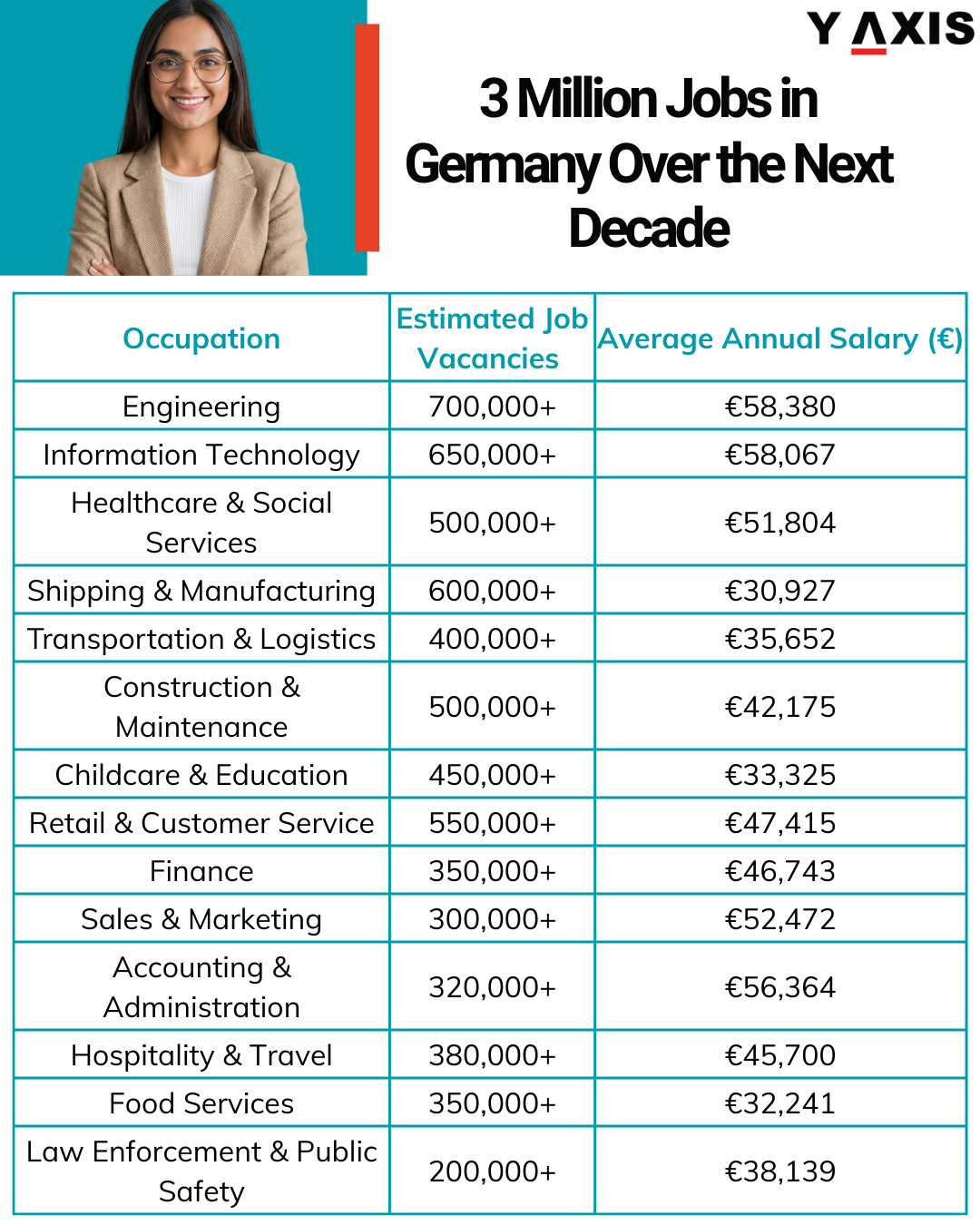
Some of the most in-demand jobs in Germany over the next decade include:
|
Occupation |
Estimated Job Vacancies |
Average Annual Salary (€) |
|
Engineering |
700,000+ |
€58,380 |
|
Information Technology (IT) |
650,000+ |
€58,067 |
|
Healthcare & Social Services |
500,000+ |
€51,804 |
|
Shipping & Manufacturing |
600,000+ |
€30,927 |
|
Transportation & Logistics |
400,000+ |
€35,652 |
|
Construction & Maintenance |
500,000+ |
€42,175 |
|
Childcare & Education |
450,000+ |
€33,325 |
|
Retail & Customer Service |
550,000+ |
€47,415 |
|
Finance |
350,000+ |
€46,743 |
|
Sales & Marketing |
300,000+ |
€52,472 |
|
Accounting & Administration |
320,000+ |
€56,364 |
|
Hospitality & Travel |
380,000+ |
€45,700 |
|
Food Services |
350,000+ |
€32,241 |
|
Law Enforcement & Public Safety |
200,000+ |
€38,139 |
High-Demand Sectors and Job Roles in Germany for Skilled Professionals
Germany’s labour shortages are spread across several key industries, with employers actively hiring both skilled and technical professionals. Long-term investment, digital transformation, and an ageing workforce are keeping demand high across these sectors.
Germany offers growing English-speaking job opportunities, particularly in IT, engineering, research, and multinational companies. Many employers prioritise skills over language, making it possible to work without fluent German, especially at mid to senior levels. Basic German can support daily life and long-term career growth.
Some of the high-demand sectors and job roles in Germany include:
|
Sector |
In-Demand Job Roles |
Job Outlook |
|
Information Technology (IT) |
Software Developer, Data Scientist, AI Specialist, Cloud Engineer, Cybersecurity Analyst |
Very High |
|
Engineering |
Mechanical, Electrical, Civil, Automotive, Industrial Engineers |
High |
|
Healthcare & Life Sciences |
Registered Nurse, Medical Technician, Physiotherapist, Healthcare Administrator |
Very High |
|
Manufacturing & Automotive |
Production Engineer, Automation Engineer, Robotics Specialist |
High |
|
Logistics & Supply Chain |
Supply Chain Analyst, Logistics Coordinator, Warehouse Manager |
Moderate to High |
|
Renewable Energy & Sustainability |
Renewable Energy Engineer, Environmental Engineer, Sustainability Consultant |
High |
|
Construction & Infrastructure |
Civil Technician, Construction Manager, Skilled Trades |
High |
|
Research & Innovation |
Research Scientist, R&D Engineer, STEM Researcher |
Moderate to High |
Germany Work Visa Options for Foreign Professionals
Germany offers several work visa pathways to help employers fill labour shortages and allow foreign professionals to work legally in the country. The most suitable option depends on qualifications, work experience, and whether a job offer is already secured.
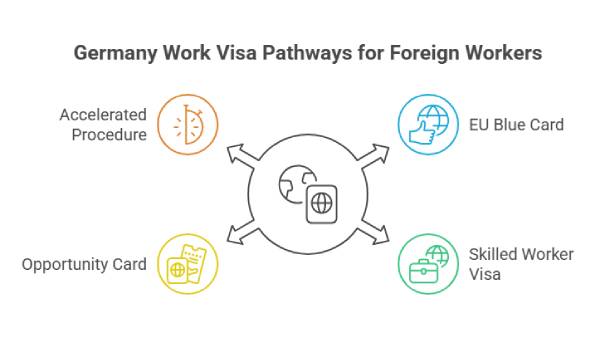
Main work visa options in Germany for foreign professionals include:
- EU Blue Card: Designed for highly skilled professionals with a recognised degree and a qualifying job offer. It offers higher salary thresholds, faster access to permanent residence, and mobility within the EU.
- Skilled Worker Visa: For professionals with recognised academic or vocational qualifications and a confirmed job offer from a German employer. This visa covers roles across IT, engineering, healthcare, manufacturing, logistics, and research.
- Opportunity Card (Chancenkarte): Allows eligible candidates to enter Germany without a job offer to search for employment. Selection is based on a points system that considers qualifications, experience, age, and language skills.
- Accelerated Skilled Worker Procedure: An employer-initiated fast-track process that significantly reduces visa processing times, helping skilled professionals start work in Germany sooner.
Top Companies Hiring Foreign Professionals in Germany
Germany is home to many global employers that actively recruit international talent to address skills shortages across key sectors. These companies regularly hire for roles in IT, engineering, manufacturing, healthcare, finance, and research, with many supporting work visa applications.
|
Company |
Key Sectors |
Chances of Visa Sponsorship |
|
SAP |
IT, software, cloud, AI, data |
High |
|
Siemens |
Engineering, automation, energy, IT |
High |
|
BMW Group |
Automotive, R&D, manufacturing, IT |
Medium to High |
|
Volkswagen Group |
Automotive, EV, manufacturing, software |
Medium to High |
|
Bosch |
Engineering, electronics, automation, AI |
High |
|
Deutsche Telekom |
IT, cybersecurity, telecom, cloud |
High |
|
BASF |
Chemicals, engineering, sustainability, R&D |
Medium |
|
Deloitte Germany |
Consulting, finance, IT, analytics |
High |
|
Amazon Germany |
Logistics, operations, IT, cloud |
High |
|
Google Germany |
Software, AI, data, product |
Medium |
Also Read…
Fast-Track Hiring Options in Germany for Skilled Professionals
How to Apply for Jobs in Germany from Abroad?
Step 1: Identify in-demand roles that match your qualifications and work experience.
Step 2: Search and apply through German job portals, employer career pages, and professional networks.
Step 3: Prepare a German-style CV that is clear, factual, and well-structured, along with a role-specific cover letter.
Step 4: Attend interviews, which are commonly conducted online for overseas candidates.
Step 5: Secure a job offer and confirm eligibility for the appropriate work visa.
Step 6: Apply for the work visa and relocate to Germany after approval.
*Looking for Jobs in Germany? Sign up with Y-Axis Resume Marketing Services to find the right job faster.
Best Cities in Germany with the Most Job Opportunities for Foreign Professionals
Germany’s job growth is concentrated in major cities that serve as hubs for industry, innovation, and global employers. These locations offer stronger hiring activity, broader sector coverage, and better access to visa-sponsoring employers.
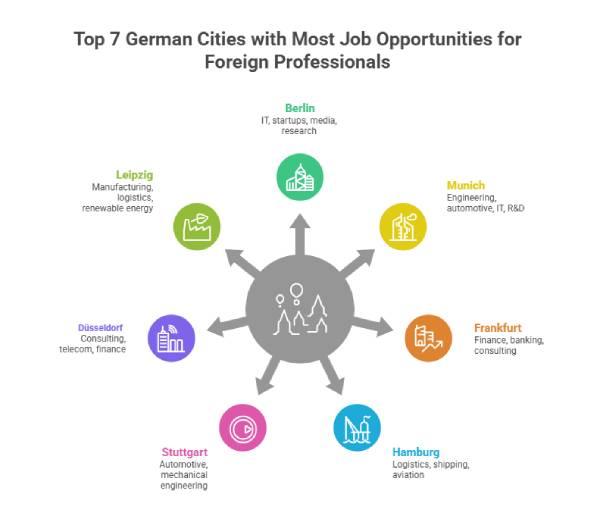
List of top 7 cities in Germany to find job opportunities from abroad:
- Berlin: Strong demand in IT, startups, fintech, media, and research; many international and English-speaking roles
- Munich: High salaries and opportunities in engineering, automotive, aerospace, IT, and R&D
- Frankfurt: Finance, banking, consulting, and corporate IT roles; strong presence of multinational firms
- Hamburg: Logistics, shipping, aviation, engineering, and trade-related jobs
- Stuttgart: Automotive, mechanical engineering, and advanced manufacturing
- Düsseldorf: Consulting, telecom, finance, and corporate services
- Leipzig: Manufacturing, logistics, and renewable energy roles with relatively lower living costs
Step by Step Process to Apply for a Germany Work Visa
Step 1: Check your eligibility based on qualifications, work experience, and salary requirements
Step 2: Secure a job offer from a German Employer
Step 3: Get your qualifications recognised in Germany
Step 4: Choose the relevant work visa such as EU Blue Card, Skilled Worker Visa, or Opportunity Card
Step 5: Prepare required documents, including passport, job contract, and qualifications
Step 6: Attend the visa appointment and submit your application at the German embassy
Step 7: Relocate to Germany after approval and begin employment
*Want to apply for German Work Visa? Get expert guidance from Y-Axis.
Pathways to Permanent Residence in Germany for Foreign Workers
Germany offers clear routes for foreign professionals to move from a temporary work visa to long-term residence. These pathways are designed to support skilled workers who contribute to the economy over time.
Some of the main pathways leading to permanent residence in Germany:
- EU Blue Card holders can apply for permanent residence after meeting salary, employment, and language requirements.
- Skilled Worker Visa holders may qualify for permanent residence after a defined period of continuous employment in Germany.
- Language proficiency and integration can shorten the time required to obtain permanent residence.
- Family members are generally allowed to live and work in Germany under dependent residence permits.
Tips to Improve Your Chances of Getting a Job in Germany
- Get your qualifications recognised before applying
- Use a German-style CV that is clear, factual, and well structured
- Focus on in-demand sectors such as IT, engineering, healthcare, and manufacturing
- Apply through official job portals and employer career pages
- Tailor your cover letter to each role and employer
- Highlight skills that match shortage occupations
- Use fast-track visa options once a job offer is secured
FAQs
Why are there 3 million job openings expected in Germany over the next decade?
Germany is expected to have around 3 million job openings over the next decade due to large-scale retirements and ongoing economic growth. More than 30% of the workforce is projected to retire by 2035, creating strong replacement demand. At the same time, investment in infrastructure, digitalisation, green energy, and defence is driving new jobs, leading employers to increasingly hire foreign professionals through simplified work visa pathways.
What is the job outlook in Germany for the next 10 years?
The job outlook in Germany for the next 10 years remains strong, with around 3 million job openings expected across the economy. Labour shortages caused by an ageing population, combined with steady industry expansion, are driving demand. Sectors such as IT, engineering, healthcare, manufacturing, logistics, and renewable energy are expected to see sustained hiring and long-term employment stability.
Which sectors have the most job opportunities in Germany?
The sectors with the most job opportunities in Germany include IT, software development, engineering, healthcare, manufacturing, automotive, logistics, construction, renewable energy, and research. These industries are facing ongoing skills shortages due to retirements and expansion. Jobs in Germany within these sectors often offer work visa options for qualified foreign professionals and long-term career prospects.
Are there jobs in Germany for foreign professionals?
Yes, Germany offers strong job opportunities for foreign professionals due to widespread labour shortages. Employers are actively hiring international talent in IT, engineering, healthcare, manufacturing, logistics, and research. Jobs in Germany for foreigners are supported by simplified immigration rules and structured work visa pathways, making it easier to work legally and build long-term careers in the country.
Can foreigners work in Germany without knowing German?
Foreigners can work in Germany without fluent German, especially in English-speaking jobs. Roles in IT, software development, data, engineering, research, and multinational companies often use English as the working language. While basic German is helpful for daily life and career growth, many jobs in Germany focus more on skills and experience than language ability.
What are the most in-demand jobs in Germany over the next decade?
The most in-demand jobs in Germany over the next decade include software developers, data scientists, engineers, healthcare professionals, automation specialists, logistics managers, renewable energy engineers, and research scientists. These roles are driven by large-scale retirements and long-term investment in technology and infrastructure, offering strong job security and eligibility for German work visas.
What work visa options are available for jobs in Germany?
Germany offers several work visa options for foreign professionals, including the EU Blue Card, Skilled Worker Visa, Opportunity Card (Chancenkarte), and the Accelerated Skilled Worker Procedure. These visas allow eligible candidates to work legally in Germany across in-demand sectors. The suitable work visa depends on qualifications, experience, salary level, and whether a job offer is secured.
What is the EU Blue Card Germany?
The EU Blue Card Germany is a work permit for highly skilled professionals with a recognised degree and a qualifying job offer. It offers higher salary thresholds, faster access to permanent residence, and mobility within the European Union. Many high-paying jobs in Germany, especially in IT, engineering, and research, qualify for the EU Blue Card pathway.
What is the Opportunity Card (Chancenkarte) Germany?
The Opportunity Card is a points-based work visa that allows foreign professionals to enter Germany without a job offer to search for employment. Points are awarded based on qualifications, work experience, age, and language skills. This visa helps graduates and skilled workers explore job opportunities in Germany and transition to a long-term work visa after securing employment.
Is it easy to get a job in Germany as a foreigner?
Getting a job in Germany as a foreigner is becoming easier due to labour shortages and simplified immigration policies. While competition exists, professionals with in-demand skills, recognised qualifications, and relevant experience have strong chances. Many employers actively hire international candidates and support work visa applications, especially for shortage occupations.
Do German companies sponsor work visas?
Yes, many German companies sponsor work visas, particularly for roles facing skills shortages. Jobs in Germany with visa sponsorship are common in IT, engineering, healthcare, manufacturing, logistics, and research. Employer support is often provided for the Skilled Worker Visa, EU Blue Card, and Accelerated Skilled Worker Procedure.
What qualifications are required to work in Germany?
To work in Germany, foreign professionals usually need recognised academic or vocational qualifications relevant to the role. Some regulated professions require formal recognition of overseas credentials. Skills, work experience, and salary level also influence eligibility for German work visas, especially for skilled and technical jobs.
How long does it take to get a German work visa?
German work visa processing times vary based on visa type and individual circumstances. Standard processing can take several weeks to a few months. Faster options, such as the Accelerated Skilled Worker Procedure, can significantly reduce processing time. Planning ahead is important when applying for jobs in Germany and preparing visa documents.
Can a German work visa lead to permanent residence?
Yes, Germany provides clear pathways from a work visa to permanent residence. Holders of the EU Blue Card or Skilled Worker Visa can apply for permanent residence after meeting employment, salary, and language requirements. This makes Germany attractive for professionals seeking long-term settlement and career stability in Europe.
What salary can foreigners expect in Germany?
Salary levels in Germany depend on industry, experience, and location. IT, engineering, healthcare, and finance roles typically offer higher salaries, while entry-level positions pay less. Overall, jobs in Germany provide competitive wages supported by strong labour protections, social security benefits, and a high standard of living.
Which cities offer the best job opportunities in Germany?
Cities such as Berlin, Munich, Frankfurt, Hamburg, Stuttgart, and Düsseldorf offer strong job opportunities across multiple sectors. These cities host global companies, innovation hubs, and industries with high demand for skilled workers. Many employers in these locations also support work visa sponsorship for foreign professionals.
When is the best time to apply for jobs in Germany?
The best time to apply for jobs in Germany is between January and March, when companies open new hiring budgets. September to October is another strong recruitment period. Hiring activity slows during summer months and late December due to holidays, making timing an important factor in the job search.
Are there English-speaking jobs in Germany?
Yes, Germany has many English-speaking jobs, especially in IT, software development, engineering, research, and multinational companies. These roles often focus on technical skills rather than language proficiency. While German is not always required, learning the language can support long-term integration and career progression.
What challenges do foreign professionals face in Germany?
Foreign professionals may face challenges such as qualification recognition, language barriers, housing shortages, and adapting to workplace culture. However, Germany offers structured systems, legal protections, and integration support to help international workers settle and succeed in the job market.
Is Germany a good country for long-term careers?
Germany is considered an excellent country for long-term careers due to its strong economy, job security, labour protections, and clear immigration pathways. With around 3 million jobs expected over the next decade, Germany offers stable employment, career growth, and permanent residence opportunities for skilled professionals.
Tags:
Germany jobs
Work in Germany
Germany work visa
EU Blue Card
Skilled migration
Job opportunities in Europe
Share
Latest Article
Popular Post
Trending Article
Posted On March 31 2026
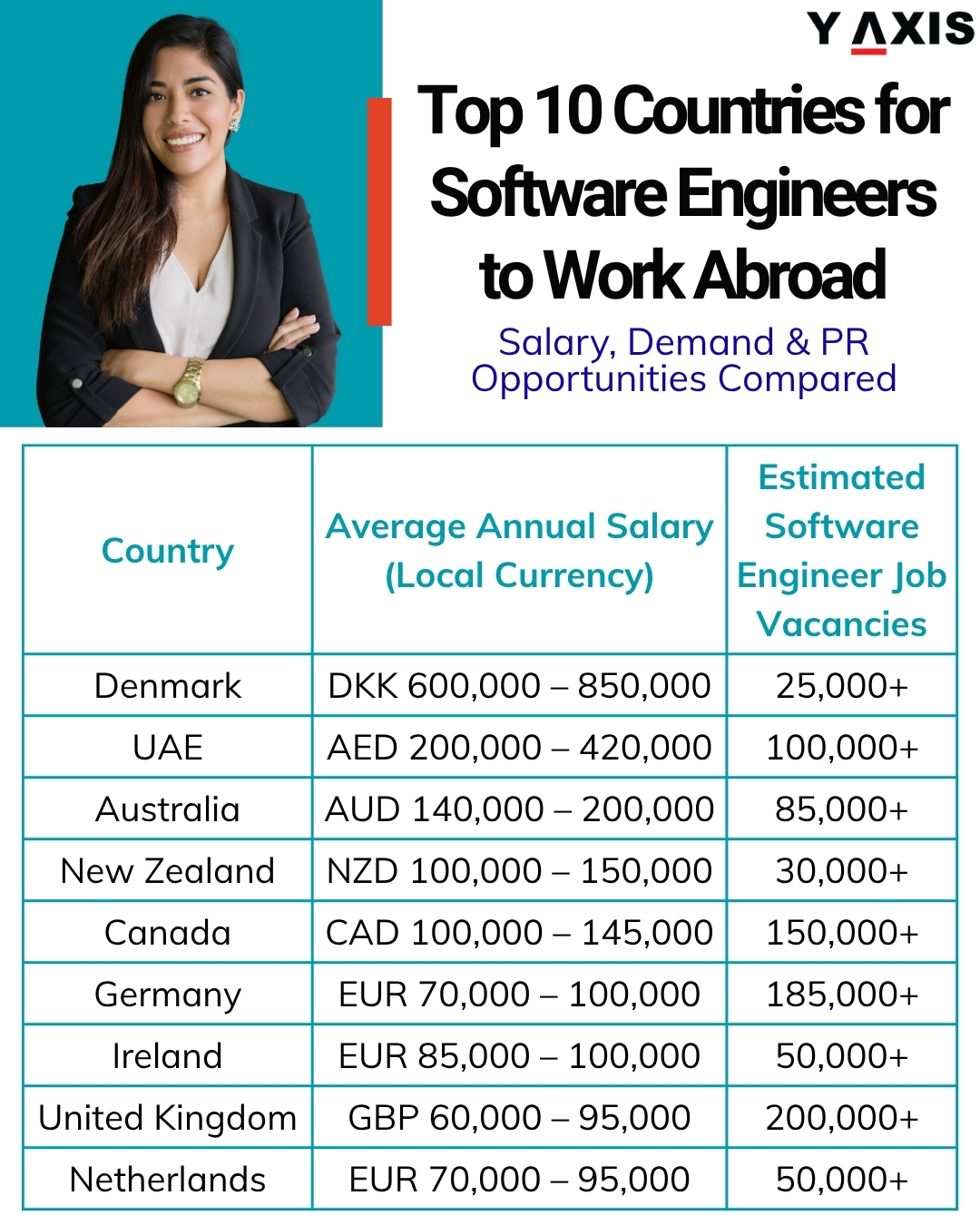
Top 10 Countries for Software Engineers to Work Abroad: Salary, Demand & PR Opportunities Compared